





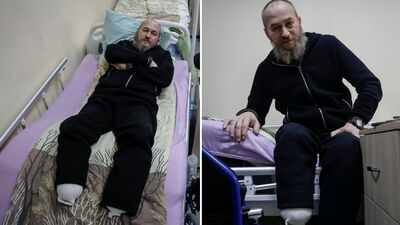
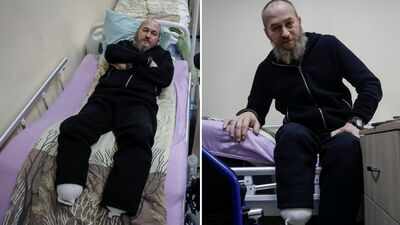
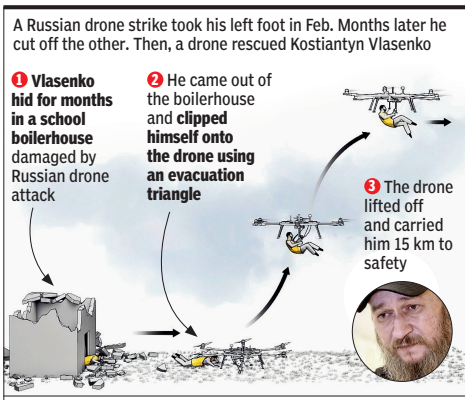
A Ukrainian soldier who spent nearly eight months trapped in a bombed-out school has been rescued from the frontline by a heavy-lift drone, in what Ukrainian commanders described as the first known aerial drone rescue of a soldier.Kostiantyn Vlasenko, 49, had been stranded in a boiler room with severe injuries after a Russian drone strike. With no way to escape and little hope of being rescued, he made a desperate decision to amputate his remaining foot to survive.On October 4, a large drone lifted him into the air using a harness and carried him 15km to safety. The operation ended an ordeal that had kept him on Ukraine’s drone-infested frontlines for 491 days.The Ukrainian military corroborated Vlasenko’s account, although some details could not be independently verified.
A desperate fight to survive
Vlasenko was sent to a frontline position in May last year to join a fellow soldier known by the call sign Basky. The two men lived in a cramped dugout and depended on daily drone deliveries for supplies.When the time came to rotate troops in autumn, two soldiers sent to relieve them were killed on their way to the position, Vlasenko said. Two more soldiers sent to recover their bodies also died.After spending 10 months together, Vlasenko and Basky were forced to take shelter in a ruined school when their foxhole flooded in mid-February. Their refuge was soon struck by a Russian drone. Basky was killed on his 50th birthday, while Vlasenko suffered devastating injuries.
A giant new heavy-lift drone came to rescue.
The strike destroyed his left foot and severely damaged his right leg, leaving him barely able to move. He took shelter beneath the school’s boiler, where his condition continued to deteriorate.His right leg was broken, with the bone protruding through the injury. Unable to move properly and fearing he would not survive, he eventually used a knife to amputate his remaining foot and applied a tourniquet to stop the bleeding.“I had to amputate it because it was just dragging along behind me,” he said. “The leg was dragging so much that the bone was sticking out. So I no longer had either of my legs.”Looking back on his ordeal, Vlasenko told Reuters from his hospital bed in Kharkiv, “I had already buried myself,” adding, “I knew there was no hope left.”
Why conventional rescue missions failed
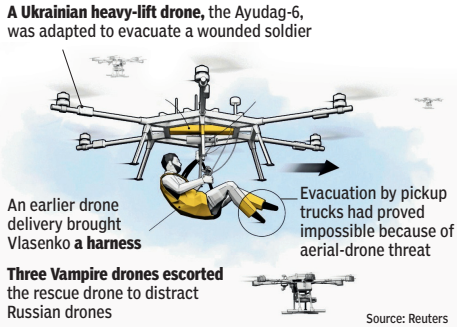
Rescuing wounded soldiers from the area had become extremely dangerous because Russian drones could target vehicles moving towards the frontline.According to the officer overseeing the operation, who identified himself only by the call sign Alex, evacuations using pickup trucks and armoured vehicles had become almost impossible.Ukrainian forces also tried using unmanned ground vehicles that travelled on wheels or tracks. However, two vehicles sent to reach Vlasenko were destroyed by drones.The officers then learned about a heavy-lift drone being developed by the Ukrainian manufacturer Gurzuf Defense. Its six vertical rotors and black frame gave it the appearance of a giant insect. It could carry loads weighing up to 90kg over distances of up to 25km.The officers estimated that Vlasenko weighed around 70kg after spending more than a year at the frontline. The drone would have to transport him approximately 15km to reach safety.The mission remained dangerous because larger Ukrainian drones could be intercepted by smaller Russian first-person-view drones. These allow remote operators to see what the drone sees in real time and guide it towards its target.
Suspended beneath a drone
In early October, Vlasenko received an unusual delivery among his regular supply parcels. It contained a harness and a phone with instructional videos explaining how to use it.The following day, October 4, the heavy-lift drone arrived. Vlasenko attached himself to a carabiner connected to a winch beneath the aircraft. The machine then lifted him to a height of 70 metres and began carrying him away from the frontline.
The drone rescue marked a stunning turnaround for Vlasenko.
Three smaller six-propeller drones accompanied the aircraft to distract Russian attack drones. Meanwhile, four Ukrainian first-person-view drone crews, artillery units and larger fixed-wing drones attacked known Russian drone positions for two hours to suppress enemy fire.After a tense 15-minute journey, the drone reached its destination and landed safely.Vlasenko said he had worried about falling during the flight, particularly into water because he could not swim.“I wasn’t afraid of falling, say into the forest,” he said. “But I was afraid of falling into the water, because I can’t swim,” he said.The rescue demonstrated how Ukraine is increasingly relying on unmanned aircraft not only to deliver supplies and attack enemy positions, but also to evacuate wounded soldiers from areas where conventional rescue vehicles cannot safely operate.