




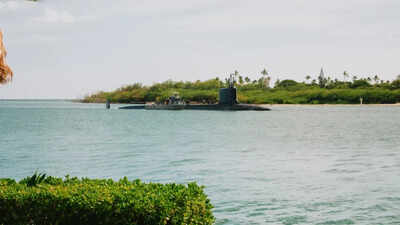
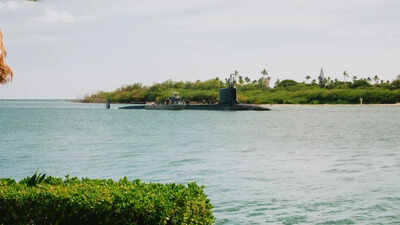
The Pentagon has designated the USS Colorado as the first US Navy submarine to join an Australian-based rotational force, strengthening Washington’s undersea military posture in the Indo-Pacific as the US and its allies seek to deter China’s growing naval influence in the region.US defence secretary Pete Hegseth announced the selection alongside Australian deputy Prime Minister and defence minister Richard Marles and British defence secretary John Healey, according to a joint statement issued by the three countries.The Virginia-class USS Colorado fast-attack submarine is scheduled to join Submarine Rotational Force-West (SRF-West) in late 2027 at HMAS Stirling in Western Australia.The rotational force is expected to host up to four US fast-attack submarines and one British submarine, expanding maintenance and support facilities for allied undersea operations in the Indo-Pacific.The arrangement is part of AUKUS, the trilateral security partnership between Australia, the United Kingdom and the United States established in 2021.AUKUS aims to help Australia develop its own fleet of conventionally armed, nuclear-powered submarines while deepening defence cooperation among the three allies. The move also carries wider strategic significance as Washington seeks to strengthen regional deterrence and complicate China’s military planning across the Pacific.About USS ColoradoThe USS Colorado (SSN 788) is a Virginia-class Block III nuclear-powered fast-attack submarine of the US Navy, commissioned in 2018.Measuring 377 feet and a submerged displacement of approximately 7,800 tons, the submarine can travel at speeds exceeding 25 knots (around 46 km/h) underwater. It is powered by a nuclear reactor and designed for extended operations without frequent refuelling.The submarine’s weapons include two large-diameter Virginia Payload Tubes, each capable of launching six Tomahawk cruise missiles, giving it a capacity of up to 12 missiles through these tubes.It is also equipped with four torpedo tubes that can fire Mk 48 Advanced Capability torpedoes against enemy submarines and surface vessels. These capabilities allow the USS Colorado to conduct precision strikes, anti-submarine warfare and other undersea combat missions.Beyond its weapons, the USS Colorado is designed for intelligence gathering, surveillance, reconnaissance and support for special operations forces. Its combination of stealth, endurance and strike capability makes it a valuable asset for sustained undersea operations.China expands its Pacific footprintChina has steadily expanded its diplomatic, economic and security presence across the Pacific, challenging the traditional strategic influence of Australia and the United States in a region critical to their defence planning.A June 2026 report by the Australian Strategic Policy Institute (ASPI), Pressure Points Part 3, said Beijing was building a wider pattern of military access, security cooperation and regional influence across the Southwest Pacific and Australia’s maritime approaches. The report noted that China’s expanding blue-water navy, policing partnerships and overseas access arrangements were reshaping regional security dynamics.One of the biggest concerns for Canberra and Washington is China’s 2022 security agreement with the Solomon Islands. The agreement expanded cooperation between Beijing and Honiara on security matters, including policing, and raised fears in Australia and the US that it could eventually provide China with access to strategically located ports or enable a military presence close to Australia.The Solomon Islands’ new Prime Minister Matthew Wale said in 2026 that his government would review the agreement, although he later said a non-disclosure clause prevented its publication. China has denied that it intends to establish a military base there.China’s growing presence has prompted Australia and the US to strengthen their own regional defence partnerships.Reuters reported on September 3, 2026, that Australian defence minister Richard Marles said the American military presence in Australia was growing across multiple domains. Washington and Canberra have also expanded cooperation involving military training, equipment storage, aircraft rotations and logistical support for US vessels