



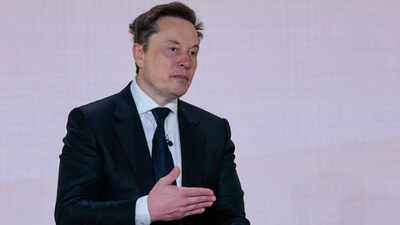
NEW DELHI: SpaceX CEO and the world’s richest man Elon Musk on Thursday went on a rant explaining how the Starlink’s satellite internet services will help the “least served” in India.Musk had earlier alleged that his telecom firm was facing regulatory hurdles in India due to “oligarchs”, a claim which was strongly rejected by the Indian government.He then went on a tweet blitz, writing three posts within a span of 10 minutes.“Starlink will help the least-served in India,” he said in a post at 6.18pm.He followed it up with another post at 6.25pm, writing, “Starlink provides Internet connectivity to the least-served, enabling self-education and prosperity by giving people access to sell their products worldwide!”Three minutes later, Elon posted again: “People who oppose @Starlink hurt only the least-served. The wealthy or those living in large cities already have good Internet, so they don’t understand.”Musk’s comments come as a Starlink delegation is attending the India Mobile Congress organised in the national captial.Musk’s claim about Starlink serving the “least-served” in India is somewhat ironic, as India already ranks among the countries with the lowest internet charges in the world.“The last decade was about scalability, penetration, affordability. We have discussed many times of how voice prices have crashed, data prices have lowered by almost 97%, which has led to greater penetration,” information & technology minister Jyotiraditya Scindia said on Thursday.On the other hand, Starlink will reportedly cost Rs 8,600 per month, with an additional Rs 34,000 one-time hardware charge.
What Musk claimed & how govt reacted
“Unfortunately, we are being blocked by certain oligarchs in order to maintain their monopolistic chokehold on the Indian people. You can guess who they are … This is a crime against the people of India!” Musk said in a post on Wednesday.The telecom ministry rejected Musk’s claim stating, “Security assessment as part of this process is currently under way in respect of all three licensees”“The Department of Telecom has issued licences to all satcom companies as well as provisional spectrum. Now the issue is pending with MHA for security clearance. As soon as it is cleared, they will get it. It has nothing to do with one company,” minister of state for communications Chandra Sekhar Pemmasani told reporters on the sidelines of the India Mobile Congress.
Why Starlink has sparked controversy
The logic behind Starlink is simple: Get internet to places where conventional networks are difficult or too expensive to reach. But Elon Musk’s satellite internet service has increasingly become much more than a tool for connectivity. Its growing use in war zones, conflict areas and during internet shutdowns has turned Starlink into a strategic technology and raised questions over who controls access to it.Critics have raised concerns about the company’s links with US intelligence and military agencies, arguing that a privately controlled satellite network could have implications for national security and sovereignty.
How does Starlink work
Starlink uses thousands of small satellites in low-Earth orbit, around 550km above the planet. Unlike traditional communications satellites positioned around 36,000km away, these satellites can transmit data with lower latency. Users connect through a small receiver with an electronically controlled antenna, which automatically links with satellites passing overhead. The satellites can also transfer data between themselves using laser links.
Share your thoughts in the comments
Be respectful · TOI community guidelines
What are the major concerns
A 2024 report by the Kutniti Foundation, had described Starlink as “a wolf in sheep’s clothing”. The foundation argued that Starlink’s global satellite network gives it capabilities that go beyond conventional telecom services and could create strategic concerns for countries such as India.
- US intelligence links: Kutniti has highlighted Starlink’s links with US intelligence and military agencies, including publicly known contracts involving Musk’s companies.
- Dual-use technology:The foundation argues that Starlink can provide high-speed internet while also supporting capabilities such as high-definition imagery and live video transmission.
- Control beyond borders: Unlike traditional telecom networks that rely on infrastructure within a country, Starlink’s satellites operate from outside national territory, raising questions over regulatory control.
- Security requirements: Communications Minister Jyotiraditya Scindia has said Starlink has not yet fulfilled all required security conditions. India’s licence will be issued only after those requirements are met.
Furthermore, the satellites also raise security questions. Satellites travel at roughly 11,000 km/h to 28,000 km/h orbiting the earth and can also be used to monitor activity inside the territory of a country.In 1995-96, India had to put off its planned nuclear tests after intense international pressure, led by the US, following the detection of the tests through satellite imagery.