





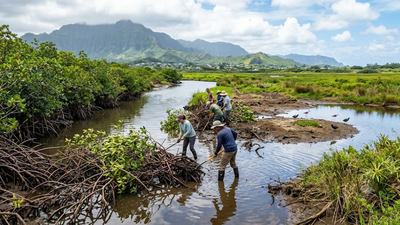
Environmental teams in Hawaii have launched a major effort to remove invasive red mangroves from nearly two miles of waterways in Kailua. The project aims to reverse more than a century of environmental damage and protect endangered native waterbirds. The multi-year project, announced on 25 August 2026 by the Hawaii Department of Land and Natural Resources (DLNR), will target thick stands of red mangrove (Rhizophora mangle) that have spread through streams feeding the Kawainui and Hamakua wetlands on the windward coast of Oahu. The work is funded through joint grants from the National Fish and Wildlife Foundation and the National Oceanic and Atmospheric Administration (NOAA). It brings together the DLNR Division of Forestry and Wildlife (DOFAW), the University of Hawaii Pacific Cooperative Studies Unit and Kailua-based environmental non-profit Hui o Koolaupoko (HOK). Community involvement is a key part of the plan. Project leaders are asking volunteers, community groups, schools and private landowners to help field crews remove young mangrove plants and seed pods from affected waterways. The first physical removal work is scheduled to begin on Saturday, 26 September 2026. Crews will initially focus on Kawainui Stream between Kawainui Neighborhood Park and the Hamakua Street Bridge.
An invasive tree that changed Hawaii’s wetlands
Red mangroves are not native to the Hawaiian Islands. The trees were first brought from Florida to Molokai in 1902 by the American Sugar Company to help control coastal erosion and soil runoff. They later spread quickly through brackish estuaries, coastal lagoons and freshwater streams across the islands. Over more than a century, the invasive trees have changed the way water moves through wetlands. Unlike native Hawaiian coastal plants, red mangroves grow dense networks of stilt roots that trap sediment, raise stream beds, slow water flow and reduce water quality. In low-lying areas such as Kailua, blocked drainage can also increase the risk of local flooding during periods of heavy rain. Ecologists say the changes have seriously damaged important wetland habitats. Thick mangrove canopies push out native plants and remove open mudflats that provide important feeding and nesting areas for endangered Hawaiian waterbirds. Birds affected by the spread of mangroves include the Hawaiian stilt (aeo), Hawaiian coot (alae keokeo), Hawaiian gallinule (alae ula) and Hawaiian duck (koloa maoli). These birds depend on shallow, open water and clear views to spot predators such as mongooses and feral cats.
Community support is key
Field teams will remove small trees and seed pods before planting native Hawaiian wetland species along cleared stream banks. Native plants can help hold the soil in place and reduce the chances of mangrove seedlings becoming established again. Organisers say long-term community support will be essential because the project covers both public and private land along the waterways. “We’re honored to partner with the Division of Forestry and Wildlife to bring the wetland and bird habitat restoration techniques we’ve developed at Heʻeia State Park back to our hometown,” said Kristen Nalani Kane, Executive Director of Hui o Koolaupoko, in an official statement released by the DLNR. “This is the first of many phases needed to achieve functional eradication of mangrove from Kailua’s waterways, and community participation will be essential to its long-term success.”Scientists involved in the project said restoring the natural flow of water will benefit the wider ecosystem, not just native birds. “Removing invasive mangrove is essential to restoring the health and function of these wetlands. This project reflects what’s possible when agencies and community work together to create better habitat for Hawaiʻi’s native waterbirds and a more resilient ecosystem for future generations,” said Lailan Uy, a wetland biologist working with the University of Hawaii Pacific Cooperative Studies Unit in cooperation with state wildlife authorities.
Long-term work needed
The Kailua project builds on earlier restoration efforts at nearby Heeia State Park and the Kawainui Marsh State Wildlife Sanctuary, the largest remaining wetland on Oahu. Removing mangroves is only the first step. Long-term monitoring will be needed because mature trees can produce hundreds of pencil-shaped seed pods called propagules. These can float for long distances on ocean currents and tides before taking root in muddy areas. Without regular checks and removal of new seedlings, cleared areas can quickly become covered by mangroves again. Monthly community workdays are planned from late 2026 through 2027, with participation focused on people aged 18 and older. Hui o Koolaupoko coordinators are also working with private landowners along the streams to provide access to removal crews and help ensure the full two-mile area is covered. By restoring natural water flow and bringing back open mudflat habitats, conservationists hope to make Oahu’s windward coast more resilient to climate change while creating safer habitats for some of Hawaii’s unique native species.