





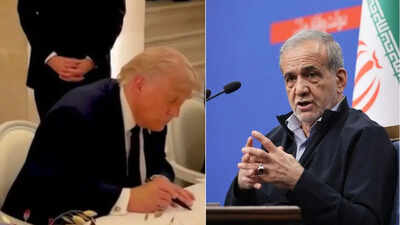
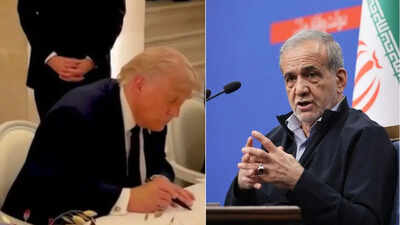
US President Donald Trump and Iranian President Masoud Pezeshkian have virtually signed a 14-point memorandum of understanding (MoU) aimed at ending hostilities between the two countries, reopening the Strait of Hormuz and launching negotiations on a broader agreement covering sanctions relief and Iran’s nuclear programme.Trump signed the memorandum during a meeting with French President Emmanuel Macron in Paris on Wednesday, while Pezeshkian also signed the document. The agreement came into force immediately after both sides signed it, CNN reported. The development marks a significant step towards de-escalation following months of heightened tensions in the region and military confrontations involving Iran, Israel and the United States.The memorandum, referred to as the ‘Islamabad Memorandum of Understanding between the United States of America and the Islamic Republic of Iran’, lays out a framework for a ceasefire, economic cooperation, sanctions relief and negotiations on Tehran’s nuclear activities.Confirming the development, Trump told reporters that the agreement had been signed during his visit to Paris.“It’s signed. Signed it in Versailles, I just signed it,” Trump said.A senior US administration official described the agreement as a mechanism to immediately reopen the Strait of Hormuz, address concerns surrounding Iran’s enriched uranium stockpile and create a pathway for economic engagement.“This is fundamentally an agreement that allows us to open the Strait of Hormuz immediately, commit the Iranians to destroying the nuclear dust, and then gives us a dial where if the Iranians dial up their good behaviour, we respond by dialling up the kind of economic and sanctions relief that can make them a more prosperous country,” the official said.Iran also confirmed the agreement. Iranian foreign ministry spokesperson Esmaeil Baghaei said consultations involving Oman and other countries had been underway for some time and that arrangements concerning navigation through the Strait of Hormuz had largely been finalised.Baghaei said safe maritime passage would be guaranteed while maintaining Iran’s authority over the strategic waterway.“It was agreed that the Iran-US memorandum of understanding would be signed digitally. The memorandum is now officially finalised because both sides have signed it,” he said.He added that the agreement would ensure ‘the sovereignty and authority of the Islamic Republic of Iran over the Strait of Hormuz.’
What the deal includes
The 14-point agreement provides for an immediate and permanent cessation of military operations between the parties and commits both sides to conclude negotiations on a final agreement within 60 days. The deadline may be extended if both governments agree.The memorandum also includes provisions for reopening the Strait of Hormuz, one of the world’s most important energy shipping routes, through which a significant share of global oil supplies passes.Under the arrangement, Iran will facilitate the safe passage of commercial vessels through the strait free of charge for an initial 60-day period. In return, the United States will begin lifting restrictions linked to its naval blockade and related measures.The agreement further outlines a phased process for sanctions relief, including Treasury waivers for Iranian oil exports and the gradual release of frozen Iranian assets.One of the most significant provisions is a proposed US-backed reconstruction and economic development programme for Iran worth at least USD 300 billion.The memorandum also addresses concerns over Iran’s nuclear programme. Tehran has reaffirmed that it will not develop or acquire nuclear weapons, while discussions on the future of its enriched uranium stockpiles will be conducted under the supervision of the International Atomic Energy Agency (IAEA), Press TV reported. According to earlier reports by Fox News, the broader framework also includes a structured ceasefire arrangement involving Israel and Hezbollah alongside negotiations on Iran’s uranium enrichment activities.
What are the 14 points?
According to the text released by White House, the 14-points of the deal are:
- The United States of America and the Islamic Republic of Iran and their allies in the current war, by signing this MOU, declare the immediate and permanent termination of military operations on all fronts, including in Lebanon, and undertake from now on not to initiate any war or any military operation against each other, and to refrain from the threat or use of force against each other, and ensuring the territorial integrity and sovereignty of Lebanon. The final deal will confirm the permanent termination of the war on all fronts, including in Lebanon, and other provisions of this paragraph.
- The United States of America and the Islamic Republic of Iran undertake to respect each other’s sovereignty and territorial integrity and to refrain from interfering in each other’s internal affairs.
- The United States of America and the Islamic Republic of Iran commit to negotiating and achieving the final deal in maximum 60 days extendable with mutual consent.
- Immediately upon the signing of this MOU, the United States of America will begin the removal of its naval blockade and any disturbances or impediments against the Islamic Republic of Iran, and will fully end the naval blockade within 30 days. During this period, the traffic of vessels will be in proportion to the numbers of pre-war traffic being restored by the Islamic Republic of Iran. The United States of America further undertakes to remove its forces from the proximity of the Islamic Republic of Iran within 30 days after the final deal.
- Upon the signing of this MOU, Islamic Republic of Iran will make arrangements using its best efforts for the safe passage of commercial vessels with no charge for 60 days only from the Persian Gulf to the Sea of Oman, and vice versa. The traffic of commercial vessels will immediately start, and considering the need for removing the technical and military obstacles and demining by the Islamic Republic of Iran will be instated within 30 days. The Islamic Republic of Iran will conduct dialog with the Sultanate of Oman to define the future administration and maritime services in the Strait of Hormuz in discussion with other Persian Gulf or littoral states in line with the applicable international law and the sovereign rights of coastal states of the Strait of Hormuz.
- United States of America undertakes with regional partners to develop a definitive, mutually agreed plan with at least USD $300 billion for the reconstruction and economic development of the Islamic Republic of Iran. The mechanism for the implementation of this plan will be finalized as part of a final deal within 60 days. All required licenses, waivers, and permissions needed for the relevant financial transactions will be granted by the United States of America.
- The United States of America undertakes to terminate all types of sanctions against the Islamic Republic of Iran, including the United Nations Security Council resolutions, i.e. a Board of Governors resolutions, and all unilateral US sanctions, primary and secondary, in an agreed-upon schedule as part of the final deal. The Islamic Republic of Iran and the United States of America acknowledge the critical importance of the sanctions termination issue above mentioned, and expressed their intentions to immediately address these issues in the negotiations in order to achieve mutual agreement on them.
- The Islamic Republic of Iran reaffirms that it shall not procure or develop nuclear weapons. United States of America and Islamic Republic of Iran have agreed to resolve the disposition of stockpile enriched material pursuant to a mechanism that will be mutually agreed upon in accordance with the schedule mentioned in paragraph seven, with the minimum methodology to be down blending on site under the supervision of the IAEA. The two parties also agreed to discuss the issue of enrichment and other mutually agreed matters related to the Islamic Republic of Iran’s nuclear needs, based on a satisfactory framework being agreed upon in the final deal. The final deal will confirm the provisions of this paragraph. The United States of America and the Islamic Republic of Iran acknowledge the critical importance of the nuclear issues above mentioned and express their intention to immediately address these issues in the negotiations in order to achieve mutual agreement on them.
- Pending the final deal, the United States of America and Islamic Republic of Iran agree to maintain the status quo. The Islamic Republic of Iran will maintain the current status quo of its nuclear program and the United States of America will not impose any new sanctions and will not deploy additional forces in the region.
- The United States of America undertakes that immediately upon the signing of MOU until the termination of sanctions, US Department of Treasury will issue waivers for the export of Iranian crude oil, petroleum products, and derivatives, and all associated services, including banking transactions, insurances, transportation, etc.
- The United States of America undertakes to make fully available for use the frozen or restricted funds and assets of the Islamic Republic of Iran. Upon the implementation of this MOU, the United States of America and the Islamic Republic of Iran will mutually agree on the procedures related to the release of these funds during the negotiations. Such funds, whether retained in the original account or transferred, shall be made fully usable for payment to any ultimate beneficiary designed by the Central Bank of the Islamic Republic of Iran. The United States of America undertakes to issue all necessary licenses and authorizations accordingly.
- The United States of America and the Islamic Republic of Iran agree that an executive mechanism will be established to monitor the successful implementation of this MOU and the future compliance of the final deal.
- After signing this MOU, and subject to the beginning of the implementation of paragraphs 1, 4, 5, 10, and 11 of the MOU, and the continuing implementation of these measures, the United States of America and the Islamic Republic of Iran will start negotiations regarding the final deal exclusively on the other paragraphs.
- The final deal will be endorsed by a binding UNSC resolution.
Why it matters
The reopening of the Strait of Hormuz is regarded as one of the most consequential aspects of the agreement. The strategic waterway carries a substantial portion of the world’s oil shipments, and any disruption has immediate implications for global energy markets.The memorandum is being viewed as an attempt to reduce regional tensions, restore commercial shipping through the Gulf and establish a pathway towards a wider diplomatic settlement between Washington and Tehran.If implemented successfully, the memorandum could mark one of the most significant diplomatic breakthroughs between the United States and Iran in recent years, easing regional tensions while opening the door to sanctions relief, economic cooperation and renewed engagement on nuclear issues.