






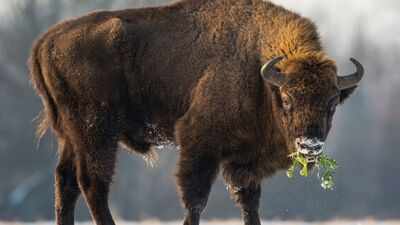
In 1987, 30 bison from the Fort Riley Military Reservation were brought to Konza Prairie in Kansas. Nearly three decades later, researchers found that native plant species richness had increased by 103% at the local scale and by 86% across catchments compared with areas without grazing.The findings come from a long-term study at Konza Prairie Biological Station, a large area of native tallgrass prairie in the Flint Hills of eastern Kansas, according to Kansas State University. The research compared areas grazed year-round by bison with areas grazed by domestic cattle during the growing season and areas where there were no large grazers.The study found that the increase in native plant diversity under bison grazing continued for nearly three decades. It also survived an extreme drought that affected the region in 2011 and 2012. The researchers said the gains in plant richness recovered after the drought.The bison had been introduced as part of long-term ecological research at Konza Prairie. Their grazing is studied along with other processes such as fire and climate. Unlike cattle operations in the region, the bison remain on the prairie throughout the year and are not given supplemental feed. The herd grew through reproduction, as well as additional donations, trades and purchases.
How bison changed the prairie
Researchers found that bison grazing reduced the cover of dominant grasses over time. Four grass species can make up about 80% of annual net primary production in ungrazed areas. In the bison-grazed areas, their cover declined initially, stabilised for several years and then declined again. During the final 11 years of the study, dominant grass cover remained around 20% to 25%.At the same time, the number of native plant species increased. From 1994 to 2010, native species richness in bison-grazed areas rose by an average of 0.58 species per year at the plot scale and 1.06 species per year at the catchment scale. By 2020, native species richness was 103% higher than in ungrazed areas at the plot scale and 86% higher at the catchment scale.The researchers linked this pattern to the way bison graze. Bison mainly eat grasses and repeatedly return to areas with fresh growth. Their grazing can reduce the dominance of some grasses, allowing other plants to grow. Bison also create grazing lawns and physical disturbances such as wallows, producing different conditions across the prairie. This variation can provide opportunities for more plant species to survive.The increase in plant diversity was not driven by invasive plants. Nonnative species remained uncommon in the bison treatment, while native plants associated with prairie habitats became more frequent. Forb cover, which includes many plants that are not grasses, also increased in areas grazed by bison.
Bison performed better than cattle
The study also compared bison with domestic cattle. Cattle grazing increased native plant species richness too, but the increase was less than half that recorded under bison grazing. Compared with ungrazed areas, cattle increased native species richness by 41% at the plot scale and 30% at the catchment scale.The researchers noted that bison generally graze throughout the year, while cattle in the experiment grazed during the growing season. Bison and cattle also differ in how they choose grazing patches and what they eat. The study found that bison tend to focus more heavily on grasses, while cattle consume a greater share of nongrass plants.Earlier work at Konza Prairie had also found differences between the two animals. Bison maintain large grazing lawns and return repeatedly to them to eat new grass growth. Cattle tend to graze smaller patches more evenly across a pasture. At Konza Prairie, plant diversity was greater in bison pastures than in cattle pastures, with more forbs, particularly annual plants.
Diversity recovered after extreme drought
One of the most important parts of the long-term study was what happened during the 2011 and 2012 drought. The two years brought one of the most extreme dry periods recorded in the Great Plains since the 1930s Dust Bowl. The researchers found that native plant richness in bison-grazed areas initially declined during the drought.However, the decline did not permanently change the long-term trend. Native species richness returned to the trajectory seen before the drought. Recovery took about four years at the plot scale and two years at the catchment scale. The researchers described this as evidence that the biodiversity gains produced by bison grazing were resilient to the extreme dry period.The researchers said greater plant diversity may help communities withstand drought because different plants use resources in different ways. Grasses at the site mainly use shallow soil water, while many forbs use deeper soil water. This difference can reduce competition when shallow soil water becomes scarce during dry conditions.The study concluded that restoring grazing by native large herbivores such as bison can produce sustained increases in native plant diversity in tallgrass prairie.