









For many employees, provident fund (PF) is a deduction they notice on their salary slip every month but rarely think about until they change jobs, need funds for an emergency or start planning for retirement. The Government’s decision to increase the PF wage ceiling from Rs 15,000 to Rs 25,000 has put the spotlight back on one of India’s most important social security benefits.For affected employees, the implications go beyond a higher PF deduction. The change could influence take-home pay, retirement savings, pension benefits and insurance protection. However, the exact impact will vary depending on factors such as PF wages, previous PF and pension membership, and whether the employer currently contributes only up to the statutory ceiling or on actual wages.
New EPFO Wage Ceiling: What has changed?
The wage ceiling relevant to the PF, pension and Employees’ Deposit Linked Insurance (EDLI) framework has been increased from Rs 15,000 to Rs 25,000 per month.
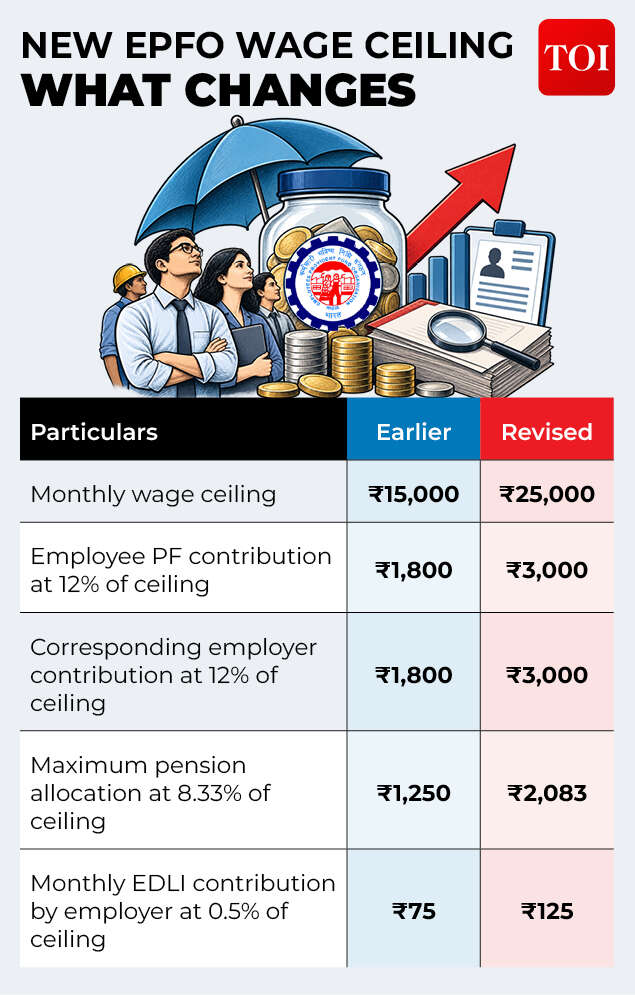
New EPFO wage celing: What changes for you
Actual contributions may differ where employers are already contributing on wages higher than the statutory ceiling.
Who is most likely to be affected?
The biggest impact is likely to be on employees whose PF wages fall between Rs 15,000 and Rs 25,000 per month.Under the earlier framework, a new employee whose wages exceeded Rs 15,000 at the time of becoming eligible could, subject to prescribed conditions, be treated as an excluded employee. With the higher threshold, employees earning up to Rs 25,000 will now come within mandatory PF coverage.The change will also affect existing PF members whose contributions are currently restricted to the earlier statutory ceiling of Rs 15,000.Employees earning statutory wages between Rs 15,000 and Rs 25,000 who were previously outside mandatory PF coverage could be among the biggest beneficiaries of the change because it may bring them within the ambit of provident fund, pension and insurance protection.
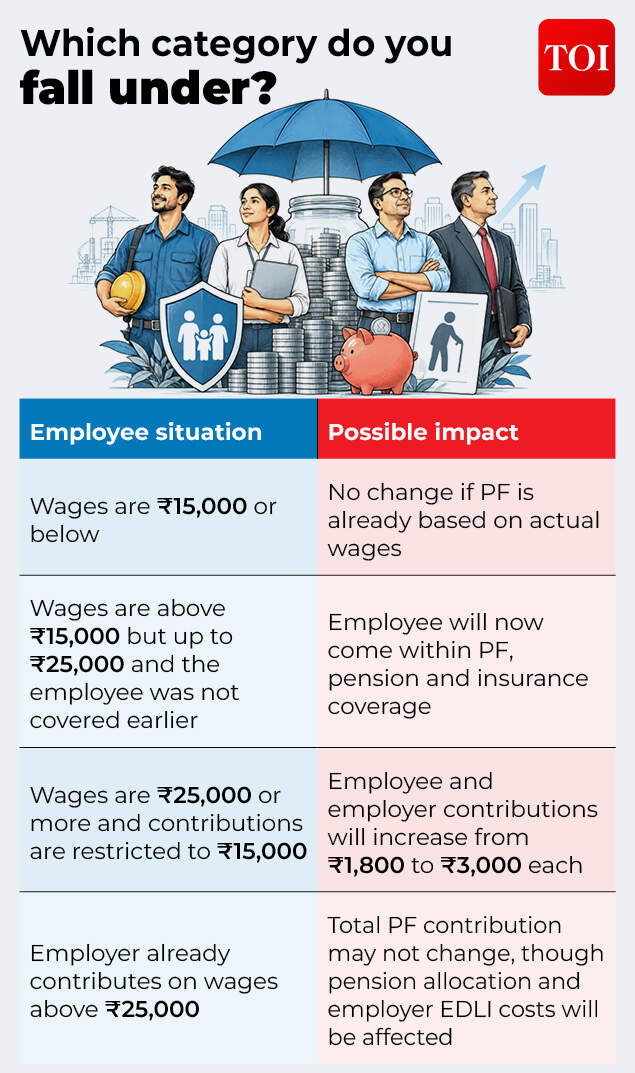
Which category do you fall under?
Your take-home pay may reduce
For some employees, the most immediate impact will be a reduction in monthly take-home salary. Both the employee and employer typically contribute 12% of the relevant PF wages, subject to the applicable ceiling.If an employee earns Rs 25,000 or more and the employer currently restricts contributions to Rs 15,000, the employee’s mandatory contribution would increase from Rs 1,800 to Rs 3,000 per month. That means an additional deduction of Rs 1,200 every month or Rs 14,400 over a year.Example: Contribution restricted to the statutory ceilingAssume an employee has PF wages of Rs 30,000 per month and contributions are presently capped at the statutory ceiling.
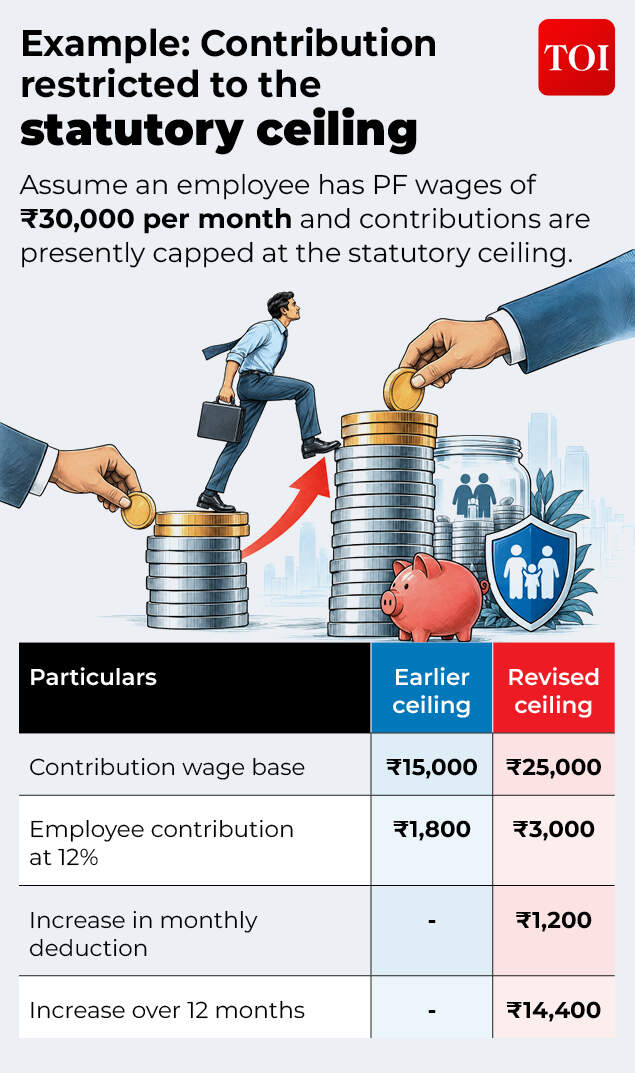
Contribution restricted to the statutory ceiling
The employee may therefore receive Rs 1,200 less as monthly take-home pay. However, the amount is being redirected towards long-term social security benefits rather than being lost.Employees earning between Rs 15,000 and Rs 25,000 need special attentionConsider an employee who joins his or her first formal-sector job with PF wages of Rs 22,000 per month.Under the earlier Rs 15,000 ceiling, the employee may have remained outside mandatory PF coverage, subject to the applicable membership rules. Under the revised ceiling, the employee will have to become a PF member because the wages fall within the revised threshold.At 12% of Rs 22,000, the employee contribution would be Rs 2,640 per month. The employer would ordinarily make a corresponding contribution, although part of that contribution may be allocated towards pension.For the employee, this could mean:
- Lower take-home salary every month.
- Creation of compulsory retirement savings.
- Possible pension membership.
- Insurance cover through EDLI.
- Access to PF withdrawals and advances subject to applicable rules.
Practical example
A first-time employee earning PF wages of Rs 22,000 per month who was previously outside mandatory PF coverage will now have to contribute Rs 2,640 every month. While this reduces take-home salary, it also creates retirement savings and may provide access to pension and insurance benefits that were not available earlier.Does the entire employer contribution go into your PF account?Not necessarily.Many employees assume that the employer’s entire contribution is credited to their PF balance. In reality, a portion may be diverted to the Employees’ Pension Scheme (EPS). The pension allocation is currently 8.33% of wages, subject to the statutory ceiling. With the revised ceiling, the maximum pension allocation would rise from Rs 1,250 to Rs 2,083 per month.For an employer contribution of Rs 3,000 per month, the allocation may look like this:
| Pension fund | Rs 2,083 |
| PF account | Rs 917 |
| Total employer contribution | Rs 3,000 |
Employees should therefore not compare the employer contribution mentioned in their salary structure with the PF credit reflected in their account without understanding how much has been allocated towards pension.
What could change for your pension?
The higher wage ceiling could expand mandatory pension coverage for employees whose wages exceed Rs 15,000 but do not exceed Rs 25,000 when they become members.Since monthly pension benefits are linked to eligible wages and years of service, a higher wage ceiling could help some employees build pension benefits on a larger base. The eventual impact will vary depending on individual circumstances, including previous membership, years of service and any higher-pension arrangements.
What about insurance benefits?
PF membership is linked to the Employees’ Deposit Linked Insurance Scheme (EDLI). Employees who are newly brought within PF coverage may also gain access to EDLI insurance protection.The employer bears the EDLI contribution and cannot recover it from employee wages. Although the maximum monthly EDLI contribution could increase from Rs 75 to Rs 125, employees should note that the current maximum insurance benefit remains Rs 7 lakh. Therefore, unless the Government separately enhances the benefit limit, the insurance payout may not automatically increase.
What if you already contribute PF on your full salary?
Many employers voluntarily contribute on basic salary or other eligible wages that exceed the statutory ceiling.For example, if an employee’s eligible wage is Rs 40,000 and both the employee and employer already contribute 12% of Rs 40,000, the monthly contribution is already Rs 4,800 each. In such cases, increasing the statutory ceiling to Rs 25,000 may not increase the total contribution amount.This is why employees should not assume that everyone will experience a Rs 1,200 increase in PF deductions. The actual impact depends on how contributions are currently structured.
What should employees do now?
Before assuming how the change will affect them, employees should check:
- Whether they are already PF members.
- Whether their employer contributes only up to the statutory ceiling or on actual wages.
- Whether their PF wages fall between Rs 15,000 and Rs 25,000 per month.
- Whether they are currently covered under the pension scheme.
- How a higher PF deduction could affect their monthly budget.
The real trade-off: less today, more protection tomorrowFor some employees, the revised wage ceiling may mean a lower take-home salary every month. However, it could also provide stronger long-term social security through higher PF savings, pension coverage and insurance protection.The impact will differ from one employee to another depending on wages, membership status and employer contribution practices. But for most employees, understanding how the revised ceiling interacts with their salary structure and social security benefits will be far more important than simply focusing on the increase in PF deductions. The change is ultimately about strengthening long-term financial protection for workers in the formal sector.(The author, Puneet Gupta is Partner, People Advisory Services Tax at EY India)