





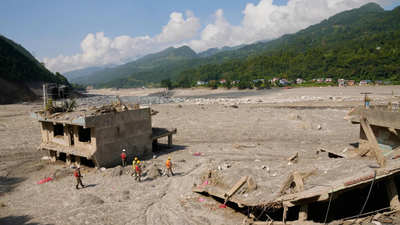
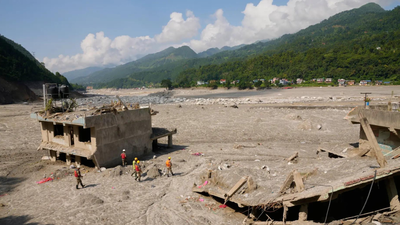
Nepal’s forensic laboratories are in a race against time 15 days after the Bhote Koshi-Trishuli flood, with thousands of DNA samples arriving at facilities accustomed to processing fewer than 900 tests in an entire year. As visual identification becomesdifficult because of decomposition and mutilation, DNA is now the main hope of putting names to 1,265 unidentified bodies and human remains.The latest count shows 2,678 DNA samples have been collected for identification – 1,286 from the dead and 1,412 from relatives. Nepal Police’s forensic laboratory alone has received 1,240 samples for DNA and related examinations, including 808 blood samples from relatives, 348 teeth and bone samples from the dead and 84 fingerprint samples. Blood samples for profiling have arrived from 26 districts. “Samples from the deceased and their relatives are continuously being received. We are working day and night,” laboratory chief SSP Yog Bahadur Pal said.The scale of the wider disaster keeps the pressure mounting. Nepal has recovered 1,367 bodies and human remains, including 498 partial remains. Only 102 have been identified and handed over to families, while 5,132 people remain officially missing, including around 589 foreigners.Nepal has two main DNA facilities – Central Forensic Science Laboratory and National Forensic Science Laboratory. Before the disaster, the latter handled around 40-45 DNA tests a month, roughly 350 a year, while Nepal Police records show 358 DNA samples were processed over seven months in one recent fiscal year. The current influx is several times that routine annual workload.“The bodies are difficult to identify because they have been badly damaged and dismembered,” Nepal Police spokesperson Abi Narayan Kafle told TOI. “In some cases, two, even three, different families have even claimed the same body.”Foreign forensic teams from India, China, Singapore and South Korea are assisting, but experts say Nepal must mobilise its own unused capacity.A parallel effort is under way using facial-comparison technology to narrow possible identities while families wait for DNA results. FaceTagr, deployed through a Nepal-specific missing-person portal, compares photographs of missing people with images of unidentified victims and reduces thousands of possibilities to a handful of likely matches for human review.Samir Panthi, founder of US-based Nowtrkit, said about 500 missing people had been registered and the system had helped generate possible matches for around 90 bodies. Panthi said facial matching worked far better with living people than with bodies affected by swelling, injury, decomposition or closed eyes.