








NEW DELHI: Delhi’s air quality deteriorated to the ‘very poor’ category for the first time this season on Monday, with the Air Quality Index (AQI) settling at 324 by 4 pm, the highest level in nine months.As pollution levels worsened, the Commission for Air Quality Management (CAQM) invoked Stage 2 of the Graded Response Action Plan (GRAP) across Delhi-NCR, while intensified checks at the capital’s borders to enforce vehicle restrictions left commuters stuck in long traffic queues.The AQI of 324 was the highest recorded since February 4, when it stood at 339. The city’s pollution levels had risen sharply over the previous two days, from 117 in the ‘moderate’ category on October 31 to 261 in the ‘poor’ category on November 1, before entering the ‘very poor’ category on Monday.Three of Delhi’s air quality monitoring stations reported ‘severe’ pollution at 4pm. Jahangirpuri recorded the worst AQI at 436, followed by Rohini at 415 and Punjabi Bagh at 413.Of the city’s 58 monitoring stations, 37 reported ‘very poor’ air quality, 17 were in the ‘poor’ category and one recorded ‘moderate’ air quality.Fine particulate matter, or PM2.5, remained the dominant pollutant. These particles, measuring 2.5 micrometres or less, can penetrate deep into the lungs and enter the bloodstream.
GRAP Stage 2 invoked across Delhi-NCR
The CAQM said Delhi’s AQI had risen sharply due to unfavourable meteorological conditions and was likely to remain in the ‘very poor’ category over the coming days, according to forecasts by the India Meteorological Department and the Indian Institute of Tropical Meteorology.Stage 2 of GRAP applies when the AQI is between 301 and 400. The emergency measures are intended to prevent further deterioration in air quality.The AQI is expected to remain in the ‘very poor’ category from November 3 to 5, according to the Air Quality Early Warning System for Delhi, before improving marginally to the ‘poor’ category over the subsequent six days.The Decision Support System for Delhi estimated that the transport sector contributed 19.2% to the city’s pollution on Monday.Industries in Delhi and peripheral areas accounted for 4.2%, while residential activities contributed 4.9%. Stubble burning accounted for 8.4% of the pollution, with other sources contributing 20.7%.Among neighbouring NCR districts, Jhajjar accounted for 6.9% of the pollution, followed by Sonipat at 5.1%, Gurgaon at 2.9%, Rohtak at 2.7%, Ghaziabad at 2.6%, Baghpat at 2.4%, and Panipat and Bhiwani at 2% each. Gautam Buddha Nagar accounted for 1.9%.
Border checks leave commuters stuck for hours
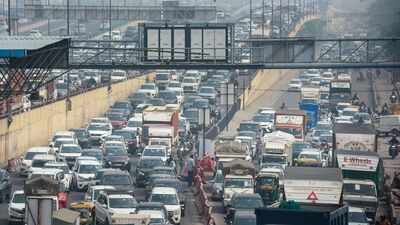
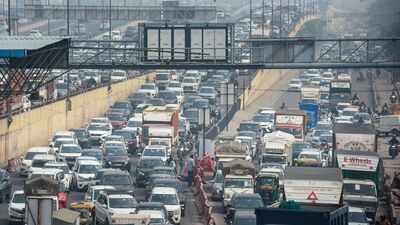
The second day of the restrictions on vehicles entering Delhi saw intensified checks at several interstate borders, triggering long traffic queues on roads connecting the capital with Haryana and Uttar Pradesh.Heavy congestion was reported at the Delhi-Gurgaon, Delhi-Noida, Delhi-Ghaziabad, Delhi-Sonipat and Delhi-Najafgarh borders. On NH-48, traffic remained backed up for several kilometres near the Sirhaul toll plaza, affecting both the main carriageway and service roads. Similar snarls were reported near Noida and Ghaziabad.At the Aya Nagar border, Delhi Traffic Police and Transport Department teams turned back vehicles that did not meet the prescribed BS-VI emission standards.Officials said checks were being conducted across borders under different traffic police ranges, with fines also being issued for violations and incomplete vehicle documents.The restrictions, effective from November 1 as part of the winter pollution-control measures, bar petrol and diesel vehicles registered outside Delhi that do not meet BS-VI emission standards from entering the capital. Electric and CNG vehicles, along with BS-VI-compliant vehicles, are exempt.The enforcement is being jointly carried out by the Delhi Environment and Transport Departments and the traffic police at several entry points, including Rajokri on NH-48, DND Flyway, Ghazipur, Singhu, Tikri and Badarpur.The Northern Range of Delhi Traffic Police said its teams checked 7,657 vehicles between midnight on November 1 and noon on November 2, turning back 609 vehicles that did not comply with the restrictions.The drive was aimed at enforcing GRAP-related vehicle curbs and preventing non-compliant vehicles from entering the capital.On November 1, Delhi Traffic Police had checked 7,279 vehicles between midnight and 8 pm, turned back 714 and impounded 38, according to an earlier statement.The department also held a coordination meeting with police officials from neighbouring districts and used information boards, pamphlets, print media, social media and radio to publicise the restrictions.Delhi environment minister Manjinder Singh Sirsa said enforcement teams had checked 14,930 vehicles on November 1, issued 566 challans for Pollution Under Control Certificate violations and inspected 300 construction sites.
HC declines interim relief against vehicle restrictions
The Delhi high court on Monday refused to stay the ban on the entry of non-Delhi-registered vehicles that do not meet BS-VI emission standards. The restrictions are in force from November 1 to January 31.A bench of acting chief justice Nitin Wasudeo Sambre and justice Sanjay Sharma issued notice on a petition filed by Faridabad-based lawyer Gurmukh Dass Kohli and listed it for hearing with a related matter on November 27.The petitioner challenged the June 23 notification issued by the Department of Environment and Forests, arguing that the restriction discriminates between vehicles based on where they are registered rather than their emission standards.The plea pointed out that pre-BS-VI vehicles registered in Delhi remain allowed to ply in the capital, while comparable vehicles registered in Haryana are barred.The petition also argued that the blanket restriction applies irrespective of the AQI on a given day and affects the movement of residents across the integrated National Capital Region. It questioned the scientific basis of the decision and contended that less restrictive measures could have been considered.
SC allows certified green crackers for two days
In a separate development, the Supreme Court allowed the sale of certified green firecrackers in Delhi-NCR from November 4 to 6 and their bursting between 6am and 7am and 8pm and 10pm on November 7 and 8. The complete ban on firecrackers will be restored from November 9.The bench of justices MM Sundresh and Prasanna B Varale imposed conditions to prevent conventional and unauthorised firecrackers from being sold as green crackers.Manufacturers must have valid CSIR-NEERI certification and PESO licences, while each box must carry a product- and batch-specific QR code.Firecrackers containing barium, those not approved by CSIR-NEERI and crackers joined in series, commonly known as ‘ladis’, have been prohibited.The court also directed authorities to designate specific sale locations, with online sales prohibited, and asked police teams to inspect markets, verify QR codes and confiscate illegal firecrackers.No firecrackers will be allowed within 300 metres of hospitals, healthcare centres, old-age homes, educational institutions and notified silence zones.In its October 29 order, the court said a complete ban was facilitating the illegal sale of conventional firecrackers while preventing people from buying legitimate green crackers tested at established facilities.It also flagged the lack of adequate data on whether the ban imposed in 2024 had served its purpose, particularly in the absence of a significant improvement in AQI readings.The bench directed the CPCB, in consultation with state pollution control boards, to prepare daily air quality reports for the pre-Diwali period, November 2 to 6, Diwali, November 7 and 8, and the post-Diwali period, November 9 to 30.Authorities have also been asked to monitor pollution levels, inspect non-functional AQI monitoring stations and ensure post-festival waste clearance.The court warned that contempt action could be taken against officials for failing to implement its directions.(With agency inputs)