












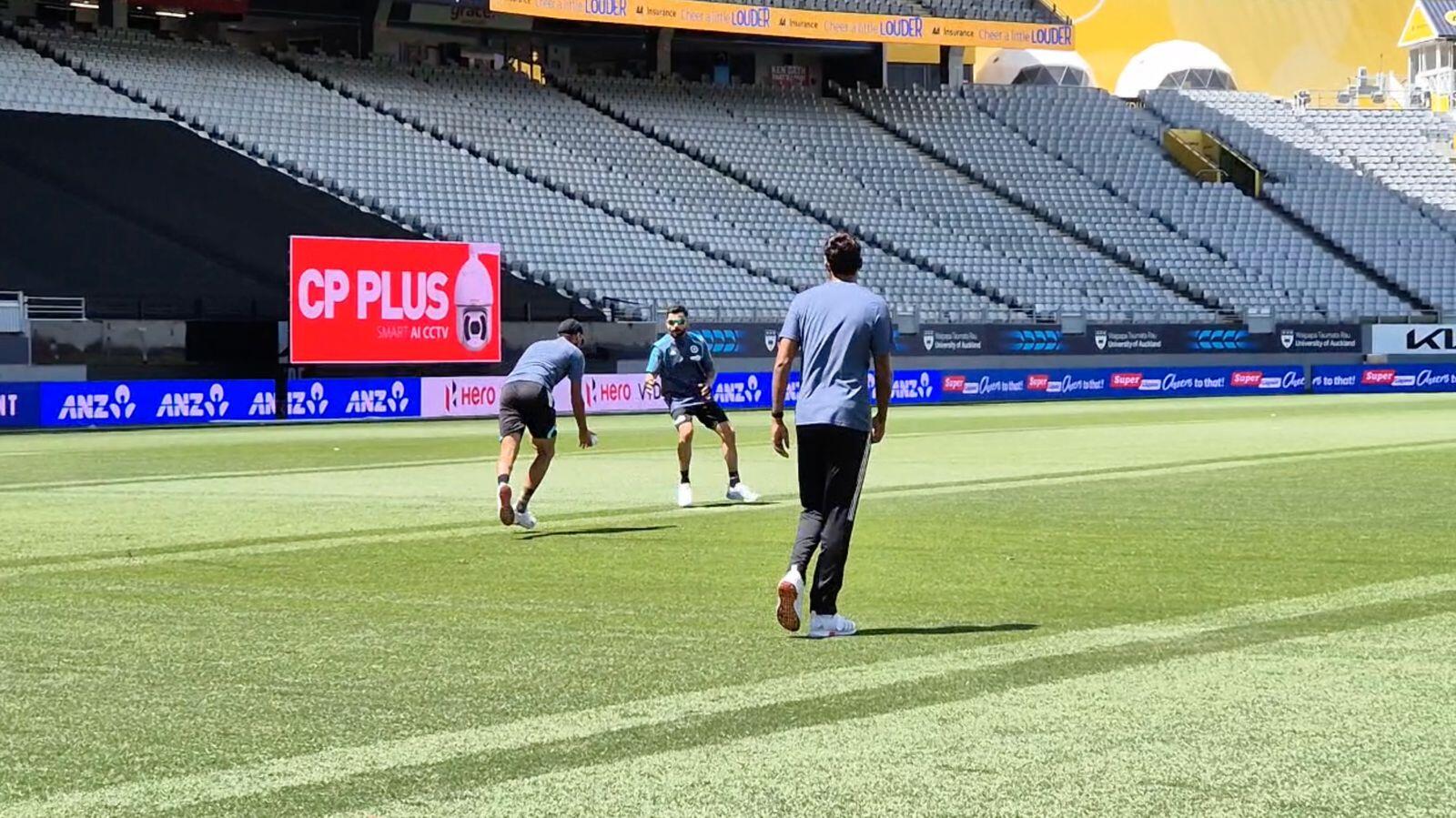
AUCKLAND: The Eden Park outfield was buzzing with activity as soon as the Indian cricket team got down to business ahead of the first ODI of the five-match series against New Zealand. Divided into groups of four, the players ran between two equidistant cones placed across the ground and intercepted deliveries fired by fielding coach Subhadeep Ghosh and other members of the support staff.The plan was simple: players were asked to call clearly and loudly while approaching the ball, and whoever reached it first had to fire it back to the thrower. The drill lasted around 30 minutes, emphasising the importance of running in straight lines, even when approaching the ball from different angles. The idea was to help players familiarise themselves with the ground’s dimensions, which differ from those they are accustomed to.That is where the challenge lies in Auckland. The floodlights are different, the dimensions could feel unfamiliar, and ground fielding could become tricky, with plenty of opportunities to take twos in the deeper pockets.Former India fielding coach R Sridhar, who was with the team during its last tour, says Auckland’s dimensions are different and challenging, making the concept of “cutting the angles” particularly important.“Cutting the angle means running in straight lines. Simple. You assess the speed of the ball and the dimensions, and then you run towards the ball in a straight line. Awareness, the ability to run and take off quickly—all these things are the challenges,” Sridhar told TOI.Other factors, such as wind, cold conditions and the match start time, will also come into play. However, the team has travelled extensively and should be equipped to deal with these variables. Having had just one training session before taking the field on Wednesday, adapting quickly to Eden Park will be crucial.Fielding is one area where India would want to put its best foot forward in the upcoming series, particularly with “catching efficiency” becoming an increasingly important metric.While India’s fielding standards are generally better in ODIs than in T20Is and Tests, the team no longer has the watertight look it once did. In the 18 ODIs played since the change of captaincy in the format, beginning with the tour of Australia last year, India have dropped 27 catches, recording a below-par catching efficiency of 77.5%.Kuldeep Yadav has dropped five catches in the 11 matches he has played, while KL Rahul is second on the unwanted list with four drops in 16 games. Interestingly, Rohit Sharma has taken the most catches among Indian players in those 18 matches, topping the list with 15 catches and just two drops.Eden Park will be the first stop on the tour, which will then move to windy Wellington and Seddon Park in Hamilton before the five-match ODI series culminates at the picturesque Bay Oval in Mount Maunganui.
“Each venue has its own set of challenges. There is wind in Wellington, and different dimensions in Auckland—where the country side is bigger—but Bay Oval should be fine. It is on the open side, but conditions will be fine for adjustment,” Sridhar said.On addressing India’s fielding lapses, Sridhar emphasised that there is no one-size-fits-all approach to preparation. He believes the experience within the ODI squad will help the players navigate the challenges.“Each player will be different. Preparation volume depends on the player’s mental state, what the player needs at that point, and what he has done before. So there is a lot of basis in volume. You just can’t go blindly and say everybody has to do this volume. It doesn’t work that way. In ODIs, there is a lot of experience. You have Rohit, Virat, Gill. All of them have played there before. I’m sure they will do well too,” said Sridhar.