






The turmoil in global crude oil markets that began in March refuses to die down. Even as the US looks to tighten its noose on Iran with economic blows, a new bill empowering the US President to impose up to 100% tariffs on countries importing Russian crude will be put to vote in the coming months.And in the middle of this continuing crisis, India, a large importer of oil, finds itself facing important questions: What happens when the world stops buying Iran oil due to the threat of secondary sanctions? What will it mean for global crude oil prices? What will happen if China bows to US pressure and looks for alternatives to Iranian crude, effectively competing with India for crude supplies?Where will India procure crude from if it faces tariffs of up to 100% for its Russian crude oil imports? The Middle East crisis has pushed Russia’s share in India’s crude oil basket to over 50%. With that cushion gone, which country will fill the gap? Will Venezuela, which has suddenly made its way to the list of India’s top crude suppliers be able to step up? We decode:
Changing oil dynamics – Iran and Russia in focus
The Donald Trump administration has launched ‘Operation Economic Outcast’ against Iran, and on Monday US Treasury Secretary Scott Bessent unveiled an “economic D-Day” plan. The US has warned countries and companies that continue doing business with Iran, claiming that they would face US retaliation.Sanctions targeting about 60 Iran-linked individuals, entities and vessels we announced, expanding pressure across areas including finance, shipping, aviation, technology, gold and digital assets.However, the administration held back the toughest secondary sanctions for now, particularly measures that could hit major Chinese financial institutions involved in Iran’s oil trade. Bessent said the campaign is intended to cut Iran’s remaining economic lifelines and force countries to sever financial ties with Tehran.While India does not import crude from Iran, if China which is the largest buyer stops procuring, it would have implications for global crude oil prices.Separately, Lindsey O. Graham Sanctioning Russia Act has been cleared by the US Senate and will now move to the House. The bipartisan legislation gives the president broad powers to impose severe sanctions on Russia and on countries that continue buying Russian energy, including the ability to impose 100% tariffs on imports from countries purchasing Russian oil and gas.If Iran and Russian supplies reduce or disappear, what will it mean for India? Will Venezuela be able to make up?
Venezuela emerges as a major supplier for India
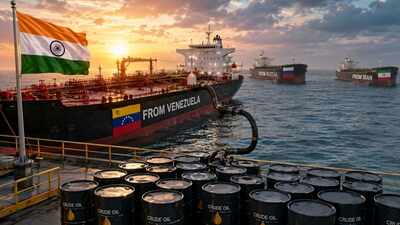
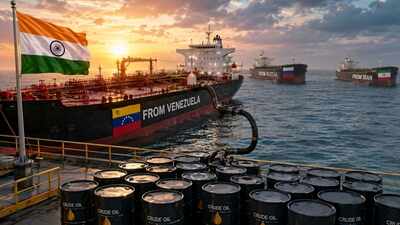
As crude oil supplies from the Middle East became unpredictable due to the Strait of Hormuz disruptions, India stepped up its diversification. Since the US-Iran war began, Venezuela has emerged as a key crude oil supplier for India, making its way into the list of the top 5. At present, Venezuela ranks as the fourth largest crude oil exporter for India.Russian oil remains the biggest chunk at around 2 million barrels per day. Latin American and African supplies have also risen, with Latin American crude accounting for 12.7% of India’s imports during April-July, up from 3.5% a year earlier, while the Middle East’s share fell to about 30% from 43%, according to Kpler data.Naveen Das, Senior Crude Oil Analyst at Kpler acknowledges that Venezuela has become a genuinely useful supplier for India again, but only since April this year.After a year of virtually nothing, Venezuelan crude is running at roughly 220–380 thousand barrels per day, or about 8% of India’s imports – enough to make it India’s third or fourth largest source.According to the Kpler analyst, this crude oil goes almost entirely to a handful of refineries built to handle it, chiefly Reliance’s Jamnagar, plus Paradip, Mundra and Vadinar.
Can Venezuelan oil make up for lack of Iran, Russian crude?
Venezuela may have surged to be among the top 5 crude suppliers to India, but there are several inherent challenges to it meaningfully replacing the lack of Russian crude for the world and India in the future.The biggest issue lies at Venezuela’s end – its oil capacities are constrained and the US remains its top priority for oil exports. According to Pankaj Srivastava, Senior Vice President, Commodity Markets – Oil, Rystad Energy, since March 2026, Venezuelan exports have averaged around 1 million barrels per day, with India receiving approximately 300-400 thousand barrels per day.The US is the primary destination for Venezuelan crude, as its complex refineries seek to maximize utilization of residue-conversion units.“Amid the current middle-distillate shortage and record-high US refinery runs, American refiners are likely to retain priority access, leaving India as the second major buyer,” he tells TOI.Note the contrast: Venezuelan crude supply is around 1.2 million barrels per day, while India has consistently imported at least 1 million barrels per day of Russian crude since mid-2025.“Venezuelan barrels therefore cannot fully replace Russian supplies in either quantity or quality,” says Pankaj Srivastava.Yet another factor that complicates the math is the quality of crude oil that Venezuela exports.Venezuelan crude is challenging to process due to its high TAN (Total Acid Number), high density and elevated contaminants.India’s complex coastal refineries-with extensive residue-upgrading and bottom-of-the-barrel conversion capacity-are well equipped to handle these grades.But, Venezuela’s crude supply remains constrained by structural deficiencies across its upstream and oil-export infrastructure. Consequently, any sustained production recovery and export stabilization will take time, says Pankaj Srivastava.But, Venezuelan crude has heavy-sour characteristics, which are not necessarily suited to all Indian refineries, though it works well with complex Indian refineries such as Reliance and Nayara.Manas Majumdar, Leader Oil & Gas, Fuels & Resources, PwC India says that because of these characteristics, Venezuelan barrels have historically traded at discounts to benchmark crude, helping refiners improve margins.“However, logistical challenges, longer shipping distances and geopolitical uncertainties mean Venezuela cannot replace India’s traditional dependence on Middle Eastern suppliers or recent Russian oil,” he tells TOI.“So with Iranian and Russian crude to be again sanctioned, Venezuelan crude cannot really make up for potential gap, as Venezuela production is limited and will take time to ramp up significantly; however enhancing supplies from Venezuela will partially cushion the impact,” he says.According to Naveen Das of Kpler on substitution Iran and Russia are different problems. India buys no Iranian crude directly, so tighter Iran sanctions hit India through higher prices rather than lost cargoes.Since India imports around 90% of its crude needs, a rise in global oil prices has a direct impact on its import bill, and in turn on retail petrol and diesel prices.On the supply front, Kpler feels that Russia is the real exposure – around 2.1-2.8 million barrels per roughly half of India’s imports.“Venezuela simply isn’t big enough to replace it. Venezuela produces about 1.3 million barrels per day in total and our forecasts have it flattening out there; around 70% of its exports currently go to US refiners under the arrangement Washington set up, and the crude itself is far heavier than Russian Urals, so it can’t be swapped one-for-one in most Indian refineries,” he explains.“Realistically Venezuela could supply India perhaps 400–600 thousand barrels per day at a stretch,” Das tells TOI.Venezuela gives India a second source of heavy sour crude it didn’t have twelve months ago. But it’s a useful extra leg, not a pillar, says Das.
The bottom line
Experts note that Venezuelan crude can be seen as an important diversification rather than a cornerstone for India’s crude sourcing.So, if Venezuelan crude cannot make up for the bulk and type that Russian crude provides, what are the alternatives for India? Where will replacement barrels come from if supplies from Russia are cut off due to potential sanctions and Iran oil ban raises prices?When the US sanctioned crude from two Russian oil majors late last year, India’s crude imports from Russia dropped. A diversified crude oil basket allowed India to step up procurement from the Middle East, but Russia still remained the largest supplier. India may have eventually reduced Russian crude imports even more, but with the Middle East war choking supplies, Russian oil is back with a bang.Naveen Das says the bulk of any Russian shortfall would have to come from the Middle East, which is currently unusually absent from India’s basket because of the Strait of Hormuz disruption and has plenty of room to return.As PwC India’s Manas Majumdar, points out: Before the Iran conflict, the Middle East (in particular UAE, Saudi, Iraq) used to be India’s key suppliers.So India would look to its diversified sources and take a portfolio approach: increasing imports from US, West African producers, Brazil, alternate routes from Saudi, UAE and of course Venezuela as one component of this.Nevertheless, as Pankaj Srivastava says, Venezuelan crude could account for nearly 10% of India’s approximately 4.5 million barrels per day of crude imports, providing valuable diversification and strengthening the country’s crude-supply security.Overall, Venezuelan crude can supplement and diversify India’s crude slate, but it cannot independently fill a major shortfall in Russian supply.Russian crude remains the mainstay of India’s crude supply. In the past India has not stopped buying it when faced with 50% tariffs. This time if the Trump administration gets the sanctions bill passed and imposes tariffs, India may still keep its energy security as the prime focus, even as supplies from the Middle East and Venezuela may offer an important cushion.