






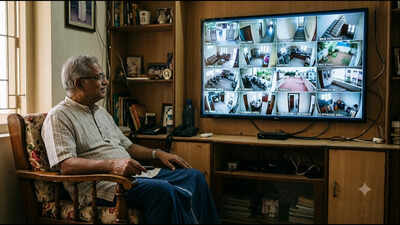
Renting a home gives you the right to use the premises without unreasonable interference, while landlords often install CCTV cameras for the purpose of protecting their property. But what happens if a landlord installs a camera in a common corridor, balcony or another area and points it directly at the entrance of your rented home?The answer may depend on where the camera is installed and what it can record. A landlord may have valid reasons to install cameras for security, particularly at entrances and other common areas. However, surveillance that invades a tenant’s private space may raise serious privacy concerns.The Supreme Court, in its 2017 judgment in Justice K.S Puttaswamy (Retd.) v. Union of India, held that the right to privacy is an intrinsic part of the right to life and personal liberty under Article 21 of the Constitution.The argument became stronger in a tenant’s favour with the Calcutta High Court’s ruling in the case of Shuvendra Mullick vs Indranil Mullick, 2024.Defendant Indranil Mallick had installed around 15 CCTV cameras inside and around the house, out of which five cameras were monitoring Shuvendra Mallick’s residential area, windows and internal movements. These cameras were installed without Shuvendra’s consent.The court held that operating cameras intruding into the occupants’ privacy could violate their right to privacy and restrained the operation of certain cameras.A tenant may also rely on Section 108(c) of the Transfer of Property Act, 1882, which gives the tenant the right to peaceful possession of rented premises if they pay rent and comply with the clauses mentioned in the rent agreement.Additionally, according to Section 66E of the Information Technology Act, 2000, whoever intentionally captures, publishes or transmits the image of a private area of any person without his/her consent, under circumstances violating that person’s privacy, shall be punished with imprisonment up to three years or a fine up to Rs 2 lakh, or both. The provision also applies to footage captured by a CCTV.Therefore, a landlord cannot assume that ownership of the property gives them an unrestricted right to monitor a tenant. A security camera covering a common entrance is different from one directed into a tenant’s private living space.