






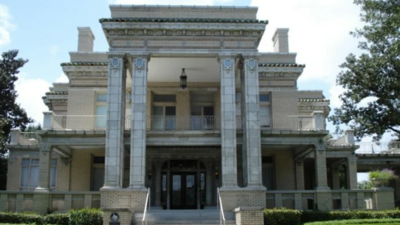
A century-old mansion with ties to one of Houston’s prominent business families has returned to the property market, with an asking price of $3.995 million. Located at 8 Courtlandt Place near the Montrose neighbourhood, the approximately 5,700-square-foot residence combines early 20th-century architecture with updated interiors and modern amenities. According to the property listing on Compass and reporting by the Houston Chronicle, the house was built in 1911 for Alexander Sessums Cleveland, known as Sess Cleveland, whose father helped establish one of Texas’s largest wholesale grocery businesses. The property last changed hands in 2015, when it was initially listed for $2.35 million. It is now being marketed as a historic residence within one of Houston’s distinctive gated residential enclaves.
A mansion shaped by Houston’s business history
The house was commissioned by Sess Cleveland and his wife, Virginia, at a time when Houston’s commercial fortunes were helping shape its most prestigious residential neighbourhoods. Sess was the son of William Davis Cleveland, a businessman who arrived in Houston in 1858 and built a successful career in wholesale groceries, cotton brokerage and civic affairs. The family business, W. D. Cleveland and Sons, became a major force in Texas’s grocery trade before closing in March 1930 during the Great Depression.The residence was designed by Sanguinet & Staats, an architectural firm known for its work across Texas. Houston architect John F. Staub later redesigned the property in the 1920s. Staub would go on to become closely associated with grand residential architecture in Houston, particularly in affluent neighbourhoods such as River Oaks. The Cleveland family remained in the house for approximately six decades, giving the property a long connection to the city’s commercial and social history.
Period details meet modern comforts
The mansion’s appeal lies partly in the survival of its original architectural features. According to the listing details carried by the Houston Chronicle and real estate platforms, the interiors retain hardwood and parquet floors, plaster walls, period windows and traditional millwork.The formal living room features wood panelling and black marble detailing, while the dining room has a Texas limestone hearth. A separate library adds to the house’s traditional character, reflecting an era when dedicated reading and entertaining spaces were standard features of larger residences. The kitchen and butler’s pantry have been updated with quartzite countertops, custom cabinetry and premium Wolf and Sub-Zero appliances. Other features include updated bathrooms, custom closets, a screened porch and landscaped grounds with an outdoor entertaining area and fireplace.The property also has a basement, a four-car garage and a separate garage apartment. An original service staircase remains among the architectural details preserved in the house. The combination of historic finishes and contemporary upgrades gives prospective buyers a home that retains much of its original character without relying entirely on period facilities.
Inside Courtlandt Place, Houston’s historic enclave
The mansion sits on Courtlandt Place, a private residential street established in the early 20th century near Westheimer Road and Bagby Street. Planned in 1906, the enclave began taking shape with the construction of its first houses in 1909.Its collection of historic residences reflects the ambitions of Houston’s wealthy families during the city’s early growth. Architects associated with homes in the neighbourhood include Birdsall Briscoe, Alfred C. Finn and John F. Staub, whose work helped define the architectural character of the area. Courtlandt Place was added to the National Register of Historic Places in 1980. Its gated setting and concentration of early 20th-century houses distinguish it from the surrounding urban neighbourhoods.The street has continued to attract attention from luxury homebuyers. In July 2026, another property at 15 Courtlandt Place sold after being listed for $4.6 million, according to Houston Association of Realtors data reported by the Houston Chronicle. That sale demonstrated the continued interest in substantial historic homes within the enclave, although the final transaction price was not disclosed in the cited report.
From $2.35 million to nearly $4 million
The Cleveland mansion’s latest asking price represents a notable change from its previous appearance on the market. It was listed for $2.35 million in May 2015 before selling later that year. The current asking price of $3.995 million is about 70 per cent higher than its original 2015 listing price, although that comparison does not account for subsequent improvements, carrying costs or changes in market conditions.The listing offers a glimpse into a part of Houston’s residential history that has survived more than a century of urban change. For prospective buyers, the appeal extends beyond the size of the house or its upgraded kitchen: the property carries a direct connection to the Cleveland family and to the development of one of the city’s early luxury residential districts. As the mansion returns to the market, its combination of historical significance, preserved period details and modern amenities places it among the notable heritage properties currently available in Houston.