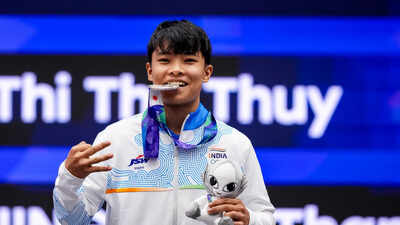





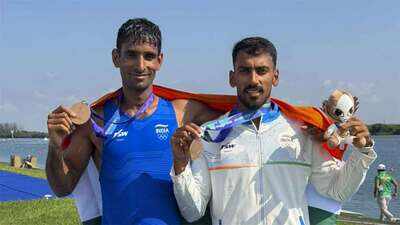
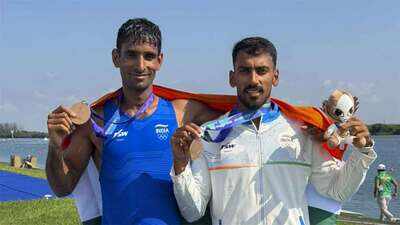
For rower Salman Khan, winning an Asian Games medal is the latest chapter in a journey that began with family responsibilities, financial struggles and a job as a cab driver.The Indian rower won the bronze medal in the men’s double sculls event alongside teammate Satnam Singh at the Asian Games 2026 on Thursday. The Indian pair stayed in second place until the 1,500m mark before slipping to third in the final 500m. They finished the race in 6:13.25 at the Nagaragawa International Regatta Course.China’s Yi Xudi and Yide Nie won gold with a timing of 6:09.37, while Uzbekistan’s Pavel Sorin and Mekhrojbek Mamatkulov took silver in 6:10.49.For Salman, the medal has come after years of hard work and a life that could have taken a very different path.
Salman lost his father at 18
Salman was born in Pure Dhingai in Amethi district of Uttar Pradesh. His father, Mohammed Kasim Khan, worked in truck-body construction in Tauru, Haryana, where Salman completed his schooling.He was the eldest of four brothers and two sisters. When his father died of dengue, Salman was just 18 years old.With his younger siblings still studying, the responsibility of supporting the family fell on him. His dream of joining the Army had to take a backseat as earning a livelihood became his priority.Salman started driving an Uber cab in Delhi. He worked day and night to keep his family going.
A friend’s advice changed his life
Salman had not given up completely on his Army dream. One day, while resting after a shift, a close friend reminded him that his height and physical build could help him in the Army. That advice pushed him to try again.He handed over the cab to another driver and spent four months preparing through hard running and training. He cleared the recruitment rally, medical and written examinations.In September 2018, he joined the Bombay Engineer Group (BEG), Kirkee, Pune.
How Salman became a rower
At the training centre, coaches noticed Salman’s height and physique and introduced him to rowing. He knew nothing about the sport and initially had no interest in taking it up. With his family’s financial situation, sport was not something he thought he could pursue.He refused several times. But the coaches continued to push him and eventually put him in a boat. They saw potential in him and began training him seriously.Salman’s first inter-centre regatta gave him the first sign that he could make something out of rowing. He won a silver medal, which gave him confidence.
The turning point
The next major step came in 2021 when Salman cleared the ergometer benchmarks and was selected for the Army Rowing Node at CME Pune. Training alongside some of India’s best rowers changed his outlook.What had started as a sport he did not even want to take up became something he wanted to pursue professionally.Salman began to believe that rowing could help him win medals for India.
From national gold to international success
Salman’s progress continued over the next few years. At the 36th National Games in Gujarat in 2022, he won gold. At the 2023 Senior Nationals, he won gold in the single sculls against Olympian Dattu Bhokanal. That performance helped him earn a place in the India camp.In 2024, Salman won his first international gold at the Asian Rowing Cup in South Korea with Nitin Deol. That victory also earned him a promotion to Naib Subedar in the Indian Army.He followed it with a silver at the 2025 Australian Rowing Championships and another silver at the 2025 Asian Rowing Championships.Those performances helped him secure his place in India’s Asian Games squad.
From driving a cab to wearing the India jersey
For Salman, representing India carries a special meaning because of where his journey started. He came from a village background and had to take responsibility for his family at a very young age.His mother, Jabrun Nisha, remained a major source of strength for him, while his wife, Sahiba Khatoon, supported him throughout his journey.His coaches and support staff also played a major role in keeping him on the rowing path, particularly during periods when he lost interest in the sport.At the Army Rowing Node, officers and coaches helped him regain his focus and develop as an athlete.Salman’s journey from Amethi to the Indian Army, and from an unfamiliar boat to an Asian Games medal, has been built over years of perseverance, discipline and the support of his family, coaches and teammates.