






Sometimes, a normal backyard hides a piece of history that has traveled further than anyone could ever imagine. A report published by Tulane University state that a couple in New Orleans recently unearthed a marble gravestone beneath their property that was almost 2,000 years old and absent from an Italian museum since the chaos of World War II. Now, the incredible find has come full circle, with the ancient Roman artifact being returned to the Italian city where it was first discovered. Scroll down to read the details.
A Roman tombstone, lurking in New Orleans
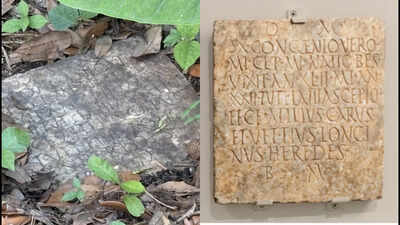
According to the University website, the marble tablet, dating from the second century A.D., commemorates Sextus Congenius Verus, a sailor who served in the Praetorian fleet based at Misenum near Naples. It was first discovered in 1866 near the old Roman port city of Centumcellae, today called Civitavecchia. It then passed into the collection of the city’s civic museum. But the story took a turn during the Second World War. The gravestone was lost from the collection and the museum was destroyed. For decades scholars had thought the ancient monument was lost forever until March 2025 and was then found in the backyard. The stone was found by anthropologist Daniella Santoro, of Tulane University, and her husband, Aaron Lorenz, as they worked in the backyard of their home in New Orleans. They took note of the odd slab because it had Latin inscriptions. Santoro contacted Susann S. Lusnia, a professor of classical studies at Tulane University, to see if she could help identify it.Lusnia immediately recognized the lettering and language to be consistent with an authentic Roman funerary inscription. She started searching scholarly databases with words from the inscription. The research soon produced a surprising result: the stone seemed to be the same monument that had been documented in Civitavecchia before vanishing in the Second World War.
The archeological mystery unveiled
It was a remarkable moment of identification for Lusnia. The inscription was more than an ancient Roman object. It was a known object, with a known history, so it was possible to follow its path from Roman antiquity to an Italian museum and finally to an American backyard. Once the connection was established, Lusnia reached out to colleagues in Italy, and helped to set up communications with the National Archeological Museum of Civitavecchia. The find quickly grabbed international attention as historians, archeologists and the public became intrigued by the mystery of how a nearly 1,900-year-old Roman monument had come to New Orleans.
Taking it home through international collaboration
The final return of the artifact involved a number of organizations on both sides of the Atlantic. The FBI Art Crime Team collaborated with the Consulate General of Italy in New York, the Italian Carabinieri Command for the Protection of Cultural Heritage, and Italian judicial authorities. The owners have agreed to return the tablet to Italy voluntarily. The ancient gravestone was returned in April 2026, according to the required procedures. The artifact has been cleaned and returned to the collection from which it was missing for more than 80 years.
An old story, a new chapter
The gravestone is being prepared for public exhibition at the National Archeological Museum of Civitavecchia. It will be one of the featured artifacts when the museum reopens September 18 after a massive renovation. The new museum will display archeological artifacts, multimedia presentations and interactive exhibits that illustrate more than 3,000 years of Civitavecchia’s history. The importance of the return of the tablet is not only for its age, but for the return of a key element of the city’s archeological heritage. For Lusnia, the journey is a powerful reminder that history can emerge in the most unexpected of places. An artifact missing since 1943 survived generations intact before turning up thousands of miles away, waiting to be recognized. A Roman sailor’s gravestone has come home, as a reminder that even after almost 2,000 years and decades of being lost, the past can find its way back.