






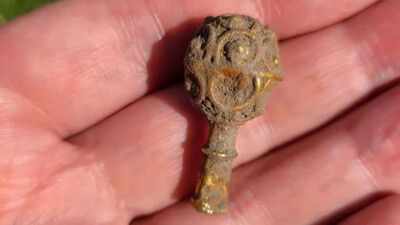
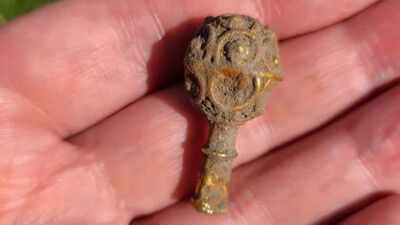
She struck gold literally. An hour and a half into her first excavation, an American archaeology student found an artefact extremely valuable for Britain’s history. Dating back to the ninth century, the small, ornate artefact is believed to have had a ceremonial purpose.Yara Souza, a Florida-native and an undergraduate at Newcastle University in northern England, was digging along with other students at Redesdale in Northumberland when she discovered the gold piece. According to a statement from the university, the 1.5-inch piece has a decorative finial at one end and appears to be from Britain’s early medieval period.The dig’s location in Redesdale, a valley in Northumberland National Park, is near Dere Street, which was once upon a time a “major Roman road,” per the statement. Britain was part of the western Roman Empire for more than 350 years from 43 C.C. until the early fifth century, when the declining empire fell. It was the Roman soldiers who laid the Dere Street, also known as the ‘Great North Road’ between 79 and 81 C.E. The path that runs from modern-day York, England, to the Firth of Forth, Scotland, and is today an over 200-mile drive, was used by them to colonise northern Britain.In 2021, another gold object, akin to Souza’s find, was discovered in the same area of Redesdale by metal detectorist Alan Grey, per the statement. In the ninth century, gold was only possessed by elites, and Dere Street connected two major religious centres: Jedburgh and Hexham. Today, the homes of abbeys, Jedburgh and Hexham’s Christian histories go back to the seventh to ninth centuries, when bishops built churches in both towns. Researchers think the gold objects might have been used by upper-class people for religious or ceremonial purposes.“We know that Dere Street continued to be a major thoroughfare long after the Romans, and it’s clear from this discovery that high-status people were using it,” said James Gerrard, an archaeologist at Newcastle University, in the statement. “It is possible that this pair of objects may have been deliberately buried,” to Smithsonian Magazine.“I couldn’t believe I’d found something so quickly into my first ever excavation,” Souza said in the statement. “It was actually quite overwhelming.” Souza, who is from Orlando, previously missed out on excavations at Birdoswald Roman Fort, a Roman military camp along Hadrian’s Wall, because she was ill. Her Redesdale find seems to have made up for that lost opportunity. “After I’d had to miss Birdoswald last year, it was amazing to discover something that hasn’t been seen for more than a thousand years,” she said in the statement. “I was really geeking out over it.”The two gold artefacts will be further studied before going on display in the Great North Museum: Hancock. The collaboration between the university and museum allows students to be trained in archaeological techniques while investigating historical contexts, said Andrew Agate, the museum’s finds liaison officer for the Portable Antiquities Scheme, in a statement. “This project is a great example of how metal detectorists and archaeologists can come together to add to our understanding of the past in Northumberland,” Agate said.