






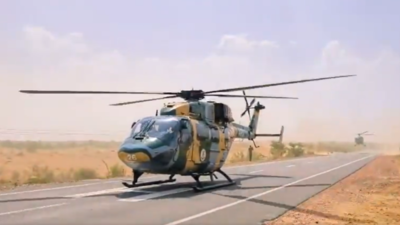
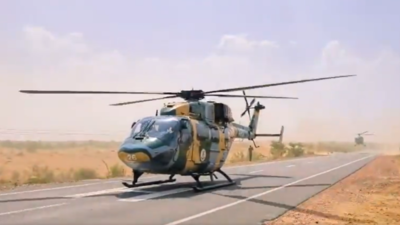
A strategically important stretch of National Highway-911 near Dantour in Rajasthan, close to the India-Pakistan International Border, was transformed into a temporary military runway on Tuesday as the Indian Army conducted ‘Exercise Jai se Vijay’, demonstrating its operational preparedness, mobility and ability to rapidly adapt to changing battlefield requirements.The exercise was conducted by the Sapta Shakti Command, with Rudra, Dhruv and Chetak helicopters demonstrating exceptional operational agility during a series of highway landing and take-off drills. The military aviation activity turned a normally busy stretch of the national highway into a temporary operating surface for Army helicopters.The exercise was conducted under the theme “Mission Ready, Future Ready”, highlighting the Army’s focus on maintaining a high level of operational readiness while developing the flexibility required for future battlefield scenarios.During the exercise, the helicopters executed precision landings and take-offs from the designated highway stretch. The activity demonstrated the capability of Army Aviation assets to operate from locations other than conventional military airbases and established helipads.The use of a national highway as an alternative operating surface is particularly significant in strategically sensitive border areas. In a contingency, conventional airfields or helipads could be unavailable, damaged or unsuitable for immediate operations. In such circumstances, suitably prepared stretches of highways and other dual-use infrastructure can provide additional options for military mobility and aviation operations.The exercise also demonstrated the importance of rapid response and situational awareness. The ability to quickly relocate aviation assets and operate from dispersed locations can support the movement of troops, equipment and essential supplies, besides providing greater flexibility during military contingencies.Operating helicopters in the desert environment of western Rajasthan presents its own set of challenges. Strong winds, blowing sand, high temperatures, dust and changing visibility can make aviation operations demanding. Conducting landing and take-off drills on a relatively narrow highway surface therefore requires precision from pilots and close coordination between the aircrew, ground crew and other elements involved in the exercise.The highway was prepared and regulated for the military activity while prescribed safety procedures were followed. The controlled exercise provided an opportunity to validate procedures for operating helicopters from alternative locations and to assess the coordination required between aviation and ground elements.The Rudra armed helicopter, Dhruv Advanced Light Helicopter and Chetak helicopter brought together different aviation capabilities during the exercise. Their operations on the highway demonstrated the versatility of Army Aviation assets and their ability to support ground forces in challenging terrain.The exercise further highlighted the growing importance of dual-use infrastructure in modern military planning. Strategically located highways can potentially serve both civilian and military purposes, providing additional operational flexibility without depending exclusively on permanent military infrastructure.For forces deployed along the western border, mobility and the ability to rapidly disperse assets are important elements of operational preparedness. The exercise demonstrated how aviation platforms can be integrated with alternative infrastructure to maintain responsiveness during contingencies.The successful conduct of Exercise Jai se Vijay provided a practical demonstration of the Sapta Shakti Command’s rapid response capability, operational flexibility and mission readiness in the demanding desert environment.The highway landing exercise thus reinforced the message of “Mission Ready, Future Ready”, showcasing the Indian Army’s focus on agility, mobility, situational awareness and the effective utilisation of available infrastructure for enhanced operational preparedness along the western frontier.