





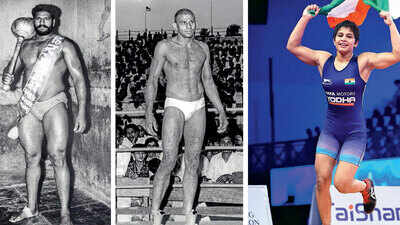
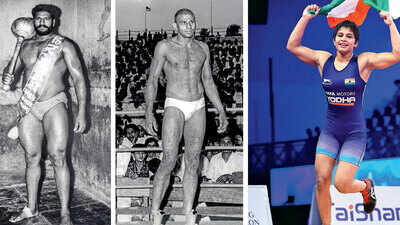
Ever since wrestling made its Asian Games debut at the 1954 Manila Games, the continental arena has served as the battleground where India’s ancient combat tradition found its voice.For centuries, the sport had lived in the country’s collective pulse, nurtured inside earthen akharas on red clay beds. But when Manila opened its doors in 1954, that rustic passion was thrust onto the international mat.Over the seven decades that followed, the Asian Games became Indian wrestling’s grand mirror, reflecting its heartaches, its periodic revivals, and an enduring legacy that today boasts 65 medals: 11 gold, 15 silver, and 39 bronze.That golden thread of legacy has run unbroken, binding together generations of Indian wrestlers one Asian Games after another. Eight years after Manila, at Jakarta in 1962, the continent witnessed the best of Indian wrestling when the legendary Maruti Mane steamrolled his way to gold in the men’s 97kg freestyle division, accompanied by Malwa Singh and Ganpat Andalkar’s gold medals in Greco-Roman wrestling. In a historic performance, Indian wrestlers finished with three gold, six silver and three bronze — a total of 12 medals — from the Games.In Bangkok 1970, the legendary Master Chandgi Ram unleashed his heavyweight ferocity to claim a fabled gold. Bangkok smiled again in 1978, crowning Rajinder Singh in the 74kg division and heralding the arrival of an all-time titan: Kartar Singh. Dominating the 90kg class in a gold-winning show in 1978, claiming silver on home soil at 1982 Delhi, and conquering the 100kg heavyweight summit at 1986 Seoul, Kartar cemented his immortality as India’s only two-time Asian Games wrestling gold medallist.That spirit burned anew in recent memory when Yogeshwar Dutt mounted an impassioned golden charge at 2014 Incheon, followed by the dazzling double-gold triumph of Bajrang Punia and Vinesh Phogat at 2018 Jakarta.By the time the contingent arrived at Hangzhou 2022, Indian wrestling had embarked on an epochal evolution. The sport had decisively traded raw mud-pit stamina for world-class technical precision.
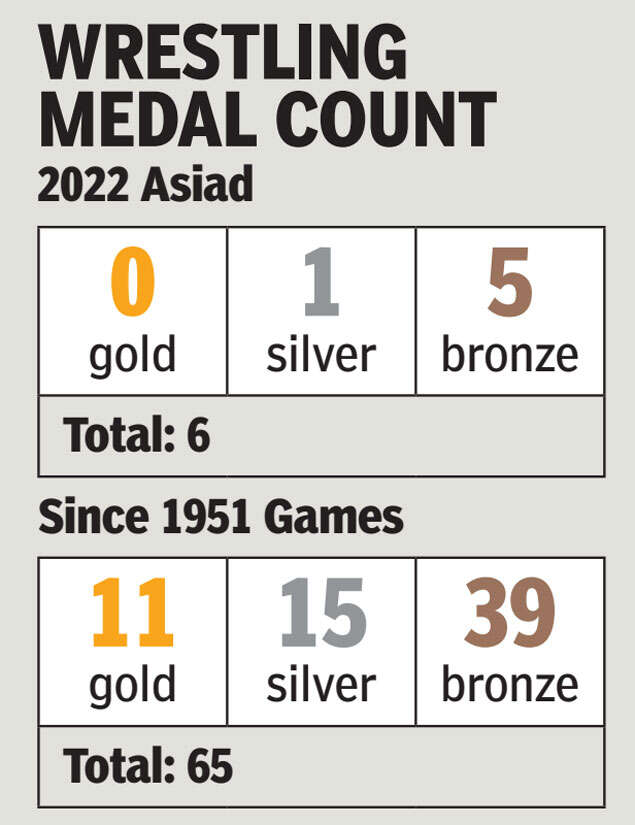
India returned from the 2022 Asiad with six wrestling medals — one silver and five bronze. Deepak Punia grappled with immense heart to capture silver in the men’s 86kg freestyle, while Sunil Kumar shattered a 13-year drought for a Greco-Roman medal at the Asiad with an 87kg bronze. Alongside them, 19-year-old Antim Panghal stepped onto the mat with breathtaking audacity to claim bronze in women’s 53kg. She was joined by podium finishes of Aman Sehrawat (men’s freestyle 57kg), Sonam Malik (women’s 62kg) and Kiran Bishnoi (women’s 76kg).Six medals represented consistency, but there was no gold. For a country whose wrestling history is studded with Asian Games champions, this was telling.The 2026 Asian Games in Aichi-Nagoya, Japan, therefore, is not simply the next edition. It is another chance to close a chapter that Hangzhou left unfinished, with one eye on the 2028 Los Angeles Olympics.Expectations surged when an 18-strong squad — six wrestlers each across men’s freestyle, women’s freestyle and Greco-Roman — was selected after intense trials on May 30 and 31. Thereafter, the Wrestling Federation of India (WFI) sent its men wrestlers overseas for exposure-cum-training camp. The freestyle group flew to Armenia, while the Greco-Roman team went to Uzbekistan.The stage seemed set but then came a blow that nobody wanted. Doping positives changed the complexion of the campaign.The anti-doping net closed in, delivering a devastating three-part shock. Deepanshu, selected in the 130kg Greco-Roman category, was the first to return a positive test. Mukul Dahiya, a strong medal contender in the 86kg freestyle category, followed. Deepak, who had won the 67kg Greco-Roman trial, was also caught in the dope net.For the WFI, the absence of any selected woman wrestler from the doping controversy has been a significant relief.Now pruned to fifteen, the squad bound for Aichi-Nagoya will be longing to salvage some pride. Olympic bronze medallist Aman Sehrawat (57kg) will lead the men’s freestyle charge, alongside Sujeet Kalkal (65kg), Sagar Jaglan (74kg), Deepak Punia (97kg) and Rajat Ruhal (125kg). In Greco-Roman, Sumit Dalal (60kg), Aman Baroniya (77kg), Sunil Kumar (87kg) and Nitesh Siwach (97kg) will walk onto the mat. And in women’s freestyle, Dipanshi (50kg), Antim Panghal (53kg), Manisha Bhanwala (57kg), Mansi Ahlawat (62kg), Nisha Dahiya (68kg) and Priya Malik (76kg) carry India’s hopes.