


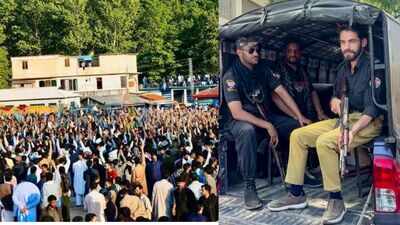
Pakistan‘s legislative assembly elections in Pakistan-occupied Jammu and Kashmir (PoK) are taking place under an unprecedented security blanket, with thousands of police, paramilitary personnel and around 2,100 army troops deployed across the region. But rather than projecting stability, the polls have been overshadowed by weeks of protests, allegations of rigging, political boycotts and international concern over the treatment of demonstrators.The election comes after nearly two months of unrest that has left dozens dead, hundreds injured and sparked widespread criticism of Islamabad’s handling of the region.Polling for the 45 directly elected seats of the 53-member assembly is being conducted in three phases, with the first round covering 13 constituencies in Mirpur division. However, the political backdrop has shifted the focus away from the election itself, with rights groups and local organisations arguing that longstanding grievances have taken precedence over electoral politics.
Heavy security and allegations of irregularities
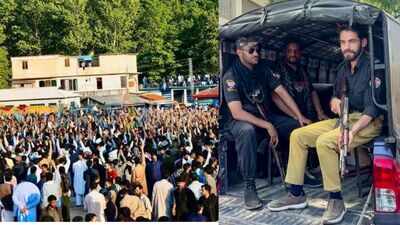
Pakistan has deployed an extensive three-tier security arrangement for the election. According to Dawn, police form the first layer of security, followed by Pakistan Rangers and the Federal Constabulary, while the Pakistan Army serves as the third layer. Around 2,100 army personnel have been deployed alongside 18,560 police and other law enforcement personnel, with Quick Response Force teams kept on standby.Even before polling gathered pace, the Joint Awami Action Committee (JAAC), which has led the recent protest movement, alleged irregularities at several polling stations. In a series of posts on X, the group claimed signs of election rigging had already emerged in Mirpur Division.It also alleged that although polling was scheduled to begin at 8am in Kotli, many polling stations remained inactive well past 10am, with few voters visible and the area “completely shut down”.Pakistan Tehreek-e-Insaf’s PoK unit also rejected the electoral process, describing it as a “sham”.“The people have rejected the sham and unfair election At the Nangi polling station in Mirpur, police personnel are present, but the aggrieved public of voters has rejected the fake election. At night, bags will be filled with fake votes, and history will be presented by declaring the most controversial election a success,” the party said.
Why protesters are boycotting the polls
The election is unfolding against the backdrop of one of the biggest protest movements witnessed in PoK in recent years.The agitation, led by the Joint Awami Action Committee, has continued for nearly two months, with demonstrators demanding greater political freedoms, economic relief and structural reforms. Among its key demands are the abolition of the 12 assembly seats reserved for Pakistan-based refugees, which JAAC argues allow Pakistan’s mainstream political parties to influence government formation in PoK.The committee has also sought the removal of privileges enjoyed by the political elite, free healthcare, uniform education, the establishment of an international airport and an end to employment quotas favouring Pakistan-based refugees.According to Arab News, JAAC has boycotted the election over the issue of the reserved refugee seats.The movement has escalated significantly in recent weeks. After negotiations between JAAC and authorities collapsed, thousands of protesters marched towards Muzaffarabad, marking the 52nd day of continuous demonstrations.The prolonged unrest has disrupted election campaigning, with rallies, public meetings and door-to-door canvassing affected by strikes and sit-ins. Polling in two constituencies was postponed because of the deteriorating security situation.Residents quoted in local media said public enthusiasm for the election had declined sharply, with many believing that basic rights and governance issues should be addressed before any electoral exercise.
Crackdown draws international attention as India rejects polls
The protests have been met with a strong response from Pakistani authorities. Following violent clashes, JAAC was banned under anti-terrorism legislation and more than 100 people were arrested before and after the unrest.The Human Rights Commission of Pakistan said it was “deeply alarmed” by the violence, while United Nations High Commissioner for Human Rights Volker Türk criticised internet restrictions imposed across parts of the region, saying communication blackouts undermine freedom of expression during periods of heightened tension. The UN called on authorities to restore full internet connectivity.Amnesty International also criticised Pakistan’s actions, condemning the ban on JAAC as a disproportionate restriction on freedom of association and peaceful political activism. Amnesty International USA separately described reports from Rawalakot as “disturbing” and urged Islamabad to “restore all communications access and allow media and independent observers into the area.”Pakistan defence minister Khawaja Asif drew further criticism after saying he viewed protesters in PoK as enemies.“I put the protesters of PojK in the same category as India and consider them as enemies,” Khawaja Asif said.India has repeatedly cited the unrest as evidence of deep-rooted discontent in the territory. The ministry of external affairs on Tuesday rejected the election outright, calling it an attempt to “camouflage its illegal occupation” over the region.“We have seen reports regarding the so-called legislative assembly elections being conducted in the Pakistan-occupied Jammu and Kashmir… The entire union territories of Jammu, Kashmir and Ladakh, including the areas currently under illegal and forcible occupation of Pakistan, are integral parts of India,” MEA spokesperson Randhir Jaiswal said.“The current cosmetic electoral exercise is nothing but an attempt by Pakistan to camouflage its illegal occupation and hide its grave human rights violations in the region. The ongoing mass protest in the Pakistan-occupied Jammu and Kashmir is the direct consequence of its economic exploitation, its denial of fundamental rights to the people and its administrative oppression,” he added.