






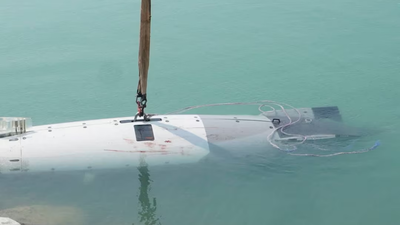
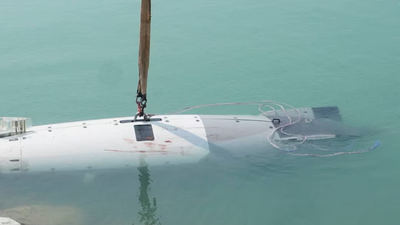
The US military has rejected claims by Iran’s Revolutionary Guard that it seized an advanced American underwater vehicle carrying out surveillance in the Strait of Hormuz.US Centcom spokesman captain Tim Hawkins told Al Jazeera that the US retains “positive control of all of our operational drone assets,” dismissing the IRGC’s claim as “clearly desperate.“Earlier today, Iran’s Islamic Revolutionary Guard Corps (IRGC) said it had captured a second advanced US unmanned underwater vehicle, the Remus 600, in the Strait of Hormuz.The IRGC said the operation had been carried out through a “coordinated and complex operation” involving military intelligence and electronic warfare capabilities.“With the help of God Almighty, the IRGC navy soldiers, through a coordinated and complex operation with intelligence and electronic warfare, were able to trap an advanced UAV of the American terrorist army that was operating in the Strait of Hormuz for the purpose of espionage,” the statement read.Iranian officials alleged that the underwater drone had been conducting espionage missions within the strait. IRIB reported that the captured vehicle had been handed over to specialist military technicians for analysis and to recover its stored data.
Previous capture
Earlier this month, the IRGC captured a US uncrewed submarine near the entrance to the Strait of Hormuz.Iranian state media identified the vessel as a Dive-LD, a large autonomous underwater vehicle manufactured by California-based defence firm Anduril. According to the company, the 5.8-metre submersible is capable of carrying out missions such as mine countermeasures, seabed mapping, intelligence gathering and the inspection of underwater infrastructure including cables and pipelines.“We trapped one of the most modern, intelligent and unmanned submarines of the terrorist American army at the entrance to the Strait of Hormuz. This submersible is equipped with the latest technologies,” Tehran’s navy said in a statement carried by the state media.In response, a Pentagon spokesperson said the underwater drone had malfunctioned “more than a day ago.”“It was surveying regional waters in support of ongoing operations. The defective drone was an older model that neither collected sensitive data nor carried any classified sonar or radar equipment,” the spokesperson said.