









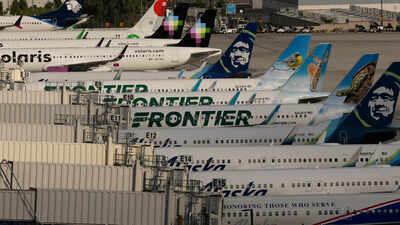
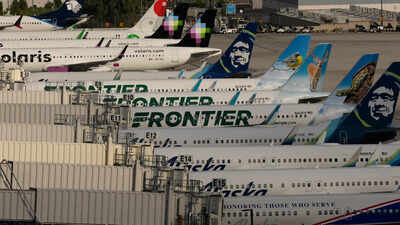
NEW DELHI: For several hours on Friday, one of the world’s busiest aviation networks came to a near standstill. Airports across the United States witnessed mounting delays, grounded departures and diverted aircraft after a communications failure forced the Federal Aviation Administration (FAA) to halt flight operations nationwide. Thousands of passengers were left stranded as airlines struggled to manage the disruption.The FAA imposed the nationwide ground stop on November 13 after communications problems affected air traffic control centres across the country. Although aircraft already in the air were allowed to continue towards their destinations, departures remained suspended for more than four hours.The shutdown, the second nationwide aviation stoppage of its kind since the September 11, 2001, attacks, affected an estimated 1.5 million passengers. More than 10,000 flights were delayed or cancelled, while hundreds were diverted.The FAA lifted the restrictions at 8:15 pm ET. However, the disruption continued as airlines worked to reposition aircraft and crew. US Transportation Secretary Sean Duffy warned that similar incidents could happen again unless the country’s ageing aviation infrastructure was overhauled.Here is how the disruption unfolded, what triggered the shutdown and how authorities responded and why the impact could continue beyond Friday.
How it unfolded: From communication failure to nationwide ground stop
The disruption began at around 3:36pm ET on Friday, when the FAA experienced telecommunications problems at air traffic control facilities and Terminal Radar Approach Control (TRACON) centres across the country.The outage affected multiple Air Route Traffic Control Centers, including the 22 regional facilities responsible for guiding aircraft travelling between airports. Citing safety concerns, the FAA ordered a nationwide ground stop to prevent further departures.The agency described the situation as a telecommunications outage and said the restrictions were imposed “due to extraordinary circumstances and for reasons of safety”.At the time, more than 3,500 aircraft were airborne across the United States. Flights already in the air were allowed to continue towards their destinations, with pilots and air traffic controllers following established procedures to ensure safe landings.Providing a timeline of the disruption in a post on X, US Transportation Secretary Sean Duffy said the number of aircraft in US airspace had fallen to fewer than 400 by 8 pm ET as planes landed safely.Duffy clarified that the FAA had not completely lost its radar or telecommunications capabilities during the outage. Exceptions were also made for critical medical evacuation flights, life-saving cargo operations and law enforcement aircraft to continue operating.International flights were handled on a case-by-case basis, while airlines adjusted their schedules to manage the disruption.The FAA lifted the nationwide ground stop at 8:15 pm ET after the affected systems began recovering. However, the resumption of departures did not immediately restore normal operations, as airlines continued to deal with delays, cancellations and aircraft displaced from their scheduled routes.
What triggered the disruption: Outdated routers and overloaded systems
Transportation secretary Sean Duffy attributed the disruption to ageing communications equipment that became overloaded with data and began transmitting inconsistent information to air traffic controllers.Speaking at a White House briefing, Duffy said the system experienced intermittent radar and communication failures, prompting the FAA to shut it down.“We have old, old switches, old routers. We use 1980s little copper lines,” Duffy said.He described the failure as a breakdown of legacy equipment that had remained in use for decades.“What went down was old, right? It was the old legacy equipment. It failed,” he said.“And listen, it’s going to continue to fail.”The communications network is used by air traffic controllers to coordinate aircraft movements and maintain contact with pilots. When such systems become unreliable, authorities may restrict departures to prevent additional aircraft from entering an already disrupted airspace system.
What happens to planes already in the air?
When the FAA orders a nationwide ground stop, aircraft already airborne are not automatically instructed to make emergency landings. The restriction primarily applies to departures, while flights in the air continue to be managed by air traffic controllers using available communication and surveillance systems.During the November 13 disruption, more than 3,500 aircraft were airborne when the FAA imposed the restrictions, according to US Transportation Secretary Sean Duffy. Pilots and air traffic controllers followed established procedures to land the aircraft safely. Duffy said the number of planes in US airspace had fallen to fewer than 400 by 8 p.m. ET. He also clarified that the FAA had not completely lost its radar or telecommunications capabilities.However, the situation becomes more complicated if an aircraft loses two-way radio communication with air traffic controllers. The FAA’s Aeronautical Information Manual (AIM), under Section 6-4-1, lays down procedures for such situations, referring pilots to 14 CFR Section 91.185, which governs instrument flight rules (IFR) operations during communication failures.Under these rules, pilots encountering a communication failure in visual meteorological conditions (VMC) are required to continue flying under visual flight rules (VFR) and land as soon as practicable. This does not necessarily mean landing at the nearest airport. The FAA clarifies that pilots can use their judgement and are not required to land at an unsuitable airport or abandon a destination when landing there remains practicable.If the failure occurs under instrument meteorological conditions (IMC), pilots must follow specific route and altitude procedures. They are required to follow the last route assigned by air traffic control, the route specified in their radar-vector clearance or, if neither is available, the route filed in their flight plan. They must maintain the highest applicable altitude among their last assigned altitude, the minimum IFR altitude and any altitude previously advised by controllers.Pilots also use a dedicated transponder code, 7600, to indicate a radio communication failure. According to the FAA’s air traffic control manual, controllers then attempt to re-establish contact through alternative means, including emergency frequencies and other available communication channels.If an aircraft cannot safely reach its intended destination because of congestion or operational restrictions, it may be diverted to another airport. The objective is to maintain the safe movement of aircraft already airborne while preventing additional traffic from entering an overloaded system.
How many flights and passengers were affected?
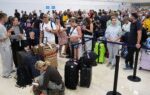
The disruption affected airports across the United States, with passengers facing cancellations, delays and diversions.According to aviation analytics company Cirium, an estimated 1.5 million passengers were affected by the disruption, CNN reported.At least 827 flights had been diverted by 7:05 p.m. ET on Friday. Of these, 670 aircraft were sent back to their original departure airports, while 157 were redirected to other airports.The disruption also put pressure on airport infrastructure. Ronald Reagan Washington National Airport reportedly ran out of space to accommodate additional diverted aircraft and stopped accepting them.Major airlines, including JetBlue, United Airlines and American Airlines, warned passengers about continuing disruptions and advised them to check their flight status before travelling.JetBlue cancelled its remaining domestic flights for Friday, with exceptions for certain Europe-bound services from New York’s JFK and Boston. The airline also warned that additional cancellations could affect Saturday operations.
What Trump said: President ‘fully engaged’ in response
US President Donald Trump remained “fully engaged” in addressing the nationwide aviation disruption, Duffy said during the White House briefing.The transportation secretary said he had spoken to Trump following the communications failure and that the administration was monitoring the situation.The president’s involvement came as the shutdown affected airports across the country, stranded passengers and forced airlines to cancel or divert flights.Meanwhile, Homeland Security Secretary Markwayne Mullin said there was no indication that the incident involved a deliberate attack or posed a national security threat.“There was no indication as of yet this was a nefarious attack against us,” he said.Authorities were continuing to investigate the cause of the communications failure, including whether it had any connection with the FAA’s rollout of a new artificial intelligence-supported system known as SMART.However, officials said there was no indication that the system was responsible. ASI, the company that designed SMART, also denied any connection.In a statement, the company said, “the current ground stop is not based on or a result of the SMART system, any product of ASI or our integration with FAA and ATC.”Microsoft separately said it had no indication that the FAA disruption was related to its services outage reported earlier in the week.
Duffy pushes $50 billion aviation overhaul, warns of more disruptions
Even as the FAA restored flight departures, Duffy warned that similar disruptions could occur again unless the United States replaced its ageing air traffic control infrastructure.He urged Congress to approve $50 billion in emergency funding to overhaul the system, including outdated hardware, telecommunications equipment and control towers.“This is an emergency. I want Congress to give us emergency funding,” Duffy said. “This is bipartisan. This is American. I want $50 billion.”He said the Trump administration had already secured $12.5 billion for modernisation but argued that additional funding was necessary to complete the overhaul.“You will have more of them unless the American people and the Congress tell us to build, and I can’t wait for that,” Duffy said in response to a question from CNN’s Kristen Holmes about why the FAA was not prepared for such a failure.Holmes asked why the agency had not anticipated a catastrophic failure of this nature.“Well, I can’t anticipate every catastrophic failure that’ll happen with a TDM network, with an analog network,” he replied.Asked whether the same incident could happen again, Duffy said he could not predict the circumstances of another outage.“Is this exact thing going to happen again? I don’t, I don’t know that this exact scenario will happen,” he said.The transportation secretary also pointed to previous communication failures involving the country’s aviation infrastructure, including incidents in New York and Newark.“We had this happen in New York when we had global leaders were flying in for the UN. We had a similar issue. We had an issue in Newark. It happened twice,” Duffy said. “How many times does this have to happen before Congress gives the money to fix it?”
Why the US air traffic control system faces modernisation challenges
The latest disruption has renewed scrutiny of the technology used by US air traffic controllers, much of which relies on legacy infrastructure that the government has been attempting to replace.The modernisation programme includes replacing ageing copper wires with fibre-optic connections, upgrading communication systems and installing new equipment at air traffic control facilities.In April, the FAA awarded a nearly $5 billion contract to Rohde & Schwarz USA to replace up to 462 outdated voice communication switches.More than 40 new switches have since been installed, according to FLYING magazine. Federal officials have also reported replacing roughly half of the ageing copper wiring used to transmit radar and communications data with modern connections.Duffy argued that the newer equipment installed under the Trump administration had not experienced the same failures as the older infrastructure. He said replacing the entire system would be more effective than continuing with temporary repairs.The issue, he said, should be treated as a national priority rather than a political dispute.“This is not one of those issues,” he said. “This is an American issue.”
What happens next?
With the nationwide ground stop lifted, the immediate priority for airlines and airports is to restore normal operations and manage the backlog of disrupted journeys.However, the return to normal schedules could take time. Aircraft and crew displaced by cancellations and diversions need to be repositioned, while airlines must accommodate passengers whose journeys were interrupted.The FAA and other agencies are continuing to examine the communications failure. The investigation is expected to establish the precise technical cause and whether additional vulnerabilities exist in the country’s air traffic control network.For passengers, disruptions could continue through the weekend as airlines work to restore schedules.Meanwhile, Duffy’s demand for $50 billion in emergency funding has put the modernisation of the US air traffic control system back in focus, with the transportation secretary warning that further failures remain possible without a comprehensive overhaul.