






NEW DELHI: It began with a fire.On the intervening night of March 14-15, 2025, firefighters responding to a blaze at the official residence of Delhi high court judge Yashwant Varma stumbled upon something far more consequential than the fire itself: a large quantity of burnt currency notes in a storeroom.What followed turned into an extraordinary judicial and political saga: an in-house inquiry, Varma’s transfer to the Allahabad high court, a Parliamentary removal motion, his decision to withdraw from the inquiry and, eventually, his resignation as a judge.Now, almost 18 months after that night, a Parliamentary inquiry committee has found the charges against Varma proved, paving the way for the Centre to pursue his impeachment even though he has already resigned.The case raises a question that goes beyond what happened in that storeroom: Why is Parliament still pursuing the removal of a judge who is no longer in office, and what would his impeachment mean for the judiciary?To understand that, it is worth going back to the night when the fire brought the cash to light.
The night the cash was found
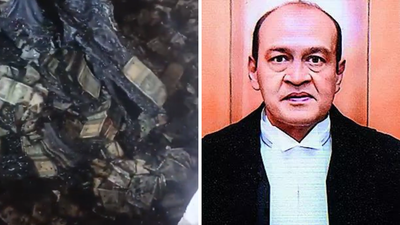
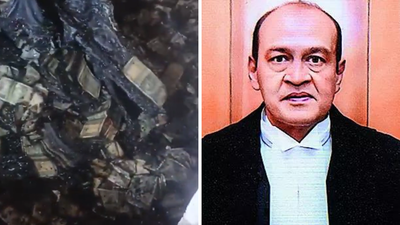
A fire was reported at Justice Varma’s residence in the early hours of March 15, 2025. Firefighters were called to douse the blaze.After the fire was brought under control, first responders found a large quantity of cash inside a storeroom. The discovery led to official entries documenting the recovery of what appeared to be unaccounted money.The news of the incident quickly reached then Chief Justice of India Sanjiv Khanna. He called an immediate meeting of the collegium, which unanimously decided to transfer Varma to his parent high court, the Allahabad high court.
In-house probe
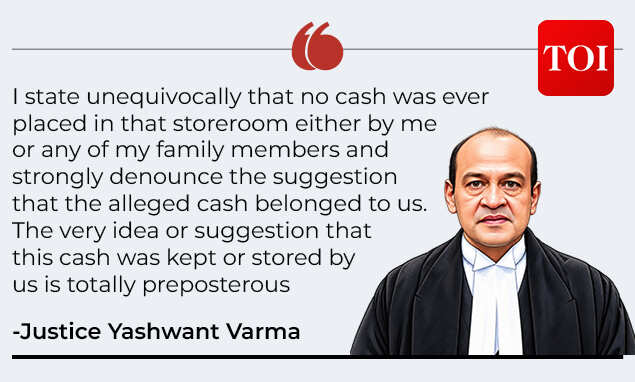
Khanna also constituted a three-member in-house committee to examine the allegations.It comprised Punjab and Haryana high court Chief Justice Sheel Nagu, Himachal Pradesh high court Chief Justice G S Sandhawalia and Karnataka high court Justice Anu Sivaraman.The committee’s voluminous report concluded that the storeroom was under the control of Varma and his family and recommended steps for his removal.Varma denied the allegations and maintained that he had been framed.“I state unequivocally that no cash was ever placed in that storeroom either by me or any of my family members and strongly denounce the suggestion that the alleged cash belonged to us. The very idea or suggestion that this cash was kept or stored by us is totally preposterous,” he said in his response.
How did Parliament get involved?
The matter did not end with the in-house inquiry.After the in-house committee recommended Varma’s removal, Parliament stepped in.Lok Sabha Speaker Om Birla received a motion signed by 146 members of the Lower House from both the governing and opposition parties seeking Varma’s removal.Acting on the notice, Birla constituted a three-member committee to inquire into the “grounds for request for removal” under the Judges (Inquiry) Act, 1968.Supreme Court judge Justice Aravind Kumar chaired the committee. Its original members were Madras high court Chief Justice Manindra Mohan Shrivastava and senior advocate BV Acharya.Shrivastava was later replaced by Bombay high court Chief Justice Shree Chandrashekhar ahead of his retirement.The inquiry then became a full-fledged legal battle.
Varma fights the inquiry
Varma did not simply accept the proceedings.Through a team of senior lawyers, he filed 11 interim applications, examined the records and cross-examined witnesses produced before the committee.The presenting side concluded its evidence on March 17. The committee then asked Varma to furnish a list of his defence witnesses and their affidavits.He sought additional time and was granted an extension. But the deadline passed without him submitting either the list or the affidavits.
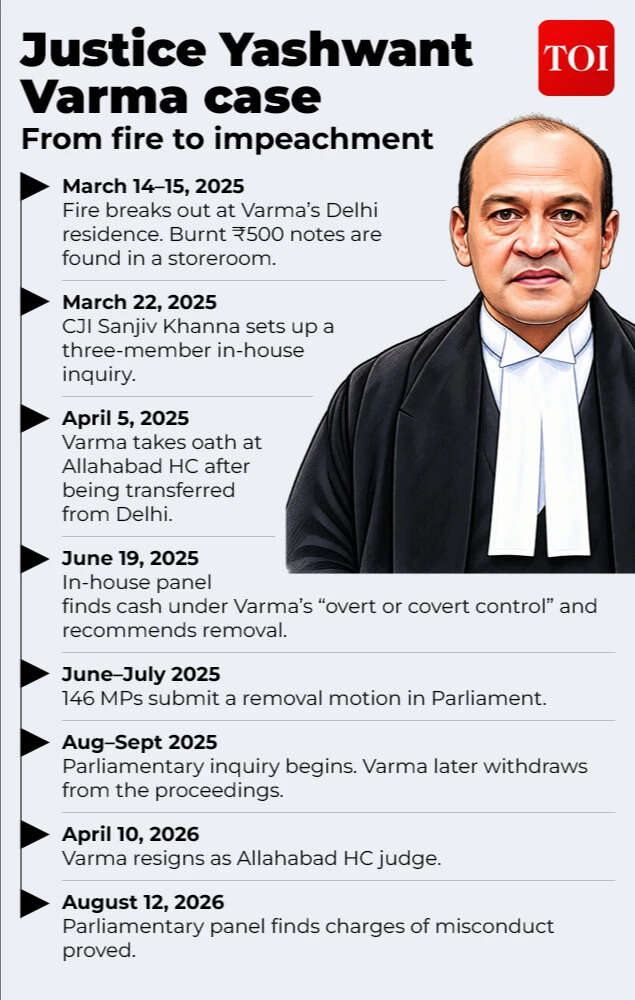
On April 9, Varma informed the committee that he would no longer participate in the proceedings.In his communication, he questioned the fairness of the inquiry on several grounds. He objected to the use of material from the earlier in-house inquiry, argued that the burden of proof had effectively been shifted onto him and alleged that crucial witnesses had not been examined.He also raised the issue of missing CCTV footage, arguing that it could have helped settle key questions surrounding the case.A day later, on April 10, Varma resigned as a judge of the Allahabad high court.In his resignation letter to the President, he did not spell out the reasons for his decision, saying he did not wish to burden the “august office” with them.“It is with deep anguish that I tender my resignation as Judge of Allahabad HC with immediate effect,” Varma wrote.But his resignation did not necessarily bring the matter to an end.
What did the Parliamentary inquiry find?
Almost 18 months after the cash was discovered, a Parliamentary inquiry committee tabled its report in the House on August 12 and found all charges against Varma proved.The committee found that Varma possessed a substantial quantity of currency notes in the storeroom of his official residence at 30, Tughlaq Crescent. It accepted videos showing charred notes as well as the testimonies of several Delhi Fire Services and police officials.
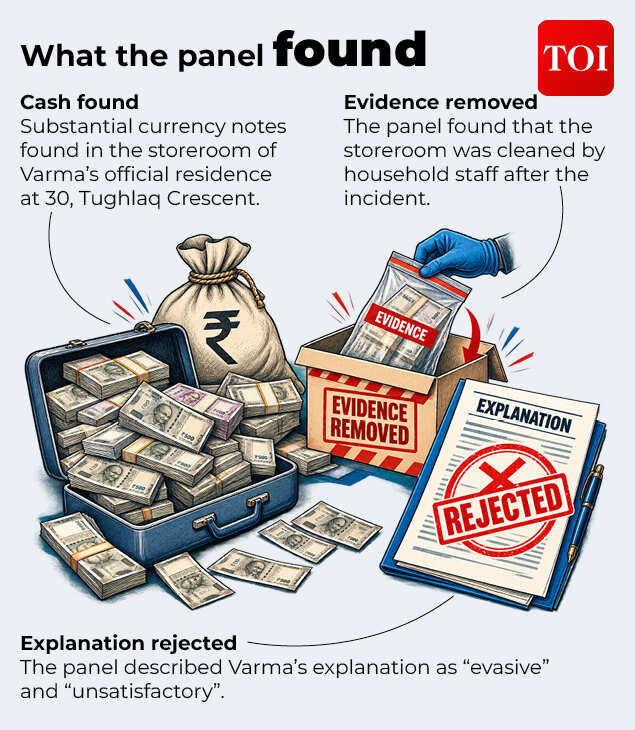
The panel also found Varma guilty of tampering with the scene of the incident. According to the report, the storeroom was cleaned by his household staff, after which the notes were no longer available.It further described Varma’s explanation for the discovery of the unaccounted cash as “evasive” and “unsatisfactory”, rejecting his claim that the currency notes had been planted.The findings have now brought the case to another crucial stage: the impeachment process.
Why does Parliament still want to pursue impeachment?
This is where the Varma case becomes constitutionally unusual.The Centre is likely to initiate the impeachment process in the Winter Session of Parliament, even though Varma has already resigned.According to a PTI report citing sources, his resignation does not affect the proceedings because it was submitted only after the removal process had begun in Parliament.The government’s reported reasoning goes beyond Varma himself. It wants to establish a precedent and send a message that a judge cannot avoid a removal process by resigning after serious irregularities have already been alleged and proceedings have begun.Constitutional lawyer advocate Ajinkya Udane said the case could become significant for future situations involving judges who resign while facing removal proceedings.“The matter may also become significant for future cases involving judges who resign while facing removal proceedings. A clear determination could help establish how similar situations should be dealt with and whether resignation can prevent an already initiated parliamentary process from reaching its conclusion,” Udane told The Times of India.“Resignation and removal through impeachment are legally different situations and may have different consequences for pension and other post-service benefits,” he added.A CBI inquiry has also been discussed as a possible course of action.
What does the Constitution say?
The removal of a judge is deliberately made difficult by the Constitution.Article 124(4) says a Supreme Court judge can be removed only by an order of the President following an address by each House of Parliament. Such an address must be supported by a majority of the total membership of that House and by a majority of at least two-thirds of members present and voting, in the same session, on the ground of proved misbehaviour or incapacity.Article 218 extends the same removal procedure to high court judges.
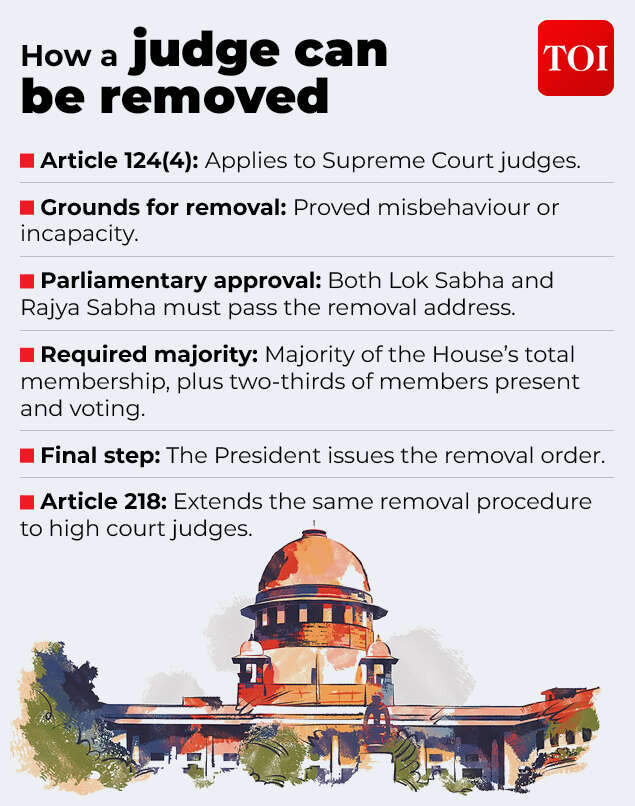
That high threshold explains why impeachment proceedings against judges are rare and why the Varma case could become an important test of how the process works when a judge resigns midway.
Has any judge ever been impeached?
No judge of a superior court in India has ever been successfully removed through impeachment.There have been several attempts, but each ended before a judge was formally removed, either because the judge resigned or because the motion failed to secure the required majority.The first major case was that of Justice V Ramaswami in 1993. As Chief Justice of the Punjab and Haryana high court, he faced allegations of extravagant spending on his official residence.A Speaker-appointed inquiry committee found him guilty on 11 of 14 charges. But when the impeachment motion came up for a vote in the Lok Sabha, Congress MPs abstained. The motion consequently failed to secure the required majority.Justice Soumitra Sen came closer in 2011.A Calcutta high court judge, Sen faced allegations of misappropriating funds he had handled years earlier as a court-appointed receiver. The Rajya Sabha became the first House of Parliament to pass an impeachment motion against a judge when it approved the motion against Sen.But Sen resigned before the Lok Sabha could take up the motion, preventing him from becoming the first judge to be formally removed from office.Justice P D Dinakaran, then Chief Justice of the Sikkim high court, faced corruption allegations in 2011 that surfaced while he was being considered for elevation to the Supreme Court.The then Rajya Sabha chairman constituted a three-member inquiry committee, but Dinakaran resigned before the process could be completed, citing a lack of confidence in the committee’s impartiality.Other attempts did not progress as far.In 2015, motions were moved against Justice J B Pardiwala of the Gujarat high court over his remarks on reservation and against Justice S K Gangele of the Madhya Pradesh high court over sexual harassment allegations. Neither case resulted in a functioning inquiry committee or a vote on the floor of Parliament.
Share your thoughts in the comments
Be respectful · TOI community guidelines
A test of more than just one judge
The Varma case, therefore, is not simply about the allegations surrounding a storeroom at a Delhi residence.It has now become a test of how India’s judicial accountability mechanism works when allegations of serious misconduct are made against a judge, and what happens when that judge resigns after Parliament has already begun the process of examining his removal.For Varma, the Parliamentary committee’s findings represent the latest and potentially most consequential chapter in a saga he has consistently denied.For Parliament and the judiciary, the case could leave behind a question that extends well beyond the individual judge: Can resignation bring an end to accountability proceedings against a judge, or can an impeachment process continue once it has already begun?The answer could shape how similar cases are handled in the future.