





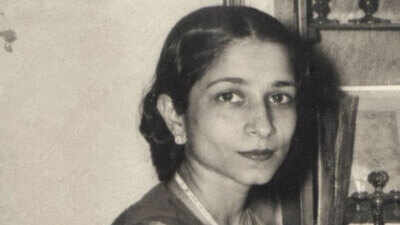
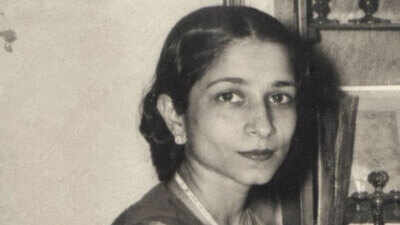
“Every thread that weaves a nation into being leaves behind a story.” Yet one of the most important threads in India’s history remained almost invisible for decades. When students learn about the Indian national flag, one name usually appears in textbooks: Pingali Venkayya, the man credited with designing the tricolour. But very few know the story of Surayya Tyabji, the artist who helped shape the final version of the flag that became the symbol of independent India.On July 22, 1947, just weeks before India gained independence, the Constituent Assembly formally adopted the national flag. It carried three familiar colours—saffron, white and green—but one important change transformed it forever.The spinning wheel, or charkha, associated with Mahatma Gandhi and the Indian National Congress, was replaced with the 24-spoked Ashoka Chakra.According to historical accounts and family records, that crucial change was proposed and illustrated by Surayya Tyabji.Born in 1919 into Hyderabad’s influential Tyabji family, Surayya was much more than an artist. She belonged to a household deeply connected to public service, education and nation-building. Her husband, Badruddin Tyabji, was an Indian Civil Service officer who later served as the Secretary of the Constituent Assembly and eventually became the Vice-Chancellor of Aligarh Muslim University.
Why was the charkha replaced with the Ashoka Chakra?
As independence approached, there was growing concern that the Congress flag should not automatically become the national flag of a newly independent country.The charkha carried immense symbolic value because of Gandhi’s freedom movement. However, many believed that an independent India needed a symbol that represented the entire nation rather than a political organisation.This is where the Tyabjis stepped in.The couple proposed replacing the spinning wheel with the Ashoka Chakra from the Lion Capital of Sarnath. The wheel represented dharma, progress, movement and justice, while also reflecting India’s ancient civilisational heritage.Surayya then prepared the visual draft that helped define the final layout of the tricolour.
She did not just help redesign the flag
Perhaps even more surprising is the fact that the national emblem also bears the imprint of the Tyabji family.According to accounts mentioned in former Delhi Chief Minister Sheila Dikshit’s memoir Citizen Delhi: My Times My Life, Jawaharlal Nehru asked Badruddin Tyabji to help create an emblem for independent India.Initial designs reportedly drew too much inspiration from British symbols.The breakthrough came when the couple looked towards the Ashokan Lion Capital.Surayya created a graphic version of the design, and impressions were prepared at the printing press at the Viceroy’s residence. The iconic three lions eventually became India’s national emblem.
An artist, a mountaineer and a pathbreaker
Surayya Tyabji’s daughter, social activist Laila Tyabji, described her mother as someone who refused to fit conventional stereotypes.She was an accomplished painter whose artwork was displayed at exhibitions in London and Jakarta. She enjoyed climbing the rocky landscapes of Hyderabad, often ignoring social expectations about how women should behave.Laila wrote that her mother would probably have preferred to be remembered as an artist immersed in her paintings rather than as a diplomat’s wife.
The first tricolour was stitched under her supervision
Historical accounts suggest that the first official national flag was stitched under Surayya Tyabji’s supervision by a tailoring establishment in Connaught Place, New Delhi.That same flag later flew on Prime Minister Jawaharlal Nehru’s car on the night India became independent.Yet, despite helping shape two of India’s most recognisable national symbols, Surayya Tyabji remained largely absent from mainstream history for decades.Her story offers an important lesson for students: history is often shaped not only by political leaders and famous personalities but also by artists, designers and thinkers whose contributions remain hidden behind the scenes.Sometimes, the people who help define a nation are the ones whose names are stitched most quietly into its fabric.Disclaimer: This article is based on historical accounts, published memoirs, family recollections and publicly available records; some aspects of Surayya Tyabji’s contribution continue to be discussed by historians.