







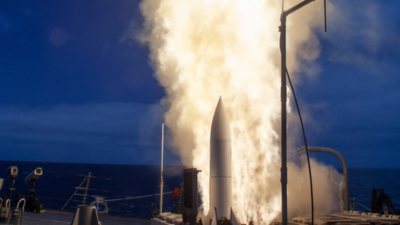
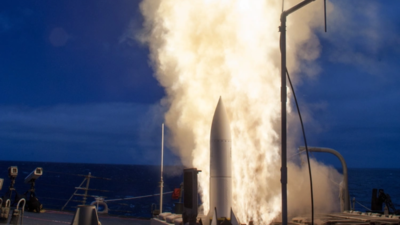
The US Navy, along with the UK’s Royal Navy and Royal Air Force, sent the decommissioned guided-missile frigate Klakring to the bottom of the North Atlantic, using the warship as target practice to test the outer range limits of the SM-6 missile among other munitions. The sinking exercise formed part of Exercise Atlantic Thunder 2026, aimed at sharpening live-fire skills against surface targets while building interoperability between American and British forces for long-range maritime sinking operations.The final blow, however, came not from the SM-6 but from a Mk 48 Advanced Capability Torpedo fired by the Virginia-class submarine Massachusetts, with sensors installed aboard the Klakring beforehand to capture data that will feed into future weapons design. The exercise also involved the Royal Navy frigate HMS Portland, P-8 maritime patrol aircraft from both nations, and US Air Force F-15E Strike Eagles.What makes the SM-6 worth watching closely is just how many roles a single missile is being asked to fill. Originally developed as an extended-range replacement alongside the SM-2 series, it swapped the older missile’s semi-active radar seeker for the active radar homing system borrowed from the AIM-120 AMRAAM, giving it the ability to track and hit highly agile targets well beyond the range of a ship’s own illumination radar. That has made it equally effective against fixed and rotary-wing aircraft, drones, anti-ship cruise missiles, and even ballistic missiles in their terminal phase, a versatility the US Navy itself describes as three missiles rolled into one.The missile’s real-world record backs up that reputation. In December 2023, the USS Laboon used multiple SM-6s to shoot down three anti-ship ballistic missiles fired by Houthi rebels in the Red Sea, and the following month the USS Carney recorded the SM-6’s first publicly acknowledged combat interception of a ballistic missile in the Gulf of Aden. It has also seen use in the 2026 Iran conflict.Perhaps the most striking evolution has been its adaptation into an air-launched weapon. Rebranded as the AIM-174 Gunslinger when fired from the F/A-18E/F Super Hornet, it became the US Navy’s first dedicated long-range air-to-air missile since the AIM-54 Phoenix was retired in 2004, with a confirmed range of around 240 kilometres, widely believed to extend further. It has also found its way onto the Army’s Typhon launcher. From ship-killer to ballistic missile shield to air-to-air weapon, the SM-6 has quietly become one of the most adaptable munitions in the American arsenal.