







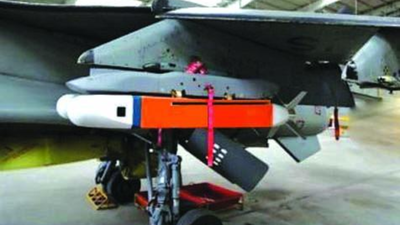
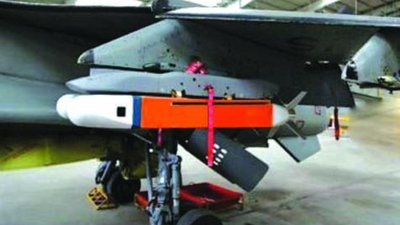
The Indian Air Force is set to get a new set of indigenously developed smart weapons that will improve its stand-off strike capability, with the upcoming induction of the satellite guided variant of the Smart Anti-Airfield Weapon (SAAW). This weapon, when deployed from an optimal altitude and speed, has an advertised range of 100 km. This will give the aircraft the ability to deploy the weapon from well outside the range of most air defence weapons.The SAAW, as the name suggests has been designed to specifically target hardened ground targets such as runways, bunkers, hardened aircraft shelters and reinforced structures. The weapon has been tested from Jaguar and Su-30MKI, but is yet to be deployed from the Tejas, as per publicly available information.The Ministry of Defence has signed a Rs 810.79 crore contract with Bharat Dynamics Limited for 160 Satellite Smart Anti-Airfield Weapons, or SAT-SAAW, along with associated equipment for the Indian Air Force. The deal falls under the Buy Indian- Indian – Indigenously Designed, Developed and Manufactured (IDDM) category, reinforcing the government’s push for indigenous defence manufacturing. It is reported that the price per unit is expected to go down with future batches, as the sunken costs go down.The SAT-SAAW is an air-to-ground precision-guided glide bomb that was developed indigenously by the DRDO, the weapon will carry 60% indigenous content.Unlike unguided bombs, glide bombs use deployable wings and satellite-inertial guidance to extend their range after release, allowing the launching aircraft to stay well clear of enemy air defences while still delivering a heavy payload accurately. This stand-off capability has become central to modern air campaigns.India’s broader glide-bomb programme extends beyond the SAT-SAAW. The DRDO is working on fitting a small turbine engine to the existing Smart Anti-Airfield Weapon, which already has a 100-km range, a modification expected to roughly double that distance. The Gaurav class of glide bombs, in 500-kg and 1,000-kg variants, offers a similar 100-km range, while the Tactical Advanced Range Augmentation (TARA) kit converts conventional bombs into 30-km precision weapons at low cost. Private industry has also entered the space, with JSR Dynamics developing the Khagantak, a glide bomb with a claimed range of up to 120 km that has already been tested by the IAF.Globally, the trend is witnessing greater acceptability. Russia has used converted Soviet-era bombs fitted with its UMPK glide kits extensively against Ukraine, alongside the newer purpose-built UMPB, which approaches a 90-km range. The US Navy, meanwhile, has unveiled a Range Extension Kit for the Mark-80 series bomb that reportedly pushes range out to 370 km, using a small turbine engine — a figure that exceeds even the original Brahmos missile’s range.Military analysts note that such weapons, first used in the Second World War as Germany’s Fritz-X and Henschel Hs-293, are now re-emerging as a cost-effective alternative to expensive cruise missiles, forcing air defence networks to rely on layered countermeasures including electronic warfare and low-cost interceptors.