






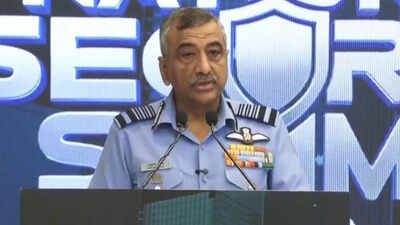
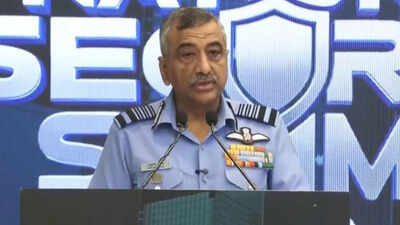
NEW DELHI: India is closely monitoring China’s military activities and has plans in place to deter any aggression, Air Chief Marshal Ashutosh Dixit said on Monday, adding that the Indian armed forces were inducting new technologies to strengthen their capabilities.Speaking at the ANI National Security Summit 3.0 in New Delhi during a session titled ‘Preparing India’s Armed Forces & Future Wars’, the Chief of the Air Staff said India’s assessment of potential threats took into account factors such as the training of adversary crews, their network-centric warfare capabilities and the altitude at which their aircraft operate.“We are keeping a very close eye, and we monitor each and every activity that is happening in our adversaries. That is our adversaries; that is our peacetime job, and align our procedures first and then capability along with it,” Dixit said.He added that the effectiveness of an aircraft or military capability depended on several factors, including whether its crew was trained, whether it operated as part of network-centric warfare and the altitude at which it could function.“Considering all these things, our plans are in place. So we add some new technology we are inducting. So, along with that, it is okay; we are in an okay situation and not a simple but okay situation that we will be able to deter this aggression,” he said.Describing the current situation as one of “no peace, no war”, Dixit said India could move from this position towards some form of offensive or defensive action.
India-China border remains a key concern
India has maintained that peace and tranquillity along the border are essential for normalising relations with China.Last month, external affairs minister S Jaishankar said any disturbance along the border would have consequences for bilateral ties.Speaking at Bloomberg New Economy Forum in Delhi, Jaishankar noted that India and China did not have an agreed border and that the issue had remained unresolved for decades.“We don’t have an agreed border between India and China. This is not a new issue; it’s been going on for multiple decades… From 1975 till 2020, a good 45 years, no blood was shed on that border. The last time there were fatalities was in 1975. In this period, India-China relations did grow,” he said.
IAF expects LCA Mark 1A squadron this financial year
At the same summit, Dixit said the Indian Air Force would induct a squadron of indigenous Light Combat Aircraft (LCA) Mark 1A within the current financial year. He also said development work on the LCA Mark 2 and the Advanced Medium Combat Aircraft (AMCA) was progressing.“Very shortly, we will have LCA Mark 1A joining the Indian Air Force; within this financial year we will have a squadron,” he said.Explaining the scale of the indigenous fighter aircraft programme, Dixit said the development of the LCA Tejas involved around 600-700 work centres and laboratories across the country, including IITs, railway laboratories and those run by the Council of Scientific and Industrial Research (CSIR).“Creating indigenous capability in a fully designed, developed, tested and then produced fighter. It is a challenge, and I think only a handful of countries have been able to achieve it,” he said.He added that developing a fighter aircraft required expertise across several scientific disciplines.“Every area of physics, chemistry, and whatever you have of the sciences, including life sciences, is utilised in developing an aircraft,” Dixit said.The air chief also described the work undertaken to improve the initial LCA Tejas aircraft. He said the Air Force had identified four areas requiring upgrades during testing and worked with Hindustan Aeronautics Limited (HAL) to address them.The IAF had also provided one aircraft from its inventory to support the development of the Mark 1A variant.“So that we have done, we have designed the aircraft, we gave them one LCA from our inventory and created LCA Mark 1A,” he said.Dixit said improvements in the four identified areas were almost complete. The integration of new weapons developed by the Defence Research and Development Organisation (DRDO), along with extensive flight testing, had also contributed to the development process.He said the LCA Mark 2 was expected to roll out next year, while work on the AMCA was continuing. Technologies developed for one aircraft would also contribute to subsequent platforms, including future stealth aircraft, he added.