









Prime Minister Narendra Modi’s visit to L&T’s Hazira facility underscored India’s renewed focus on indigenous submarine development. During the visit, the Prime Minister was presented with what is believed to be a scale model of the Project-76 submarine. Designed by the Naval Design Bureau, these submarines are expected to be developed and made in India. The project aims to address the Indian Navy’s growing submarine shortfall.At present, the Navy operates 16 conventional diesel-electric submarines across the Kalvari, Sindhughosh and Shishumar classes. Of these, only the six Kalvari-class submarines are slated to receive indigenously developed Air Independent Propulsion (AIP) systems. In addition, up to nine German Type-214 submarines equipped with AIP technology are expected to be inducted.India’s submarine modernisation programme has faced significant delays. The Navy’s plan to induct 24 conventional submarines by 2030 has fallen behind schedule, with four Sindhughosh-class submarines already retired and only six Scorpene-class submarines inducted so far. Although the Shishumar-class submarines have undergone mid-life upgrades, capability gaps remain.
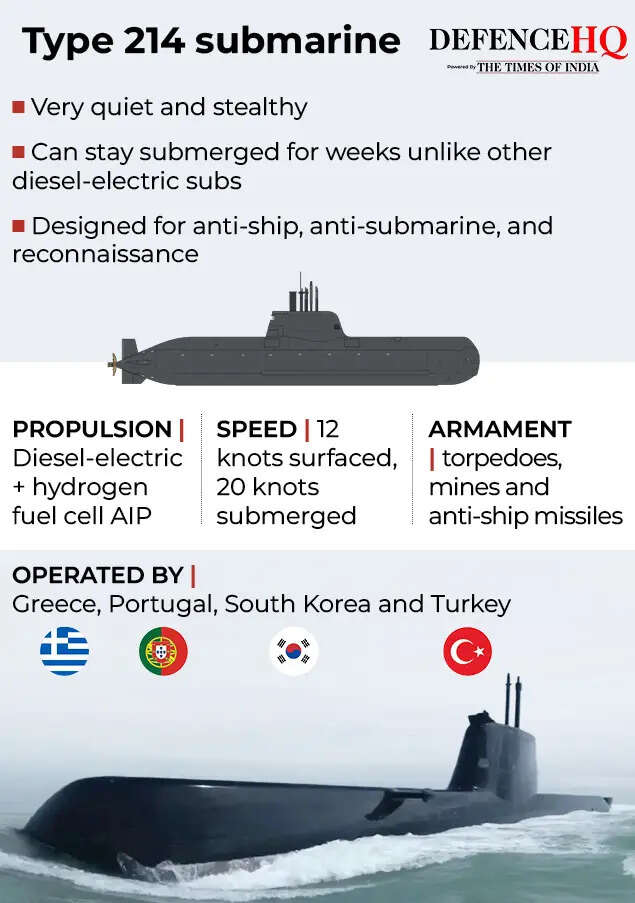
Vice Admiral AK Chatterji’s 30-year submarine-building plan, formulated in 1998, envisioned parallel construction of foreign-designed and indigenous submarines to build a fleet of 24 conventional boats by 2030. However, the Navy is expected to begin retiring more ageing submarines in the coming years. INS Sindhughosh, the lead boat of its class, has already been decommissioned, while the Shishumar-class submarines have an average age of around 35 years.The long-delayed Project-75I tender for six submarines is finally moving forward, with Mazagon Dock Shipbuilders Limited and Thyssenkrupp Marine Systems clearing the technical evaluation stage. Valued at approximately Rs 70,000 crore—significantly higher than earlier estimates—the programme is still expected to take years to materialise, with the first submarine likely to be delivered around seven years after contract signing.This timeline means that Project-75I and Project-76 could progress in parallel if development remains on track. The Navy is eventually expected to procure up to nine Project-75I submarines. Project-76 is expected to feature an improved version of the DRDO-developed AIP system that will also be fitted on the Scorpene-class submarines.An AIP-equipped submarine can remain submerged for two to three weeks without surfacing. By contrast, a conventional submarine without AIP technology must surface or snorkel more frequently, making it more vulnerable to detection by aircraft and surface vessels.Meanwhile, India’s nuclear submarine programme is also advancing. The indigenous SSN project is currently in the design phase, which is expected to take four to five years, followed by another five years for construction and validation. The Cabinet Committee on Security has approved two SSNs worth Rs 35,000 crore, with the first expected to enter service around 2036-37.Complementing this effort, India recently launched its fourth SSBN in Visakhapatnam, signalling a broader expansion of undersea capabilities that are critical for surveillance, deterrence and power projection in the Indo-Pacific.Prime Minister Narendra Modi’s visit to L&T’s Hazira facility underscored India’s renewed focus on indigenous submarine development. During the visit, the Prime Minister was presented with what is believed to be a scale model of the Project-76 submarine. Designed by the Naval Design Bureau, these submarines are expected to be developed and made in India. The project aims to address the Indian Navy’s growing submarine shortfall.At present, the Navy operates 16 conventional diesel-electric submarines across the Kalvari, Sindhughosh and Shishumar classes. Of these, only the six Kalvari-class submarines are slated to receive indigenously developed Air Independent Propulsion (AIP) systems. In addition, up to nine German Type-214 submarines equipped with AIP technology are expected to be inducted.India’s submarine modernisation programme has faced significant delays. The Navy’s plan to induct 24 conventional submarines by 2030 has fallen behind schedule, with four Sindhughosh-class submarines already retired and only six Scorpene-class submarines inducted so far. Although the Shishumar-class submarines have undergone mid-life upgrades, capability gaps remain.Vice Admiral AK Chatterji’s 30-year submarine-building plan, formulated in 1998, envisioned parallel construction of foreign-designed and indigenous submarines to build a fleet of 24 conventional boats by 2030. However, the Navy is expected to begin retiring more ageing submarines in the coming years. INS Sindhughosh, the lead boat of its class, has already been decommissioned, while the Shishumar-class submarines have an average age of around 35 years.The long-delayed Project-75I tender for six submarines is finally moving forward, with Mazagon Dock Shipbuilders Limited and Thyssenkrupp Marine Systems clearing the technical evaluation stage. Valued at approximately Rs 70,000 crore—significantly higher than earlier estimates—the programme is still expected to take years to materialise, with the first submarine likely to be delivered around seven years after contract signing.This timeline means that Project-75I and Project-76 could progress in parallel if development remains on track. The Navy is eventually expected to procure up to nine Project-75I submarines. Project-76 is expected to feature an improved version of the DRDO-developed AIP system that will also be fitted on the Scorpene-class submarines.An AIP-equipped submarine can remain submerged for two to three weeks without surfacing. By contrast, a conventional submarine without AIP technology must surface or snorkel more frequently, making it more vulnerable to detection by aircraft and surface vessels.Meanwhile, India’s nuclear submarine programme is also advancing. The indigenous SSN project is currently in the design phase, which is expected to take four to five years, followed by another five years for construction and validation. The Cabinet Committee on Security has approved two SSNs worth Rs 35,000 crore, with the first expected to enter service around 2036-37.Complementing this effort, India recently launched its fourth SSBN in Visakhapatnam, signalling a broader expansion of undersea capabilities that are critical for surveillance, deterrence and power projection in the Indo-Pacific.