

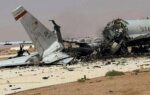





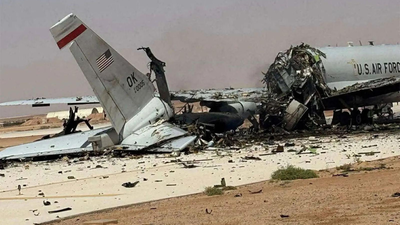
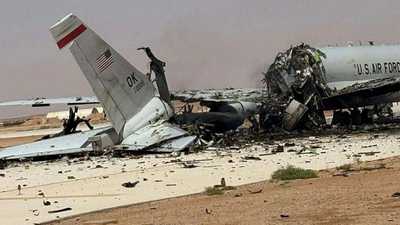
TOI correspondent from Washington: The war that Iran was supposed to lose in days if not hours has now lasted more than six months and is costing America billions – $33.4 billion to be precise. A Pentagon report and startling new photos of wreckage at US bases in the region are beginning to tell a story that official communiques have masked.The Pentagon Inspector General’s first congressionally mandated review of “Operation Epic Fury” puts the US cost as of June 29 at $33.4 billion: $22.3 billion in expended munitions, $7.4 billion in additional operating costs, and $3.7 billion in equipment losses.The losses include dozens of aircraft and drones — wreckage of some of which have been graphically captured in a trove of photographs obtained by CBS News from anonymous on-field personnel. They show Iran’s missile and drone campaign inflicted considerably more damage on US forces across the Middle East than had been publicly acknowledged — even as Washington insists it has decimated Iran and still retains the capacity to continue the war.The IG report itself says Iranian strikes damaged or destroyed hundreds of buildings and structures at American installations in Kuwait, Bahrain, Qatar, the UAE, Saudi Arabia, Iraq, Oman and Jordan. Repair costs for those facilities are not included because the Pentagon has not yet decided what will be rebuilt, where, or how the costs will be shared with host nations. All this among a clamor from sections of MAGA to simply leave.CBS, through unnamed sources, has supplied the pictures to match the IG’s paperwork. Photographs provided by active-duty personnel, who spoke anonymously because of military restrictions on media contact, show destroyed buildings and vehicles at Camp Buehring and Camp Arifjan in Kuwait and a badly damaged Boeing E-3 Sentry at Prince Sultan Air Base in Saudi Arabia, its tail apparently severed by a strike.“This is major damage to our bases that hasn’t been communicated to the American public,” one service member told the network. Another, referring to Pentagon language describing missiles that got through defenses as “squirters,” said: “We’re standing there with our eyes closed getting punched in the face.”The disclosure that Iran is giving America a bloody nose challenges President Trump and Defense Secretary Pete Hegseth’s early-war assurances that the US has beaten Iran into submission and there is no shortage of munitions as has been reported in the media. “Our stockpiles of defensive and offensive weapons allow us to sustain this campaign as long as we need to,” Hegseth said in March, adding that Iran was making a “really bad miscalculation” if it believed the US could not sustain the fight.By July, however, Hegseth was asking Congress for $67 billion in additional funding and warning that without supplemental money the Pentagon “could face critical shortfalls” affecting its ability to pay troops, replenish equipment and munitions and sustain global operations. The IG now provides the missing middle chapter: the war did not merely consume ammunition; it produced what the report calls “strategic inventory shortfalls” and exposed bottlenecks in production. Solid-rocket motors, high-grade explosives, propellants and skilled manufacturing labor are identified as constraints. The defense industrial base, the report says, requires “significant lead time” to expand production.Meanwhile, US attention is being pulled in other directions, even as the war is entering its seventh month, with the White House now talking about an end after the November midterms. Elsewhere, Congress is challenging the continuation of hostilities and public support is weakening. A September Marquette poll found only 13% of Americans believed US war objectives had been achieved, while 79% said the war had not been worth the cost.And then there is Yemen, where Iran’s Houthi allies have seized the strategic port of Mocha and advanced toward the Bab el-Mandeb, threatening a second maritime chokepoint after the Strait of Hormuz. For Washington’s Gulf partners, that creates an uncomfortable strategic question: if seven months of American military power has not prevented Iran from continuing to contest Hormuz — or its Houthi allies from gaining ground at Bab el-Mandeb — how durable is the American security umbrella?The emerging picture is neither the collapse of American military power, but nor is it the cost-free triumph once advertised. It is something more consequential: a highly talked-up US military inflicting immense damage on Iran, but itself absorbing billions in losses, consuming precious munitions and struggling to restore the strategic depth that great-power competition requires. In a region where perceptions of power matters almost as much as power itself, the photographs from Kuwait and Saudi Arabia, the Inspector General’s report, and the Houthi advance toward another global chokepoint together raise questions the US can no longer answer with bravado at briefings alone.