











NEW DELHI: What is usually Delhi’s most polluted fortnight, from Nov 1 to 15, has ended this year without a single severe air quality day for the first time. A severe day means an AQI above 400 on a scale up to 500.Data from the Central Pollution Control Board (CPCB), which began calculating the Air Quality Index (AQI) in April 2015, shows that Delhi recorded three severe days during this period in 2025, two in 2024, six in 2023, three in 2022, seven in 2021 and eight in 2020. The number of such days when AQI surpassed 400 was six in 2019, five in 2018, seven in 2017, nine in 2016 and three in 2015. The average AQI during this fortnight was 343 this year as compared to 367 last year and was the same as in 2022.Experts said better meteorological conditions, new stations recording lower readings, restrictions under the Graded Response Action Plan and Delhi’s winter framework and low contribution of stubble burning likely prevented AQI from a further rise.
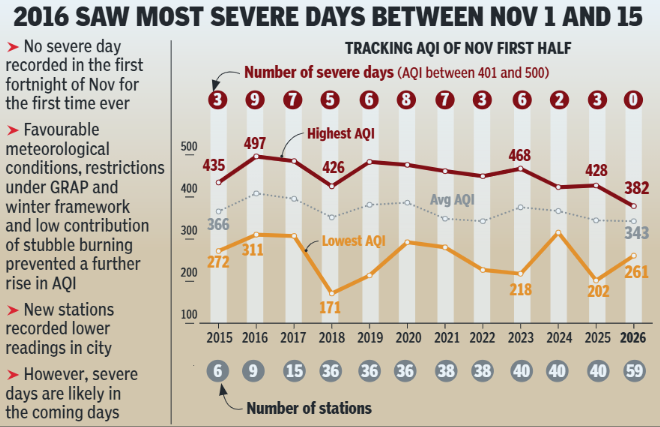
The average Air Quality Index was lower this year compared to last year
On Diwali night, CPCB did not share the readings for several hours for many stations when the particulate matter concentrations surpassed 1,000 micrograms per cubic metre. This missing data was not considered for the calculation of the 24-hour average AQI.Sunil Dahiya, founder of think tank Envirocatalyst, said Delhi didn’t record severe air pollution this Nov because weather conditions were favourable. “While wind direction helped around Diwali, it was the most stagnant start to Nov on record. Less stubble smoke reached the city this year than in the heavy-burning years. Part of the no ‘severe’ day headline is also arithmetic; the bigger monitoring network, with newer lower-reading stations, pulled the city average down. On the long-running stations alone, Delhi crossed into ‘severe’ on three days,” said Dahiya.Another expert said, “Many stations have been recording severe air quality in Nov. However, new monitoring stations have seen lower AQI which have affected the city average.” He added, “On Diwali night, particulate matter concentrations at many stations surpassed 1,000 micrograms per cubic metre which was not considered for the 24-hour average AQI.”TOI reported that missing PM2.5 data could have pushed Delhi’s average pollution levels 49% higher on Diwali, according to an analysis by Centre for Research on Energy and Clean Air (CREA). Had the missing readings been recorded at 1,000 micrograms per cubic metre, the city’s average PM2.5 level would have increased from 269 to 400 micrograms per cubic metre, it revealed.Nov 1-15 is typically the capital’s most polluted period, with the average AQI at 374. In the first fortnight of Nov this year, Delhi recorded three poor days (AQI between 201 and 300) and 12 very poor days (AQI between 301 and 400). The highest AQI was recorded at 382 on Nov 6. However, the AQI remained in the severe category for a few hours on the morning of Nov 13, but the favourable weather factors brought down the 24-hour average AQI to 373.However, experts emphasised that the worst is not over yet. The city usually records severe air quality in Dec and Jan. The analysis of CPCB data showed that the second most polluted fortnight in a year is from Dec 16 to 31 with an average AQI of 346. This fortnight witnesses low temperatures and dense fog which traps pollutants. It also records increased traffic and use of firecrackers due to wedding season, Christmas and New Year’s Eve. Last year, this period saw five severe days, including a severe-plus day when AQI touched 461.The third most polluted spell is typically from Jan 1 to 15 when the unfavourable meteorological conditions, including dense fog, low temperatures and calm winds, continue. The average AQI of the period from Jan 1 to 15 was 329.3 during the period from 2016 to 2026.Meanwhile, Delhi’s AQI was 275 in the poor range Monday. Sirifort was the lone station to witness severe air quality at 441. The air quality of Delhi is forecast to worsen to very poor Tuesday.Biomass burning, including stubble burning, domestic solid biofuel, dung cakes and wood, was the dominant source of pollution, accounting for 30.9% in Delhi’s PM2.5 between 1 am and 9 am Monday. It was followed by mixed combustion at 27%, secondary organic aerosols at 19.6% and secondary inorganic aerosols at 8.8%, according to the Indian Institute of Tropical Meteorology’s real-time source apportionment data. Emissions from vehicles and firecrackers contributed to around 7.5% and 5.8%, respectively.