







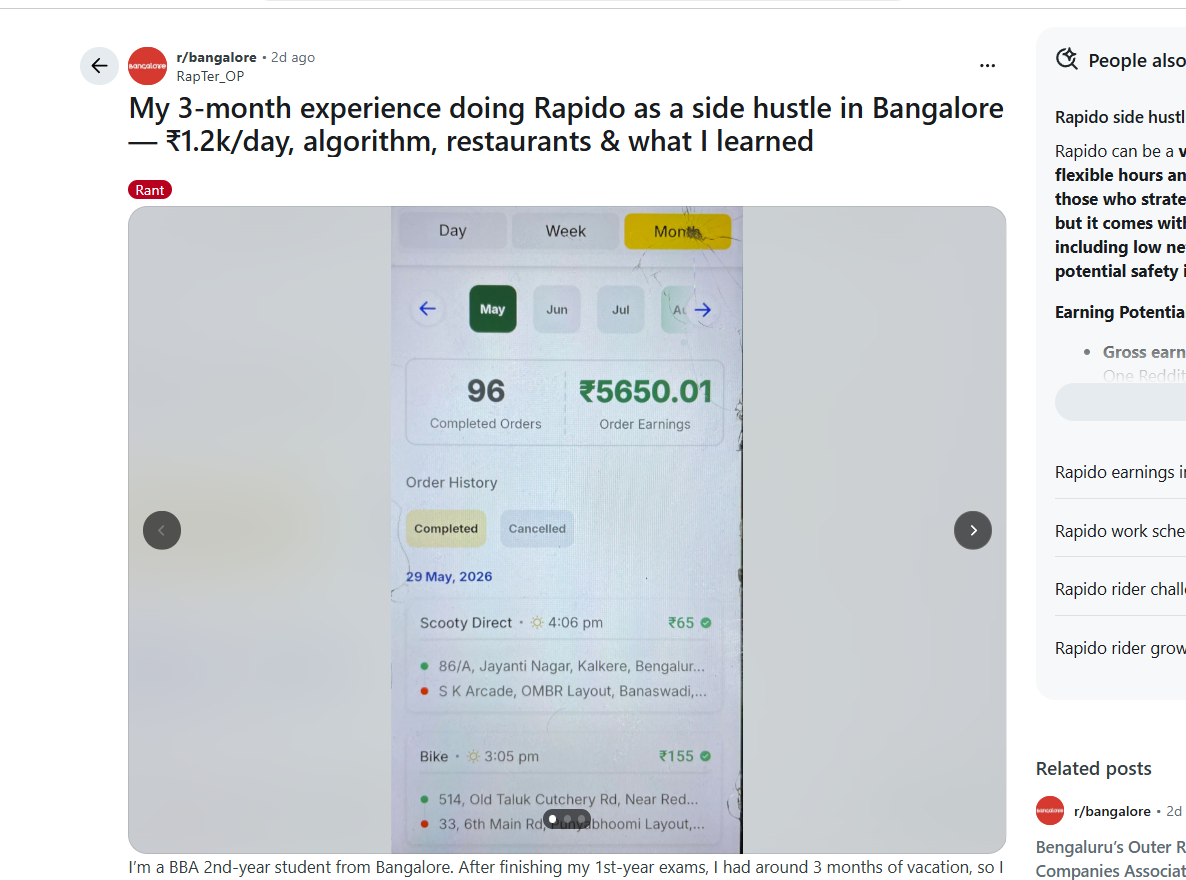
For most college students, a three-month vacation is a chance to sleep late, meet friends, travel or simply escape the pressure of classrooms and assignments. But for one Bengaluru BBA student, the break became something far more unusual.Instead of spending the vacation on the sidelines, the second-year student got on a motorcycle and began working as a Rapido captain. What started as a side hustle to make some extra money gradually turned into an experiment in understanding one of the most talked-about parts of India’s changing workforce, the gig economy.The student later shared the experience on Reddit’s r/bangalore, describing the realities of spending months on the road and earning around Rs 1,200 a day. The account offers a glimpse into a world that most customers encounter only for the duration of a ride.
From college vacation to the streets of Bengaluru
The decision was not driven solely by financial need. The student reportedly wanted to understand how app-based work actually functions beyond the polished interface of a smartphone.For three months, the student experienced the city from the other side of the booking screen, accepting rides, navigating traffic, dealing with restaurants and passengers, and observing how an algorithm can influence the daily rhythm of a worker.That experience matters because gig work is often reduced to a simple equation: log in, complete rides and earn money. The reality, however, is considerably more complicated.A rider’s day is shaped by demand, location, traffic, timing and the availability of bookings. A few hours on the road can look profitable on paper, but the experience also involves fuel, vehicle maintenance, exhaustion, traffic stress and the uncertainty of not knowing exactly how much work will come in.
The Rs 1,200 a day figure tells only half the story
The student’s reported daily earning of about Rs 1,200 may sound attractive, particularly to a college-goer looking for additional income during a vacation. But the headline number does not necessarily represent take-home earnings.This is one of the biggest realities of gig work. The money generated through a platform cannot always be equated with income that reaches a worker’s pocket after expenses.Fuel, maintenance, and the cost of spending hours on the road all have to be considered. For someone who depends entirely on such work, even a seemingly decent daily earning can become fragile once these expenses are deducted.Other accounts from Bengaluru’s gig workers have highlighted the same tension. One cab driver previously described working nearly 16 hours a day while spending heavily on vehicle rent, CNG and food, leaving considerably less than his gross earnings.The contrast is important: a platform may make earning look immediate, but the economics behind that earning can be anything but simple.
What happens when an algorithm becomes your boss?
Perhaps the most intriguing part of the student’s experiment was the attempt to understand the algorithm.In a conventional job, a manager, supervisor, or company structure largely determines how work is assigned. In the gig economy, much of that process happens through an app.A notification appears. A ride is offered. A worker decides whether to accept it. Location and demand influence what comes next. The process can feel independent, but the freedom comes with uncertainty.The student was therefore not merely earning money. They were observing what it feels like when technology becomes the invisible manager of a working day.That is a lesson classrooms cannot easily reproduce.Behind every ride is a person, not just a profile on an appThere is another, more human lesson buried in the student’s three-month experiment.For passengers, a Rapido ride may last 15 or 20 minutes. It is easy to think of the rider simply as someone who arrives at the pickup point, navigates traffic, and drops the passenger at the destination.But for the rider, that single trip is one small part of an entire working day.Bengaluru has repeatedly produced stories that expose this hidden side of gig work. From corporate employees taking up Rapido rides for additional income to workers turning to driving after prolonged unemployment, the city has shown how diverse the gig workforce has become.The student’s experience adds another dimension: curiosity.A young person who could have spent the vacation entirely within the familiar world of college chose instead to step into an unfamiliar workplace and see how it operates.
A college lesson that did not happen inside a classroom
There is something powerful about this story. The student did not simply earn money. They learned how a major city moves, how restaurants interact with delivery and mobility workers, how passengers behave and how technology shapes human decisions.For a BBA student, it was perhaps a real-world business case study, except there was no classroom, presentation, or professor. There was only Bengaluru’s traffic, a smartphone, a motorcycle and the next booking.The experience also raises a larger question about what we mean by employment in today’s economy.The gig economy promises flexibility and an easy entry point into work. Yet flexibility can also mean uncertainty. For some, it is a convenient side income. For others, it is the only income available.That distinction is crucial.The Bengaluru student’s three-month experiment may have begun as a vacation project, but it ended with something more valuable than Rs 1,200 a day: a first-hand understanding of the people and systems powering India’s rapidly expanding app-based economy.And perhaps that is the most important takeaway. Sometimes the most meaningful education does not come from a textbook. Sometimes it comes from getting on the road and seeing how the world actually works.