






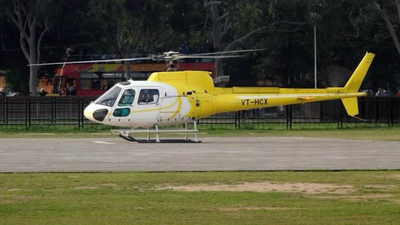

NEW DELHI: Hours after seven people on board an Aryan Aviation chopper died when it crashed near Gaurikund on June 15, 2025, the aviation ministry had found two helicopters of Trans Bharat — whose chopper crashed on Friday — were airborne “under unsuitable weather conditions.” It had suspended the licences of both Trans Bharat pilots for six months.While the cause of Trans Bharat’s Friday crash in which six people lost their lives will be known once the inquiry report is out, there have been red flags regarding this and several other chopper operators in the hill region. The Uttarakhand govt has grounded Trans Bharat fleet for now.Aviation industry insiders point out that six days before Friday crash, another Trans Bharat helicopter carrying five pilgrims from Sahastradhara to Kedarnath via Guptkashi had made an emergency landing at Baurari stadium on Oct 24 “where children were playing.” Luckily all six, five passengers and the pilot, were safe that day and the chopper took off soon again.“On May 20, 2026, a Trans Bharat Bell 407 flying from Badrinath to Dehradun with seven people on board ran into severe downdrafts over the Chamba–Arakot sector of Tehri Garhwal. During the emergency landing that followed, its tail struck a 33 kV high-tension line. The pilot, a former IAF pilot, got everyone down uninjured,” said sources. Uttarakhand Civil Aviation Development Authority (UCADA) is probing this case.The Char Dham corridor has no single agency answerable for safety. While the DGCA licenses the operators and pilots, UCADA runs the helipads, sets slots and manages shuttle operations. The Sanjay Kumar Jha-headed parliamentary standing committee on transport, tourism and culture had in Aug 2025 called this arrangement “inherently unsafe and unsustainable.” It said there was a “responsibility vacuum” between the two agencies. It found that the DGCA was acting as a passive licensing authority. It also noted that India still has no mandatory, terrain-specific mountain-flying training or certification for pilots operating in the Himalaya.This changed significantly after last summer following a spate of chopper crashes in Uttarakhand. Air traffic control units are being set up, with Kedarnath having one now and Badrinath to get a unti soon. Routes have been defined in the region and take offs are both restricted in number and controlled in a defined pattern with some gap. This is a far cry from the almost unregulated chopper movement in the hill region till last summer.“System wise there has been a lot of improvement. The Char Dham Operations are quite extensive in every aspect. From commercial to maintenance and from operations to ATC, every department is working very hard to ensure safety and efficiency is achieved. After the season of 2025 , there are many different measures that are implemented to ensure highest safety standards are met. These include ATC at Sahastradhara and Sitapur to ensure that flying is well coordinated and controlled,” said Captain Nitin Welde, a senior chopper pilot who operates in Uttarakhand.
Share your thoughts in the comments
Be respectful · TOI community guidelines
“There’s a fuel bowser at Sahastradhara to ensure that IOCL supplies fuel in best possible manner. Take off and landing tarmac is separated from parking Tarmac to ensure orderly flow of positioning. There are CCTV cameras all across valley which give feed through a mobile app. All can get a live feed as regards weather valley. For higher helipads above 10,000 feet, the weight limitations are in place and that ensures higher reserve of power while landing and take off. Training for pilots has increased since last year. And there is adequate training in Char Dham sector as well as Kedar shuttles. The DGCA FOIs have been visiting the valley on a weekly basis and UCADA ops department is fully involved in a minute to minute monitoring and support,” added Captain Welde.“Friday was a sad day where it appears that weather in exit phase of Badri valley wasn’t good,” Captain Welde said.