






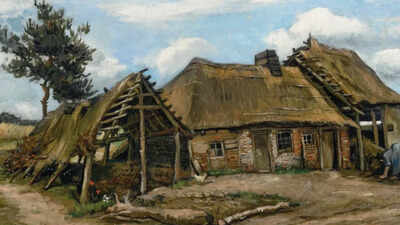
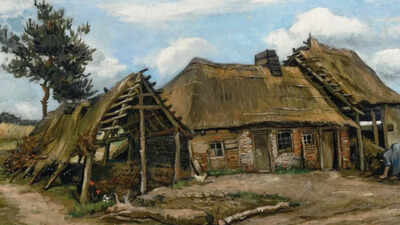
A painting bought for just £45 from a London junk shop in 1968 went on to become a multimillion-euro artwork after experts confirmed that it was an original by Dutch painter Vincent van Gogh. The painting, titled Peasant Woman in front of a Farmhouse, was sold to a private collector for approximately €12 million to €15 million at the TEFAF Maastricht art fair in the Netherlands in March 2020.The buyer who first recognised its possible value was Luigi Grosso, an Italian working for the BBC, The Art Newspaper reported. He came across the painting in a shop in Belsize Park, north London, and noticed that it carried the signature “Vincent” in the lower left corner. While the shopkeeper believed it belonged to an artist with that surname, Grosso suspected that it could be an original Van Gogh.His decision to buy the painting for £45 proved significant. With help from art curator Alan Bowness, who had organised an exhibition of Van Gogh’s work at London’s Hayward Gallery, Grosso arranged for the painting to be authenticated. It was subsequently sold at Sotheby’s in New York in 1970 for $110,000.The artwork had spent decades at a farm in Staffordshire, where it was once stored in an attic and eventually sold for only £4.
How a Van Gogh painting ended up at a farm
The painting, created in July 1885, is known in French as Paysanne devant une chaumière. Before entering the art market, it had been kept at Billington Farm, just outside Stafford in England.According to the Holme family, who owned the farm, John Holme (1871–1952) received the painting in 1929 as payment for a debt involving agricultural supplies. Rather than receiving money for the supplies, he accepted the artwork.The painting remained at the property for several decades. It initially hung inside the farmhouse but was later moved to the attic when the family grew tired of displaying it.In 1967, John’s son Charles sold the painting during a general farm sale after retiring. It fetched just £4, with its connection to Van Gogh still unrecognised.The following year, the artwork appeared in a London shop, where Grosso noticed it and decided to investigate its possible origins.
How Grosso discovered painting
In September 1968, Grosso visited a shop in Belsize Park that he later described to art writer Martin Bailey as somewhere between a junk shop and an antiques dealer.The painting caught his attention because of the signature and its appearance. Although the shop owner did not believe it was a work by the famous Dutch artist, Grosso knew enough about art to consider the possibility.He purchased it for £45 and sought help from Alan Bowness, who had recently curated a Van Gogh exhibition at the Hayward Gallery.With Bowness’s assistance, the painting was authenticated as a genuine work by Van Gogh. The confirmation changed its position in the art market.In 1970, Grosso offered the painting at Sotheby’s in New York. Hollywood film producer Joseph Levine bought it for $110,000, marking a substantial increase from the amount Grosso had paid two years earlier.
Painting changed owners several times
After acquiring the painting, Levine kept it until 1983, when it returned to Sotheby’s in New York. This time, it sold for $390,000 to Roberto Polo, a Cuban-born American art collector.Polo owned the painting for approximately two years before selling it at Sotheby’s in London in 1985. A collector from Montreal purchased it for £264,000.The artwork changed hands again in 2001, when it appeared at Sotheby’s in New York for a fourth time. It sold for $1.7 million to an American collector.Despite appearing at several major auctions, the painting was rarely displayed in institutional exhibitions.s only institutional exhibition loan was to London’s Royal Academy of Arts in 2010.
Sold for up to €15 million in 2020
In March 2020, the painting returned to the international art market through London-based gallery Dickinson, which exhibited it at TEFAF Maastricht in the Netherlands.The gallery agreed to sell the work to a private collector for approximately €12 million to €15 million, equivalent to around $13.5 million to $16.9 million at the time. It was the highest-value sale reported at the Dutch fair up to that point.