



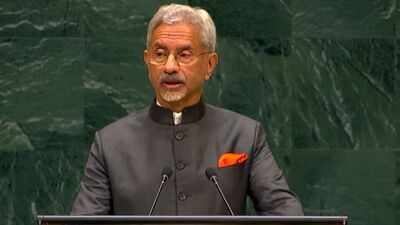
NEW DELHI: External affairs minister S Jaishankar addressed the United Nations General Assembly on Saturday and called for exercising restraint amid continued attacks on commercial ships and seafarers in Gulf region amid the Iran-US war.“Countries far from conflicts are being penalized for no fault of theirs. Those most impacted often have the least say. This assembly must face up to the true state of affairs. This year, we are witnessing a conflict in the Gulf, one that is exacerbating an already difficult situation. We remain deeply concerned over continuing hostilities,” he said.“The targeting of commercial shipping and seafarers, transiting international waterways, is simply unacceptable. India calls upon all parties to exercise restraint, de-escalate tensions, ensure protection of civilians, and uninterrupted flow of energy and commerce…,” he added.Taking aim at Pakistan Prime Minister Shehbaz Sharif, he said: “Yesterday, a serial practitioner of terrorism misrepresented facts before this assembly. Arguments were invoked to normalize terrorism and claim immunity from its consequences. That will not stand. Our right to defend ourselves against terrorism will be exercised. Friendship and goodwill cannot coexist with terrorism, and understandings premised on that will naturally be called into question. It is for the perpetrator of terrorism to mend its ways.”
Share your thoughts in the comments
Be respectful · TOI community guidelines
Here are top quotes from Jaishankar’s speech:
- The conflict in Ukraine, now in its fifth year, is equally concerning. As Prime Minister Narendra Modi stated, endless war must give way now to an end to war. India supports ongoing initiatives to bring peace. Even as this is underway, there is an urgent need to address the security of seafarers and the supply of food, grains, and energy.
- India is prepared to do everything possible to ameliorate this situation, especially with regard to food and energy security. Tensions and violence also regrettably continue in West Asia or the Middle East. We strongly believe that a durable and lasting peace requires a two-state solution.
- In the meanwhile, India is contributing to humanitarian assistance and relief efforts for the Palestinian people. Let us recognize that peace is not just the absence of war. If the world is subjected to continuous threats and pressures, then we are really living on the edge of an abyss. All it takes is one more step to push us over. Therefore, it is imperative to strengthen stability, security, and predictability. These are crucial elements of the enabling environment for peace…
- A persistent threat to peace has been the scourge of terrorism. That this could be state-sponsored, with cross-border purpose, makes it a direct affront to the global order. Governments indulging in such practices must be held accountable. There must be no dilution in our zero-tolerance approach towards terrorism. Its financial aspects, in particular, should be exposed and should be countered…
- After eight decades of the UN, this should have become second nature. Instead, what we are actually seeing is a weaponization of everything. A mindset of extreme competition has set in, undermining institutions and establishing choke points. It extends from the world of finance to constricting market access, disrupting supply chains, and withholding technology. Resources and connectivity have become particularly subject to leveraging. As a result, nations are now more focused on de-risking and diversifying. Now, while this may secure their interests to varying degrees, the overall atmosphere is no longer that of trust or goodwill…
- The predicament of the Global South is particularly acute. It faces a 4F crisis concerning the security of food, fuel, fertilizer, and finance—the combined impact of a super El Niño compounding fertilizer shortages and now impediments to grain movements. All these are a cause for alarm. Moreover, SDG progress is under increasing pressure. The Global South’s right to industrialize is also undermined by non-market practices and market denial. The march of technology that was meant to instill hope has now become a source of anxiety. The misuse of AI is sharpening bias and diluting mutual respect…
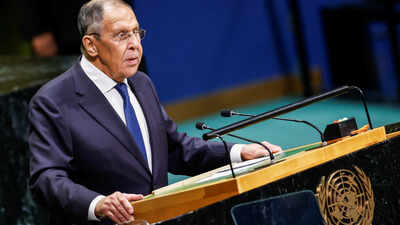
Earlier, he held discussions with Russia and Iran on the sidelines of the high-level UNGA session, days after US President Donald Trump signed a new law providing for sanctions on countries purchasing oil and gas from Moscow and Tehran.Jaishankar met his Russian and Iranian counterparts, with talks covering bilateral ties, cooperation in the Brics grouping and the Gulf conflict.Jaishankar held discussions with Russian foreign minister Sergey Lavrov on bilateral issues and cooperation within Brics