






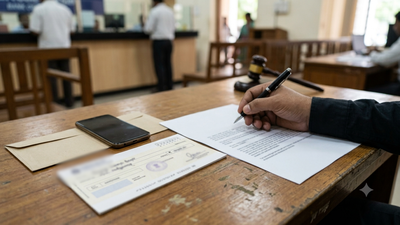
NEW DELHI: A bounced cheque feels like a banking hassle, but legally it can be a criminal offence. Section 138 of the Negotiable Instruments Act, 1881 can turn a dishonoured cheque into a court case and, for some, a jail sentence.What is Section 138?Section 138 deals with a cheque being returned unpaid because there is not enough money in the account or because the amount is more than the arrangement made with the bank.If a person issues a cheque towards a legally enforceable debt and the cheque is returned unpaid for these reasons, the person who issued the cheque can face legal proceedings, but only if the conditions set by law are met.Section 138 was added only in 1988. The original 1881 Act did not have any punishment for cheque bounce.When does a bounced cheque actually become an offence?A bounced cheque does not automatically become an offence.The cheque must have been issued for a genuine debt, presented within its three-month validity period and returned unpaid specifically because there was not enough money in the account or because the amount exceeded the arrangement with the bank.The person receiving the cheque must also follow the legal procedure after the cheque is dishonoured.What must the payee do after the cheque is dishonoured?The payee must send a written demand notice to the person who issued the cheque within 30 days of learning that the cheque was dishonoured.The person who issued the cheque then gets 15 days from receiving the notice to make the payment.If the payment is not made within those 15 days, the right to file a case arises.What if the drawer pays within those 15 days?If the drawer makes the payment within the 15-day period, no offence arises on that basis.The notice is meant to give the drawer an opportunity to make the payment before facing prosecution.How much time does the payee have to file a case, and where?The complaint must be filed within one month from the date on which the right to file the case arises. The court can allow a delay in appropriate cases.The case goes before a Judicial Magistrate First Class. It is filed in the court that has jurisdiction over the bank branch where the cheque was presented for payment.What punishment can follow?A person convicted under Section 138 can face imprisonment of up to two years, a fine of up to twice the cheque amount, or both.The offence is bailable, compoundable and non-cognizable. This means that arrest is not automatic and the matter can be settled.Courts often favour compensation instead of jail, particularly when the drawer offers to make the payment with interest.Can the case be settled before trial?Yes. Section 147 allows the parties to settle the case at any stage, even after a complaint has been filed.Can the complainant get money while the case is pending?Sometimes. Section 143A, added in 2018, allows the trial court to order the drawer to pay interim compensation of up to 20 percent of the cheque amount once the accused pleads not guilty or after charges are framed.This is not automatic. It is up to the court to decide whether such compensation should be ordered. If the drawer is later acquitted, the complainant has to return the amount with interest.What if the cheque was issued by a company?Section 141 extends liability to company officers, but this does not happen automatically.Courts require evidence showing that the dishonour was connected to the specific director’s conduct or consent. For example, a retired director will not be liable for a cheque that bounced after the director had left the company unless their involvement is shown.Does every bounced cheque lead to a conviction?No. The person who filed the complaint must prove all the required elements, and the drawer can raise defences.The law does presume, under Section 139, that a cheque was received towards repayment of a genuine debt. But this presumption can be challenged with evidence, so it does not guarantee a conviction on its own.Can someone be arrested right after a cheque bounces?No. The payee must first complete the notice process and then approach the court. Since the offence is non-cognizable, there is no direct arrest without going through this process.Is this a civil or criminal matter?It is a criminal matter. However, the proceedings also effectively involve recovery of the cheque amount, and courts can consider compensation depending on the stage of the case.What if someone convicted wants to appeal?Section 148 allows the appellate court to require a deposit of at least 20 percent of the fine or compensation as a condition for hearing the appeal.TakeawayDates are particularly important in cheque dishonour cases because the law sets specific time limits for the notice and for filing the complaint.Section 138 does not make every bounced cheque a criminal offence automatically. It applies only when its conditions are met.For payees, the key steps are cheque dishonour, sending the notice within the required time, giving the drawer 15 days to make the payment and filing the complaint within the prescribed time.For drawers, ignoring a notice can lead to prosecution. At the same time, the law allows settlement, recovery and genuine defences during the proceedings.