





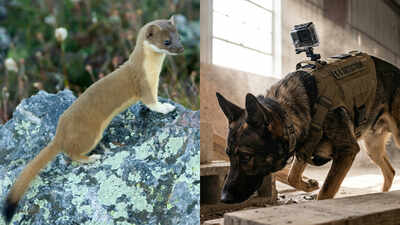
Finding a long-tailed weasel in Georgia’s forests can feel like searching for a needle in a haystack. The small predators are elusive, move quickly and leave little evidence of where they spend their time. For years, that difficulty made it difficult for researchers to determine where the weasels live, how many there are and how their populations are changing. But the change is now happening. According to a report by Phys Org, a new study from the University of Georgia has offered a surprisingly simple way to improve those odds: letting detection dogs lead the cameras to the weasels. The research, published in Wildlife Letters, combined specially trained dogs with remote cameras to track the animals across Georgia. According to experts, the approach improved detection rates and cost a fraction of traditional survey methods. It also helped researchers confirm long-tailed weasels in parts of the state where they had not been documented for decades.
A predator that’s easy to miss
Long-tailed weasels may be small, but they play an important role in forest ecosystems. As efficient hunters, they prey on smaller animals and can contribute to natural pest control. Yet their secretive behaviour has left researchers with surprisingly little information about their ecology and population health in the Southeast. If we go by the report, a camera survey can work well for larger or more common predators, but simply scattering cameras across a landscape is a poor strategy when the animal being sought is exceptionally difficult to detect. According to Phys Org, researchers tested that problem across roughly 30,000 acres of wilderness in North Georgia over the course of a year. The first survey involved 599 cameras placed at randomly selected locations; each camera was monitored for about 300 nights, with researchers retrieving the equipment every two weeks to review the footage and only nine cameras, or about 1.5 percent, captured a weasel.
Let the dogs find the cameras
For the second phase, researchers changed tactics. Instead of deciding where cameras should go based solely on a random sampling design, they brought in detection dogs trained to identify signs associated with weasels. The dogs searched the landscape and alerted researchers to locations where weasels were likely present. Cameras were then installed at 16 of those sites. As per the report, over just 200 nights, the strategically placed cameras recorded 77 weasels. The resulting camera success rate reached 81 percent, compared with 1.5 percent during the random-placement survey. The study highlights roughly a 54-fold increase in the proportion of cameras detecting weasels, while the researchers’ overall assessment described the dog-guided approach as about 33 times more effective for finding the animals. It was also approximately 10 times less expensive than traditional approaches. The study is among the first to successfully validate this combination of detection dogs and targeted camera placement for long-tailed weasels, the report states.
The cameras revealed more than numbers
Once researchers knew where the dogs were finding signs of weasels, the camera footage began filling in some of the gaps in the animals’ natural history. The recordings showed that long-tailed weasels tended to occur near water sources, particularly in areas with dense forest cover or fallen logs. Their activity also appeared to change with the seasons. As per the report, detection rates peaked during April and May, a period when female weasels may be especially active while hunting, storing food, mating and raising young. A smaller increase in activity occurred during autumn, potentially as the animals increased their foraging and built up food reserves before winter.
New discoveries across Georgia
The researchers then took what they had learned in North Georgia and applied the detection-dog-guided camera strategy across 20 wildlife management areas. Using 756 cameras during two survey periods of roughly 120 nights each, they detected weasels in four of five sampled regions. One of the most notable discoveries came from the Southern Coastal Plain, at Dixon Memorial Wildlife Management Area near the Okefenokee Swamp. The survey provided the first documented detection of weasels in that area. Researchers also found a weasel in the Southeastern Plains at Flat Tub Wildlife Management Area near Denton, marking the first detection there in more than 30 years.Images Courtesy: istock