





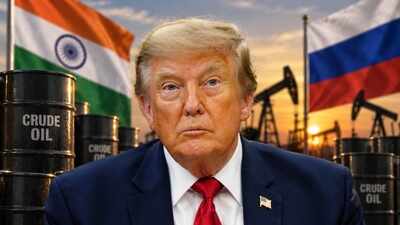
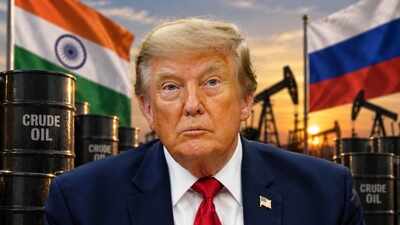
Tariffs, tariffs, and more tariffs – the Donald Trump administration’s favourite economic weapon is back in focus again with the US passing a new bill that allows its president to impose tariffs of up to 100% on countries that are buying Russian crude oil in a big way. That means India is on the list, and so is China.The US House of Representatives on Wednesday approved the “Lindsey O. Graham Sanctioning Russia and Iran Act of 2026”. This legislation will now go to President Donald Trump for his signature.So, will Donald Trump impose 100% tariffs on India for its Russian crude oil buys? What will that mean for India’s exports to the US and its energy security situation amid the Middle East conflict?How important is Russian crude oil to India and will it stop buying it if faced with fresh tariffs from the US?
What the Russia Sanctions Bill is about
Initially introduced over a year-and-half ago, the bill had proposed up to 500% tariffs on major buyers of Russian crude oil. But, that was later brought down to 100%.The House approved the bill by 262 votes to 159. The main aim of the bill is to target Russia’s energy and defence sectors along with its “shadow fleet” of tankers that are used to circumvent existing sanctions. The objective is to restrict Russia’s access to funds that the US claims help support Moscow’s war in Ukraine.This new legislation gives the US President powers to impose up to 100% tariffs on countries like China and India which are major buyers of Russian crude. At present the list of top five importers of Russian energy likely includes China, India, Slovakia, Hungary and Azerbaijan. It also expands sanctions on Iran.The Graham Act had passed the Senate last month with an 86-11 vote, receiving strong backing from both parties.So what does the bill mean for India? Let’s first understand India’s dependence on Russian crude:
How Much Oil Does India Get From Russia?
Back in 2022, Russian oil was a negligible part of India’s crude oil imports. But with the Russia-Ukraine war leading Europe to impose sanctions on crude from Moscow, the oil became available at deep discounts.Since then, Russia’s share in India’s crude imports has steadily climbed up. Russia is the biggest supplier of crude oil for India.Till the end of 2025, Russia accounted for over 30% of India’s crude oil supplies. The Middle East war has deepened this dependence further.According to Global Trade Research Initiative (GTRI), Russia accounted for 30.3 per cent of India’s crude oil imports in FY2026, with supplies worth $40.8 billion out of India’s total crude imports of $134.7 billion.In July 2026, Russian supplies accounted for more than half of India’s imported oil. This is largely due to continued supply disruptions from the Middle East due to the US-Iran conflict.As GTRI notes, other suppliers were far behind. The UAE accounted for 10.8% of India’s July imports, Saudi Arabia 9.6%, Venezuela 6.3%, Brazil 5.5%, Oman 5.3% and the US 2.9%. Russia alone supplied more crude than these six countries combined.In fact, experts see Russian crude oil as a central part of India’s crude oil and energy security strategy. But will that change if the Trump administration imposes 100% tariffs?
Is 100% Tariff Imminent? What It Would Mean For Trade
The important thing to understand is that the bill gives the US President power to impose tariffs of up to 100%. The decision on whether to impose tariffs, and in what quantity, lies with Trump.Experts believe that the Trump administration may choose not to needle delicate ties with China, which is the largest buying of Russian crude. In the case of India however, there is a precedent from last year, when Trump imposed 25% penal tariffs on Indian exports for the country’s continued purchases of Russian oil.GTRI founder Ajay Srivastava sees high stakes for India with the passage of this bill“The bill is a blunt and dangerous attempt to pressurize India to sign BTA on one sided terms. India buys Russian oil to secure affordable energy for 1.4 billion people, not to finance war, and these purchases have helped stabilise global supplies and prices,” says Ajay Srivastava.He believes that if tariffs of up to 100% are indeed imposed by the Trump administration, they would not only end up punishing Indian exporters and American consumers, but also disrupt trade and give the US president excessive power over major partners.“Washington should pursue diplomacy and stable energy markets, not threaten a strategic partner for protecting its legitimate economic interests,” he says.“The actual impact of new tariffs on Indian exports can be assessed only after the US announces the tariff rates, product coverage and implementation timetable,” he adds.India has already faced 50% US tariffs for several months since last year, till the rate was brought down to 18% earlier this year, and now stands at 10% following US Supreme Court’s decision to strike down reciprocal tariffs.And, while India’s exports basket has been diversified, with several free trade agreements opening up new markets, the US remains an important trading partner and any export hit would have an impact on India.Ajay Srivastava also points to another nuance: China buys more Russian crude than India, but Washington will put greater pressure on New Delhi as it may fear retaliation by China.“The new US Act turns sanctions into a trade weapon against India. Washington will now threaten tariffs of up to 100% and then offer a lower rate if New Delhi cuts Russian oil purchases and accepts concessions under a deeply unequal bilateral trade agreement. India should not trade away its energy security for temporary tariff relief. Neither signing a trade agreement nor stopping Russian oil purchases can protect it from future US action under Section 301, sectoral measures or other trade laws. India should continue buying Russian oil as long as it remains commercially competitive and negotiate firmly with Washington without granting unilateral trade concessions,” GTRI’s Srivastava says.
Will India stop buying Russian Crude?
The problem is further exacerbated by the fact that India’s other big oil suppliers are currently hit due to the Middle East conflict. The Strait of Hormuz continues to be blocked and now with the Houthis attacking Saudi Arabia’s key pipeline, alternative oil supplies have also been hit.India’s crude oil procurement is diversified with over 40 countries in it. However, Russia and Middle East countries continue to be the mainstay in the oil security picture.Experts don’t see Russian crude oil disappearing from India’s crude oil supplies anytime soon. Multiple reasons support this view: India did not stop buying Russian crude oil when faced with penal tariffs last year.It was only when the Trump administration imposed sanctions on Lukoil and Rosneft – two of the major Russian oil firms – did Indian refiners scale back on purchases.The logic was simple: tariffs worked as a less effective economic weapon for the US than sanctions since the latter makes trading economically unviable.In the first two months of 2026, India’s Russian crude oil purchases saw a significant dip. Announcing reduced 18% tariffs on India, Trump claimed that India would stop buying Russian oil. But in March the US-Iran war began and the global oil markets went into a spin.Faced with Middle East supply disruptions, India aggressively stepped up Russian crude oil purchases. The US even waived sanctions on Russian crude to stabilise global oil prices. But despite that waiver lapsing, India has continued to procure oil from Russia. In fact, Russian crude oil purchases hit an all-time high in July.The message is clear: energy security at any cost assumes priority for India at the current juncture.Sumit Ritolia, Lead analyst, Modelling and Refining at Kpler told TOI earlier that Russian crude is India’s best hedge against global supply disruptions. “Beyond attractive economics, it has provided reliable supply security despite fluctuations in discounts,” Ritolia told TOI earlier.Hence, he believes Indian refiners are unlikely to immediately walk away from Russian supplies unless sanctions create significant problems for shipping, insurance or payment arrangements.But once supply bottlenecks from the Middle East ease, it would be easier for India to reduce its dependence on Russian crude oil.Until then, experts say, tariffs or no tariffs, Russian oil is unlikely to disappear from India’s crude mix soon.