





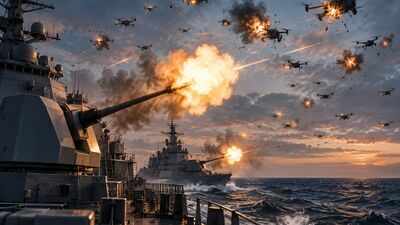
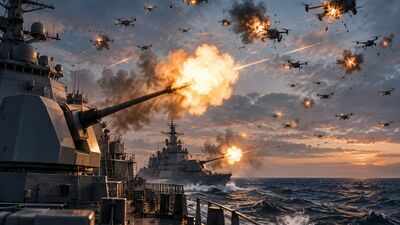
Chinese naval researchers are studying whether high-calibre naval guns could offer warships a low-cost way to counter drone swarms, potentially reviving the role of a weapon long associated with the battleship era.According to the South China Morning Post, a team led by Wang Lei of the People’s Liberation Army Dalian Naval Academy has proposed using prefabricated-fragmentation shells that explode near a drone swarm, releasing a cloud of high-speed fragments.The concept would not require the shell to strike individual drones directly. Instead, it would create a wider lethal zone around the swarm, increasing the chances of hitting multiple targets with a single round.The research comes as US President Donald Trump’s proposed Trump-class battleship puts heavily armed surface warships back in the spotlight. The US Navy describes the vessel as a 30,000–40,000-tonne large surface combatant equipped with missiles, hypersonic weapons, electromagnetic rail guns, high-powered lasers and conventional naval guns.The latest Congressional Budget Office assessment puts the planned ship at about 35,000 tonnes. It is expected to carry 128 Mk 41 vertical launch cells, one rail gun, two high-powered lasers and two 5-inch (127 mm) guns.China sees a new role for big guns in the drone ageThe Chinese researchers’ proposal is built around a simple problem: modern warships could face attacks involving large numbers of inexpensive drones arriving simultaneously. Using expensive surface-to-air missiles against individual drones could quickly deplete a ship’s limited supply of interceptors, creating an unfavourable cost exchange for the defender.High-calibre guns could offer another layer of defence. Rather than treating every drone as a separate target, a warship could fire fragmentation shells into the path of a swarm, creating a broad zone filled with high-speed fragments. A single round could therefore have the potential to damage or destroy several drones.The approach could be particularly useful against dense drone formations, where multiple targets are concentrated within a relatively small area. In this role, gun-based interception would complement, rather than replace, a warship’s existing missile-based air-defence systems.The Chinese research points to a possible new role for a weapon once regarded as a defining feature of the battleship era. As drone swarms make naval warfare increasingly dependent on the ability to defeat large numbers of cheap targets, high-calibre guns could give warships a more affordable form of area-based defensive firepower.