









US President Donald Trump may not be able to get the Russia sanctions bill passed in the House of Representatives before November, a development that would give India a breather from the possibility of up to 100% tariffs for its crude oil purchases from Moscow.The bill that received overwhelming support in the US Senate last month is facing increasing resistance in the House of Representatives and could remain stuck there until at least the November elections, according to a Bloomberg report.Lawmakers are concerned that the legislation could give President Donald Trump broader authority to impose tariffs and potentially push oil prices higher.
The Russia Sanctions Bill
The opposition emerging among lawmakers from both parties is a boost for the retail sector and the influential business group US Chamber of Commerce. Both have raised concerns that the legislation could provide the Trump administration with additional legal grounds to impose tariffs on a much wider scale.The legislation was introduced by the late South Carolina Senator Lindsey Graham, a strong supporter of Ukraine. It would allow Trump to impose tariffs of 100% on the five biggest buyers of Russian crude oil and natural gas, along with the five leading countries helping Russia circumvent energy sanctions. China, India and Turkey are currently the biggest buyers of Russian petroleum products.
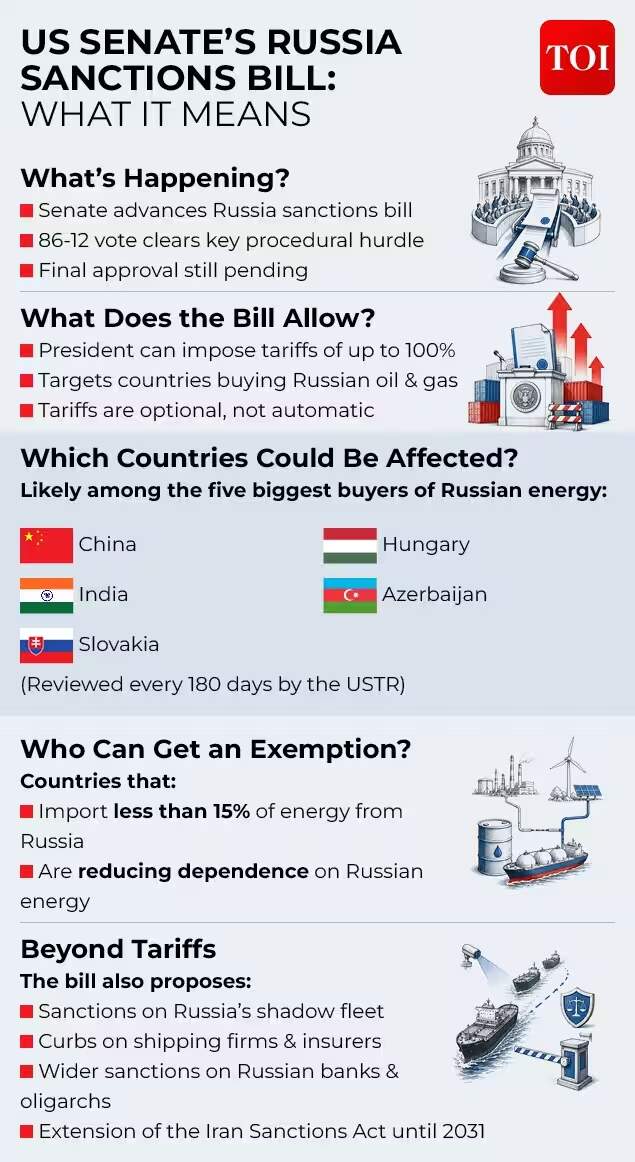
Russia Sanctions Bill: What it means
Supporters of Ukraine in Washington have been advocating the bill as a means of demonstrating continued US backing for Kyiv. However, uncertainty remains over whether Trump would make use of the additional powers provided by the legislation, particularly when it comes to China, the Bloomberg report said.The Senate approved the sanctions bill by a sweeping 86-11 vote. The strong backing was partly seen as a way for Graham’s fellow senators to pay tribute to him following his sudden death in July, shortly after he returned from a trip to Ukraine. The legislation has received a much less enthusiastic response in the House.House Speaker Mike Johnson on Thursday indicated that the bill may not even be brought to the floor for a vote before the November 3 midterm congressional elections. One reason, he said, is that lawmakers are scheduled to spend only a limited number of days working in Washington over the next two months.Johnson also pointed to opposition from the senior Democrats on the foreign affairs and tax-writing committees, saying this could signal wider problems in securing Democratic support. He added that there are also “pockets” of unease among House Republicans.“We all believe in sanctioning Russia, but you have to have the right formula if you are passing a bill,” he told reporters Thursday. “We’re trying to work through that and make sure we can get a product that can get across the line.”
US oil prices in focus
House Foreign Affairs Committee Chairman Brian Mast said lawmakers are examining the bill partly to determine how it could affect gas prices. Mast, a Florida Republican, said forcing India and other purchasers of Russian crude to seek oil from alternative suppliers could put upward pressure on prices.“That is part of what’s being evaluated right now,” he said.Gasoline prices have surged following the Iran war and are increasingly seen as a potential liability for Republicans ahead of the November midterm elections, when the party will seek to retain its majorities in Congress. The legislation would also continue longstanding sanctions against Iran.Democrats, meanwhile, are concerned that Trump could rely on the legislation as an additional legal basis for imposing broad tariffs, at a time when his existing tariff measures are already being challenged in court.Representative Gregory Meeks, the senior Democrat on the House Foreign Affairs Committee, said he could not back legislation that would give the president tariff powers “that he doesn’t have.” He also objected to a provision in the Senate-approved bill that would allow Trump to waive sanctions, arguing that the provision weakens the measure.Representative Brad Schneider, another Democrat on the committee, also said the tariff provision could not be accepted.“I’m not prepared to give any president, but in particular this president, more unfettered authority over tariffs,” he said.If Johnson seeks to move the bill through an expedited House procedure, he would need substantial Democratic backing because the process requires a two-thirds majority. The speaker has recently found it difficult to get legislation approved through the regular process, as his narrow majority has left him vulnerable to opposition from members of his own party.Business groups have also raised objections to the legislation. In August, a broad group of business lobbyists, including the Retail Industry Leaders Association, wrote to Congress outlining their concerns. The US Chamber of Commerce and the National Foreign Trade Council also joined the group. The latter represents trade-dependent companies including ExxonMobil Holdings Corp., General Electric Co., Ford Motor Co., and Pfizer Inc.“We continue to remain concerned that a piece of the bill could have unintended consequences for consumers by authorizing new, expansive tariffs on other countries, who are our trading partners and allies,” Ellen Jackson, director of government affairs at the Retail Industry Leaders Association, said in a statement.
What it means for India
India’s reliance on Russian crude has increased sharply and is at record levels. Russia was not traditionally a major source of crude for India, but that changed after Moscow’s war with Ukraine began. As European buyers moved away from Russian oil, large volumes became available to India at steep discounts.Russian oil shipments to India have risen consistently since 2022, with Russia accounting for more than 30% of India’s total crude imports for more than three years. The trend changed only in early 2026, when India’s purchases from Russia declined following the US sanctions imposed on Russian oil majors Lukoil and Rosneft.However, that decline did not establish a lasting trend. The US-Iran war subsequently disrupted access to Middle Eastern oil, prompting India to increase its purchases from Russia. The US also temporarily waived sanctions on Russian crude during this period. Although that waiver has now expired, Indian refiners have continued buying Russian oil in substantial quantities, with imports reaching record levels in recent months.Experts say Russian crude has effectively become the foundation of India’s crude procurement strategy.Russia accounted for approximately 55% of India’s crude imports in July, its highest-ever share since India began making large-scale purchases of Russian oil after the Ukraine conflict. Russian crude continues to play an important role for India from the perspectives of both energy security and refinery economics.India does, however, have a relatively diversified crude import basket, with more than 40 countries available as suppliers. It has also recently increased its purchases from Venezuela.If Russian crude becomes commercially unviable, experts believe India could raise imports from Iraq, Saudi Arabia, the UAE, the US, West Africa, Brazil and Guyana.But replacing the entire volume supplied by Russia would not be easy under current market conditions.Experts view the Bill primarily as a tool to put pressure on countries continuing to purchase Russian oil.