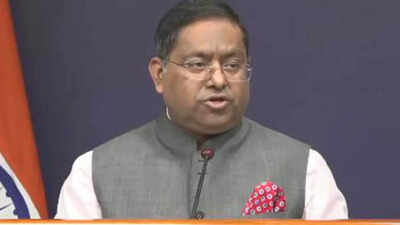






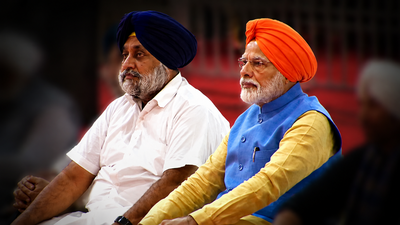
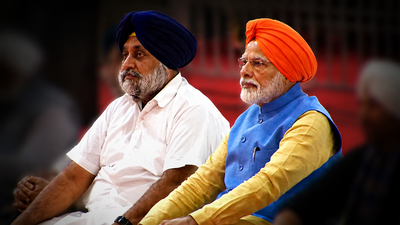
Is the BJP playing hardball with the Akalis in Punjab? Yet another senior BJP leader has announced that the party will contest all 117 assembly seats in Punjab on its own strength.BJP national general secretary Satish Poonia, in his first media interaction after being appointed the party’s organisational in-charge for Punjab, made it clear that the message from the central leadership was to prepare for all 117 constituencies in the state. He also sought to play down Shiromani Akali Dal chief Sukhbir Singh Badal’s meeting with Prime Minister Narendra Modi last month, saying meetings between political leaders should not automatically be read as signs of an alliance.Poonia is not the first senior BJP leader to reiterate the ‘solo contest’ point.BJP national general secretary (organisation) BL Santosh had earlier told party functionaries in Punjab that the BJP would contest all 117 assembly seats independently.
BJP national general secretary (organisation) BL Santosh reiterated that the party is preparing to contest all 117 Punjab assembly seats.
And yet, the speculation of an alliance between the two parties refuses to go away.The question then is whether the BJP is really shutting the door on its old ally or raising the bar before any possible deal.
BJP’s message: We can do it alone
The BJP today has reasons to sound more confident than it did when both parties went their separate ways.The BJP in Punjab was the junior partner of the Akalis for decades. The arrangement gave the BJP a share of Punjab’s urban and Hindu-dominated constituencies while the SAD remained the dominant force in the alliance.In the 2017 assembly election, the last Punjab polls the two parties contested together, the SAD fought 94 seats and the BJP just 23. The BJP won three and the Akalis 15.This arrangement will clearly no longer work for the BJP.Since splitting with the Akalis, the BJP has been working towards a plan. The party has been trying to expand beyond its old pockets in Punjab, in line with its national growth, and build an independent base. The West Bengal victory has indeed strengthened the confidence within the party. Punjab BJP leaders have also publicly argued that the party’s improved vote share and national presence have strengthened the case for fighting the elections independently.That makes the repeated declaration of contesting 117 seats more than just a message to the Akalis. It is also a message to BJP workers that the party intends to build its own organisation across Punjab.
But the doors don’t seem completely shut
Interestingly, even in the middle of this high-pitched rhetoric, the Student Organisation of India (SOI), which is the students’ wing of the Shiromani Akali Dal, extended support to the Akhil Bharatiya Vidyarthi Parishad (ABVP) candidate in the Panjab University Campus Students’ Council elections and helped its candidate win the presidential post.The SOI offered this olive branch to BJP’s student wing a day before the voting and helped ABVP create a record of winning the top post in the students’ council election for the second time in a row.This campus politics bonhomie was significant messaging. The Akalis, who had walked away from the decades-old alliance with the BJP in 2020 over the now-repealed farm bills, have dropped very clear and open hints that they desperately want to revive the ties.There have been a series of overtures from their end to seek an alliance without expressing that in as many words.
Akalis have not been subtle about wanting BJP back
If the BJP is keeping its cards close to its chest, the Akalis have been far more open about it.The PM Modi-Sukhbir Badal meeting was perhaps the beginning of this outreach. It was their first one-on-one political meeting since the SAD walked out of the BJP-led NDA in 2020 over the three farm laws, ending an alliance that had lasted nearly two decades.Days after this meeting, the SAD reversed its stand on the Delimitation Bill and announced its support for the constitutional amendment bill which the BJP is trying to pass in Parliament. This was a huge U-turn that prompted digs from the ruling AAP and the Congress over the SAD’s desperation for an alliance with the BJP.The shift in stance drew attention because the party had earlier taken a much more critical position on delimitation. The SAD had in April stated in Lok Sabha that the BJP was repeatedly changing the goal post on women’s reservation and decried that the delimitation exercise was being conducted in the garb of the Women’s Reservation Bill.Then came more signals from within the Akali leadership.Senior Akali leader Bikram Singh Majithia went public advocating an alliance, and said that people want SAD and the BJP to come together for peace, development and progress of Punjab.Majithia’s statement came after his sister and former Union minister Harsimrat Kaur Badal stoked fresh speculation about a re-alliance between the Akali Dal and the BJP by expressing a cryptic wish for “agreements” that carried progress to Punjab from Delhi.
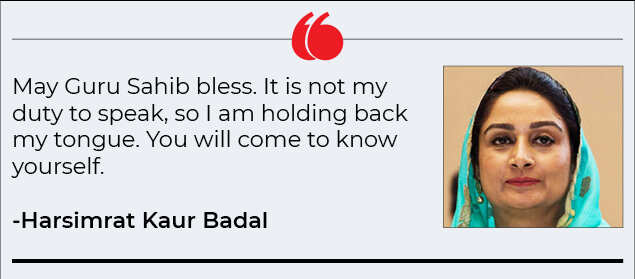
Former Union minister Harsimrat Kaur Badal’s remarks added to speculation over a possible revival of ties.
None of these statements amounted to a formal alliance proposal. However, they made it clear that the Akali leadership was increasingly interested in reviving ties with the BJP.
Akalis need BJP more than before
The reason is not difficult to see. The Akalis have been pushed to the fringes of Punjab politics.Its vote share and seat share have declined in the last few elections. In fact, in the 2024 Lok Sabha elections, the BJP managed a huge lead over SAD in terms of vote share.The BJP secured 18.56% of the votes but failed to win a parliamentary seat in Punjab. The Akali Dal, despite winning Bathinda, finished with 13.42% vote share.The BJP also finished ahead of SAD candidates across several constituencies and led in 24 assembly segments. In the 2022 assembly polls, by comparison, the BJP’s vote share was only around 6.6%, while SAD was a little over 18%.That perhaps explains why the Akalis seem desperate for an alliance. Punjab chief minister Bhagwant Mann has claimed that the Shiromani Akali Dal leadership is “on its knees” to forge an alliance with the BJP and return to power in the state to “loot” it again.
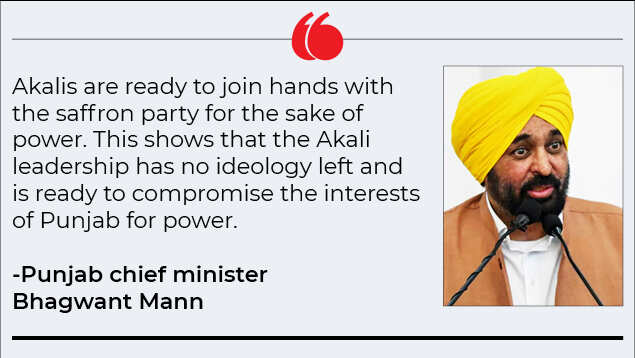
Punjab chief minister Bhagwant Mann accused the Akali Dal of seeking a reunion with the BJP for political power.
So, the big question is: why is the BJP acting tough? Is it against reviving the alliance with the Akalis? Or is the BJP just playing hardball to ensure that it is the “big brother” in any future alliance?For the Akalis, the decline has been much more painful.Akalis, who dominated Punjab politics for years, were reduced to three seats in the 2022 assembly election and one Lok Sabha seat in 2024. Now, the party has to compete not only with the Congress but also with AAP, which swept the last state election, and also a BJP trying to expand independently.That perhaps explains the urgency.
Why BJP may have kept the door open
When BJP and SAD were in alliance earlier, there was little ambiguity about who was the senior partner.The SAD had more seats and more say in deciding the assembly seats and the chief ministerial candidate. The BJP accepted most terms because the arrangement perhaps gave the BJP a space where its independent visibility was limited.But now, if there is an alliance between the two again, it surely will be on completely different terms.The BJP has spent the years since the split trying to build an identity of its own in Punjab. It has brought leaders from other parties into its fold, expanded its organisation and fielded candidates across the entire state in the 2024 Lok Sabha election.Even in recent weeks, it has continued inducting figures from outside the party as it prepares for the assembly contest.For the BJP, therefore, returning to an arrangement in which it simply receives around 20-odd seats would be difficult. This is perhaps where the bargaining may be happening. Therefore, the real question might just be if the Akalis are willing to accept the changed political reality.There is another reason why the BJP may be keeping the Akalis guessing.Declaring an alliance too early could derail BJP’s bid to strengthen its organisation in the state build an independent identity. Keeping the 117-seat option alive allows the BJP to continue expanding and encouraging its cadres.The BJP knows the Akalis are willing to return. There is little reason for the BJP to make any commitment before discussing seats and leadership.The public posturing notwithstanding, the BJP also stands to gain from a possible alliance. The BJP’s 18.56% vote share in the Lok Sabha election did not translate into a single seat. This shows that the party did expand its base, but that vote share by itself may not be enough.The Akalis, meanwhile, still have traditional pockets of support. That gives both sides something the other may want.
But does BJP actually need the Akalis?
Fighting independently gives it the freedom to contest every region, develop new leaders and try to move beyond its traditional urban base. Even an election in which it improves substantially without forming the government could further that objective. An alliance with SAD could interrupt that process.Also, the Sikh community’s identity continues to play an important role in Punjab politics. For the BJP, a renewed alliance with the Akali Dal could help it reach sections of Sikh voters and rural Punjab where the party has traditionally struggled to build a strong independent base.For now, the two sides appear to be speaking in very different registers.The Akalis have repeatedly sent signals that they are willing to reopen the relationship. The BJP is listening but not reacting. For now, all BJP leaders are maintaining that the party is preparing for all 117 seats.
Share your thoughts in the comments
Be respectful · TOI community guidelines
Yet the Modi-Sukhbir meeting, the SOI-ABVP cooperation and reports of discussions behind the scenes mean the possibility of an alliance cannot be written off either.It is possible that the BJP means exactly what it says and will go into the election alone. But if the two former allies do eventually come together, it is unlikely to be a return to the partnership that existed before 2020.The fight, therefore, may not just be about whether BJP and SAD become allies again. It may be about who gets to be the ‘big brother’ this time.