







Sugar is leaving a bitter aftertaste in consumers’ household budgets.The all-India average retail price has climbed to Rs 64.24 a kilo, nearly 30% higher than a month ago and 38.63% above last year’s level. In some markets, the sting is even sharper, with consumers paying as much as Rs 70 a kilo for the everyday sweetener.So, what made the humble ‘cheeni’ costlier? The classic case of less supply meeting more demand.India’s sugar production for the 2025-26 season is now estimated at around 306 lakh metric tonnes (LMT), nearly 11% below the initial projection of 343 LMT made by sugarcane-growing states. Crop damage in key growing areas contributed to the shortfall, with diseases such as Red Rot and Top Borer, along with waterlogging caused by excess rainfall, hurting sugarcane output.That tighter supply cushion came just as demand was getting a festive boost. As the country gears up for a string of festivals, households, sweet shops and food businesses are stocking up on sugar, adding pressure to supplies.The global market has added to the nerves. International sugar prices have climbed more than 16% in less than two months amid tighter global supplies. In India, concerns about future availability, along with reports of hoarding and speculation by some traders and mills, added further heat to prices.The government has since stepped in, allowing 10 lakh tonnes of raw sugar to be imported duty-free and tightening stock limits to curb hoarding.But here is the curious bit: the imported sugar has not yet reached India, yet prices at the mill gate have already fallen sharply.
What is making sugar sweet again?
The biggest correction has happened at the mill gate, the price at which sugar leaves the factory.Ex-mill prices had jumped from around Rs 47-48 per kg to Rs 62-67 per kg within just 7-10 days. Food secretary Sanjeev Chopra called the rise “unjustified”, saying it was largely driven by mills raising prices and restricting the release of stocks.Prices have since fallen nearly 20% to around Rs 55 per kg, Chopra said. The National Federation of Cooperative Sugar Factories (NFCSF) also said ex-mill prices were now at Rs 55 per kg or lower across the country.So, what changed when the imported sugar was still nowhere in sight?In short, the market got the promise of more sugar before it got the sugar itself.The Centre allowed 10 lakh tonnes, or 1 million tonnes, of raw sugar to be imported duty-free under the Tariff Rate Quota (TRQ) system, with imports allowed until October 31, 2026. The move eased fears of a supply crunch in the months ahead.
Government takes measures to ease sugar supplies
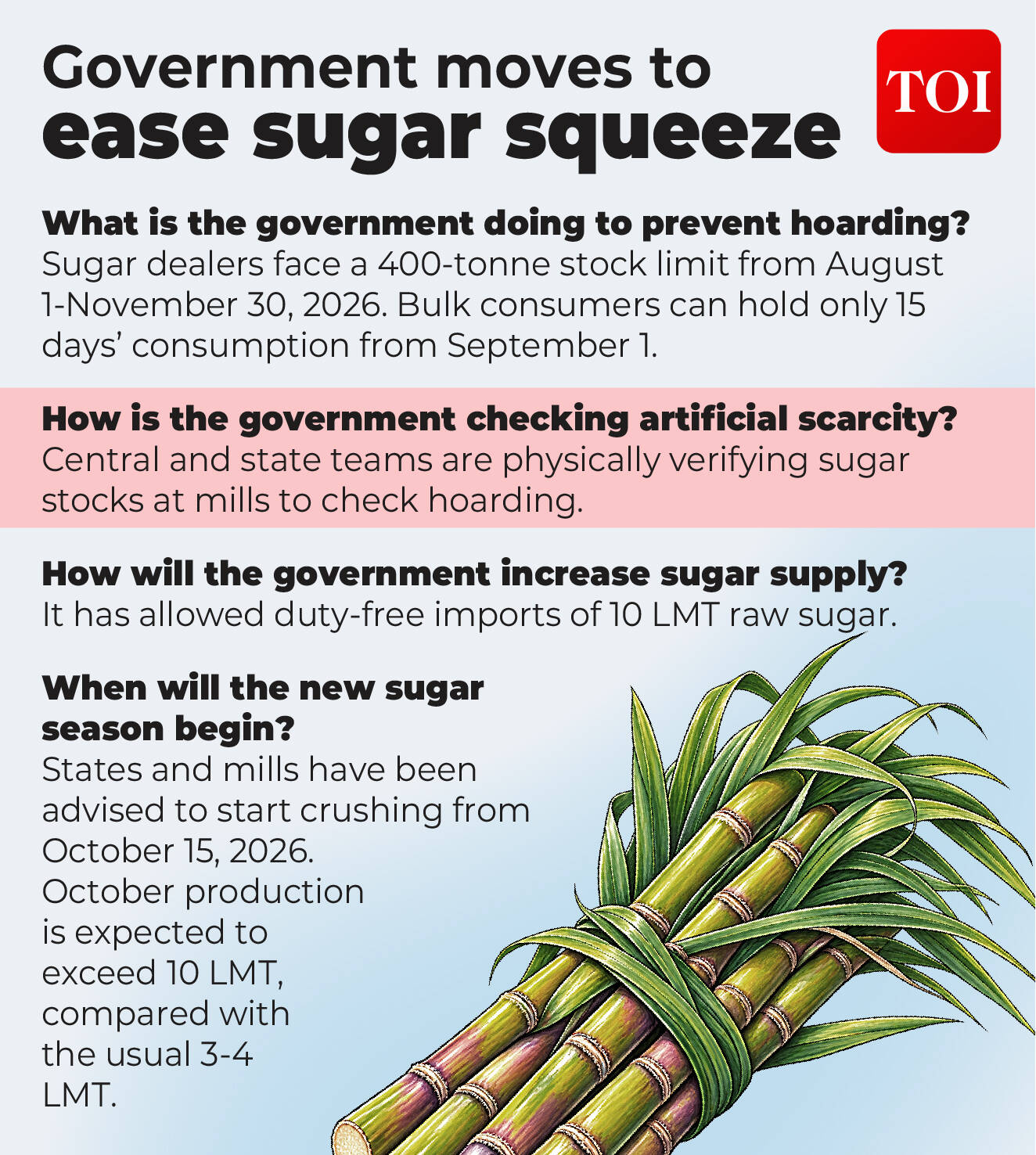
The Directorate General of Foreign Trade invited applications from sugar mills and refiners with their own functional facilities to turn raw sugar into white or refined sugar. The application window was open from August 21 to August 28. Applicants had to provide details of their refining capacity and supporting documents, including consent to operate from the state pollution control board. Importers committing to complete shipments by October 15 were given preference.The announcement changed the market mood. Traders and mills that had been betting on tighter supplies suddenly had to factor in the possibility of another 10 lakh tonnes entering the market.Markets often react to expectations before the actual commodity arrives, and sugar was no different.At the same time, the government tightened stock limits for bulk consumers and stepped up inspections to check hoarding and speculation. “Flying squads” were deployed across the country to inspect stocks, NFCSF managing director Prakash Naiknavare said.The government’s physical verification also found cases where some mills were holding more sugar than they had declared in their monthly returns. Some were also accused of “short selling,” selling less sugar than the quantity allocated to them under the monthly quota.The idea was simple: keep the sugar already available in the country moving, while keeping the door open for fresh supplies.
Myth vs Fact behind the sugar price rise
Why is sugar still expensive for shoppers?
The problem is that the correction at the mill gate has not yet travelled all the way to the retail shelf.According to the consumer affairs ministry, the average wholesale price was Rs 58.29 per kg on August 24, while the average retail price was Rs 63.05 per kg.By August 30, the average retail price had risen to Rs 64.24 per kg, from Rs 63.12 a week earlier. It was still around 30% higher than a month ago and 38.63% above its year-ago level. The wholesale average stood at Rs 59.73 per kg, up from Rs 58.66 a week earlier.Prices also varied sharply across cities. Sugar was selling at around Rs 62 per kg in Delhi, Rs 66 in Mumbai, Rs 63 in Chennai and Rs 68 in Ranchi. The maximum reported retail price was Rs 74 per kg, while the minimum was Rs 40.There is normally a Rs 2-3 per kg gap between ex-mill and wholesale prices, while retail prices are generally Rs 7-8 higher than ex-mill rates, Naiknavare said.That helps explain why consumers have not yet seen the full benefit of the mill-level correction. Sugar bought by wholesalers and retailers at earlier, higher prices can remain in the supply chain even after mills begin cutting rates.So, for now, sugar is cheaper at the factory gate, but the discount is still taking its sweet time to reach the shopping basket.
Was there really a sugar shortage?
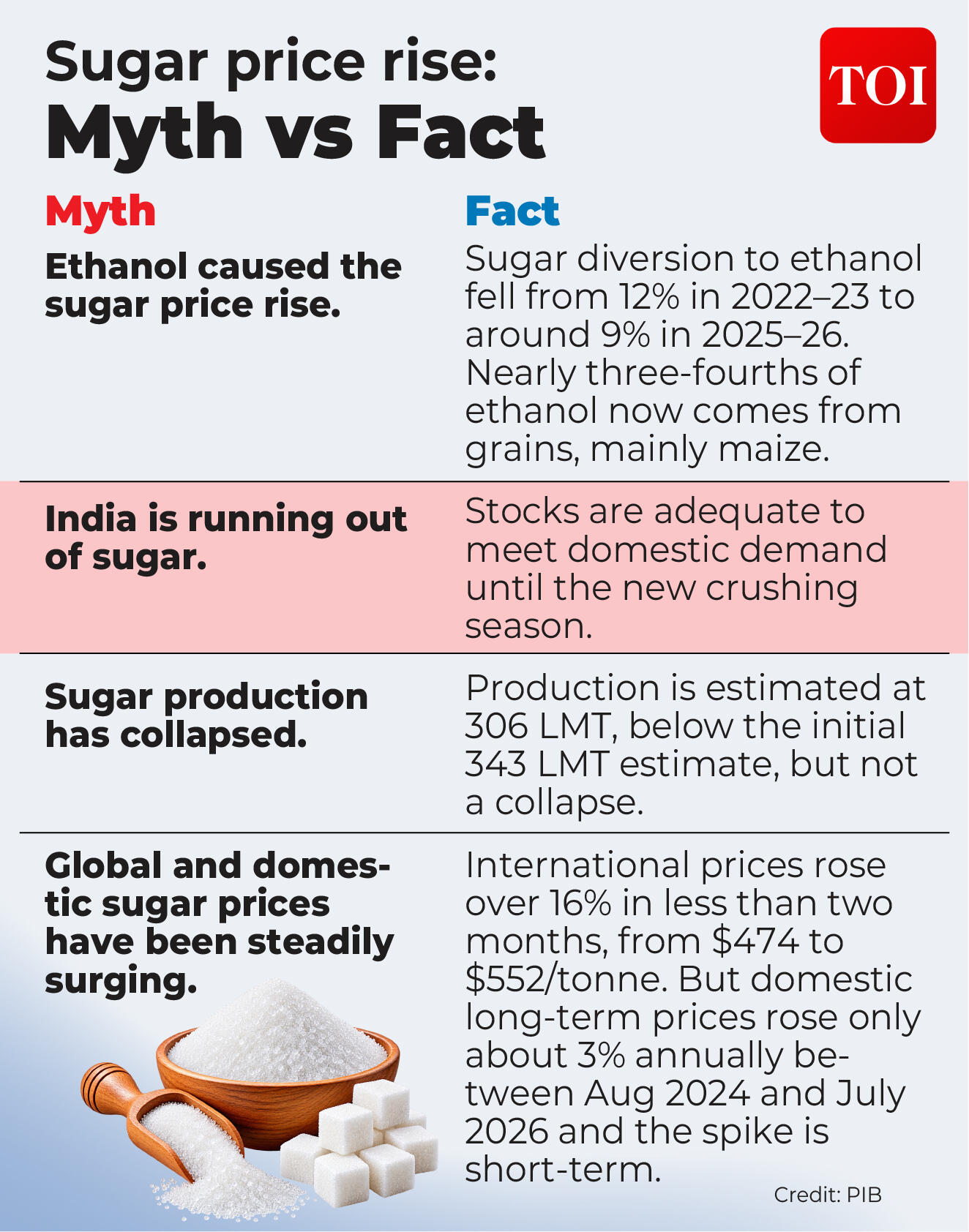
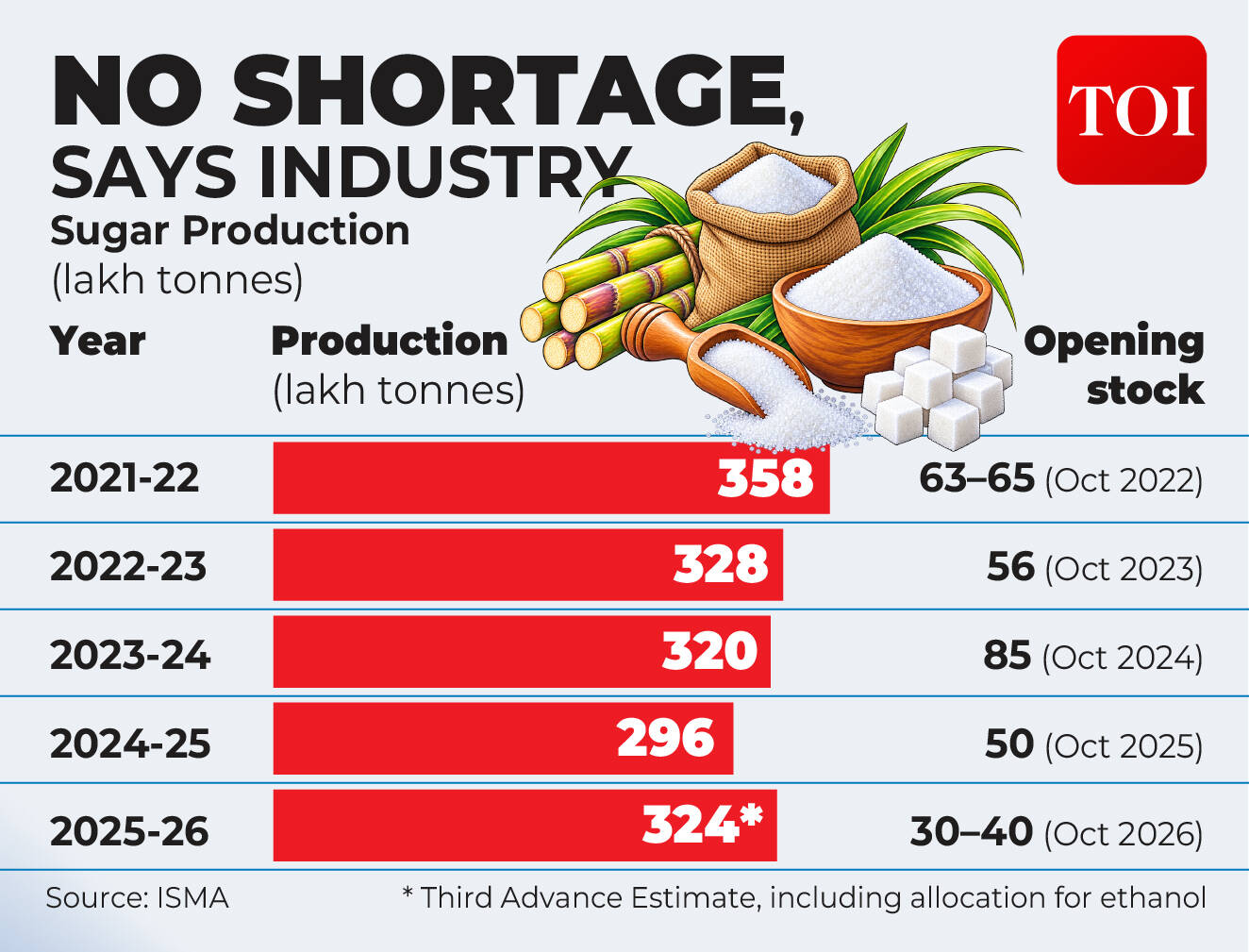
This is where the government and industry draw an important distinction.India’s sugar production for the 2025-26 season is estimated at 306 lakh tonnes, down sharply from the earlier estimate of 343 lakh tonnes. Red Rot and Top Borer diseases, along with waterlogging caused by excess rainfall, affected sugarcane output.
Is India running out of sugar?
But annual domestic consumption is estimated at around 280-285 lakh tonnes. According to Chopra, this means that India has enough sugar stocks to meet its requirements and that the recent price surge was not caused by an outright shortage.The industry, however, points to a much tighter supply cushion.The season began with around 47-50 lakh tonnes of opening stocks. Estimates for stocks that will be carried into the next season vary: some industry estimates put them at 40-42 lakh tonnes, while some researchers expect only 32-35 lakh tonnes.The Indian Sugar & Bio-energy Manufacturers Association (ISMA) estimates net sugar production at around 279 lakh tonnes. Taking opening stocks of about 50 lakh tonnes and around 8 lakh tonnes exported before export restrictions, it expects closing stocks of around 35 lakh tonnes.The festive season has added another layer of pressure. Demand typically rises from August to November as households, sweet shops and food companies stock up for Ganesh Chaturthi, Dussehra and Diwali.Global markets have added to the nervousness too. International sugar prices climbed from around $474 per tonne on June 30 to $552 per tonne on August 20, a rise of more than 16% in less than two months. The government expects a global sugar deficit of around 33 lakh tonnes in 2026-27.But global tightness, lower domestic production and festive demand do not, according to the government and industry, fully explain the sharp domestic price jump. Panic buying, speculation, hoarding and slower release of stocks also played a role.ISMA director general Deepak Ballani said the earlier rise was largely driven by panic and speculative buying rather than a physical shortage. ISMA expects prices to soften further as speculative buying eases.“Over the last few days, ex-mill sugar prices have declined by nearly 20%, and we expect this reduction to be reflected in retail prices very soon. There is adequate availability of sugar in the country, and consumers will get the commodity at reasonable prices during the forthcoming festive season,” he told TOI.
The next sweetener: Domestic sugar supply
The government is also pushing mills to keep sugar moving instead of letting stocks sit in warehouses.From September, the monthly quota system will shift to fortnightly allocations. Mills must sell at least 40% of their quota in the first week and the rest in the following week. They have also been told to dispatch sugar within seven days of sale. Bulk consumers will face tighter stock limits from September 1, while states have been asked to step up checks against hoarding.The next major supply boost could come from the new domestic crushing season. The government has asked mills to start crushing around October 15 and expects more than 10 lakh tonnes of sugar to be produced in October, against the usual 3-4 lakh tonnes, followed by around 45 lakh tonnes in November.Early crushing could add 10-12 lakh tonnes in October, while some mills in Karnataka and Maharashtra could produce around 2 lakh tonnes in September. Mills have also been allowed to sell October production without restrictions so that fresh supplies reach the market quickly.
Sugarcane FRP over the years: 2015–2026
Crisil Intelligence expects sugar prices to remain firm in the near term, but has cut its forecast for the 2025-26 price rise to around 7% from 9% earlier. The 10 lakh tonnes of additional imports are expected to lift closing stocks to about 4.9 million tonnes from an estimated 3.9 million tonnes, taking stock cover from around one-and-a-half months to nearly two months of consumption.
Bottom line — Behind the sugar rush
The sugar spike is not quite a simple case of India running out of sugar.Lower production, tighter stocks, festive demand and worries over future supplies created the pressure, while hoarding and speculative buying added fuel to the fire. The government’s response, from duty-free imports and stock limits to inspections and faster movement of existing stocks, has already cooled prices at the mill gate, even before imported sugar has arrived.For consumers, however, the relief is still some distance away. Retail prices remain elevated as the correction works its way through the supply chain, while the next crushing season and additional imports are expected to improve availability.In short, the sugar rush may be losing steam, but it could take a little longer before the sweeter prices reach the household kitchen.