







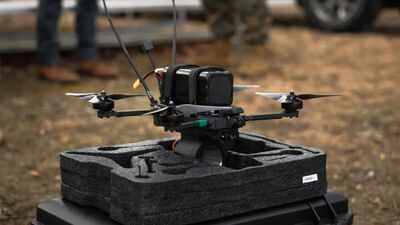
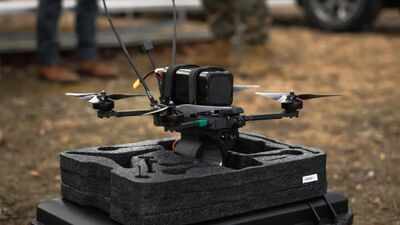
The US Marine Corps is planning to redesign its infantry force for future wars dominated by drones, with a new roadmap calling for greater use of unmanned systems, counter-drone weapons, electronic warfare and precision fires at the small-unit level.The plan, called Ground Combat Element 2040, aims to make Marine ground units more capable of fighting on a battlefield saturated with enemy drones, sensors and surveillance systems.According to The War Zone (TWZ), the Marine Corps plans to push these capabilities down to the rifle-squad level. The approach would give small units their own counter-drone systems, drones and longer-range precision-strike capabilities, reducing their dependence on larger formations for some battlefield tasks.The Marine Corps’ modernisation plan will be implemented in three overlapping phases. The first, covering 2026 to 2030, will focus on accelerating ongoing force-design reforms, addressing the immediate threat posed by drones and laying the groundwork for future investments.From 2031 to 2035, the Marines plan to expand the use of AI, autonomous systems and unmanned formations while strengthening layered counter-drone capabilities. By 2036-2040, the force is expected to move towards AI-enabled command and control, human-machine teaming and more dispersed, resilient formations with greater combat power at lower levels.The plan draws heavily on lessons from the Russia-Ukraine war, where drones have become a persistent threat to troops, armoured vehicles and other battlefield assets. Russian and Ukrainian forces are deploying large numbers of drones to create increasingly dangerous zones for ground troops, making protection against small unmanned systems a critical challenge for frontline units.The war in Ukraine has also demonstrated how rapidly drone technology is evolving, with newer systems increasingly capable of striking targets well beyond the immediate frontline. The experience is therefore forcing militaries to rethink not only how they use drones, but also how infantry units operate and survive while under near-constant surveillance and attack.What India is doing to build its drone-warfare capabilitiesThe lessons from Ukraine are not limited to the US. India, too, is moving to integrate drones more deeply into its ground forces, with the Army building unmanned capabilities across combat formations rather than keeping them confined to specialised units.In a June interview with TOI, then Army chief General Upendra Dwivedi said drones were being integrated into formations and sub-units, alongside counter-UAS and electronic-warfare capabilities.The Army is building a tiered drone structure. Ashni drone platoons are being introduced in infantry battalions for reconnaissance and offensive operations. It is also raising Shaktibaan regiments and Divyastra batteries as part of the broader push towards unmanned and precision capabilities, while work is underway on Shaurya squadrons for armoured formations.The focus is also on building a large pool of trained personnel. TOI reported that the Army plans to train around five lakh personnel in drone operations over five years, with about 50,000 already trained and a dedicated drone-warfare framework established across 19 military training establishments.At the same time, India is strengthening its counter-drone network with sensors, jammers, spoofers and kinetic systems, alongside electronic-warfare capabilities designed to detect, disrupt and neutralise hostile UAVs.The effort is now expanding into dedicated drone formations as well. The Army has raised its first Baaz Battalion under the Jalandhar-based 11 Corps. The unit is designed to operate larger UAVs, including Searcher, Heron and Hermes, and will serve as a centralised hub for flight operations, data exploitation, maintenance and coordination with troops on the ground.The battalion is also expected to use AI-based battlefield decision-support systems to process the huge volume of data generated by the Army’s expanding drone fleet. The objective is to help commanders turn persistent aerial surveillance into actionable battlefield intelligence.