


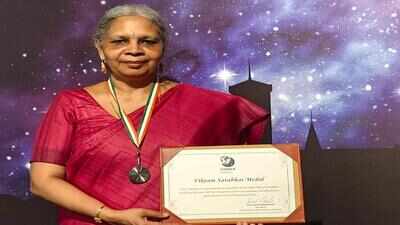
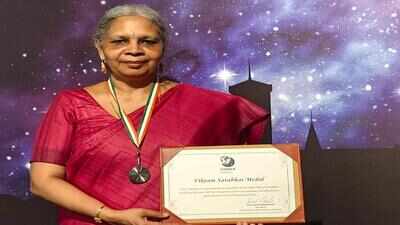
For decades, Professor Annapurni Subramaniam has studied some of the universe’s most fascinating mysteries—from star clusters and galaxies to the evolution of stars and ultraviolet light that cannot easily be observed from Earth.Now, the Director of the Indian Institute of Astrophysics (IIA), Bengaluru, has added another milestone to her career: she has become the first Indian woman to receive the COSPAR Vikram Sarabhai Medal.The 2026 honour also makes her only the fourth Indian to receive the prestigious international medal, following U.R. Rao in 1996, Gurbax Singh Lakhina in 2014 and Anil Bhardwaj in 2024.
A historic first for an Indian woman scientist
The COSPAR Vikram Sarabhai Medal is awarded jointly by the Committee on Space Research (COSPAR) and ISRO for outstanding contributions to space research, particularly recognising work carried out in developing countries.Professor Subramaniam received the 2026 medal at the 46th COSPAR Scientific Assembly in Florence, Italy. COSPAR’s official records list her as the 2026 recipient, while the Indian Institute of Astrophysics has also confirmed the recognition.Her achievement is particularly significant because she is the first Indian woman scientist to receive the medal and only the third woman overall to be honoured with it.
The scientist behind India’s ultraviolet eye in space
Professor Subramaniam specialises in stellar physics and has worked extensively on star clusters, nearby galaxies and astronomical instruments used both on Earth and in space.One of her most significant contributions has been to AstroSat, India’s first dedicated multi-wavelength space observatory, launched in 2015.She served as the calibration scientist for AstroSat’s Ultraviolet Imaging Telescope (UVIT) and led its in-orbit calibration and performance verification. Ultraviolet observations are particularly important because much of this radiation is absorbed by Earth’s atmosphere, making space-based instruments essential for studying many celestial objects.Her work has also contributed to India’s participation in the international Thirty Meter Telescope project. She is the Principal Investigator of INSIST, a proposed next-generation ultraviolet-optical space telescope that aims to build on India’s experience with AstroSat and UVIT.
From becoming IIA’s first woman director to a global honour
In 2019, Professor Subramaniam became the first woman to head the Indian Institute of Astrophysics.Over a scientific career spanning more than three decades, she has published around 175 research papers and guided 15 PhD students, according to information from IIA and reports on her scientific work.Her contributions have previously been recognised with several honours, including the Rashtriya Vigyan Puraskar – Vigyan Shri 2024 in the field of Space Science and Technology. The official citation recognised her work on stars, star clusters, galactic structure and the Magellanic Clouds, as well as her contributions to UVIT and the AstroSat mission.
Professor Annapurni Subramaniam’s journey at a glance
| Achievement | Milestone |
| Scientific field | Astrophysics and stellar physics |
| Leadership | First woman Director of IIA |
| Major space mission | Calibration scientist for AstroSat’s UVIT |
| Future mission | Principal Investigator of INSIST |
| Major national honour | Vigyan Shri, 2024 |
| Latest milestone | COSPAR Vikram Sarabhai Medal, 2026 |
| Historic achievement | First Indian woman to receive the medal |
For students interested in science, astronomy and space research, Professor Subramaniam’s journey offers a reminder that India’s space programme is not built only on rockets and launch vehicles.It is also built by scientists who spend decades asking questions about the light from distant stars, developing instruments capable of observing the universe and training the next generation of researchers.Professor Annapurni Subramaniam has spent much of her career looking beyond Earth.Now, her work has earned her a place in the history of Indian space science.Disclaimer: This article is based on publicly available information and official records from COSPAR, the Indian Institute of Astrophysics and other cited sources. TOI Education has compiled the information for educational and informational purposes.