







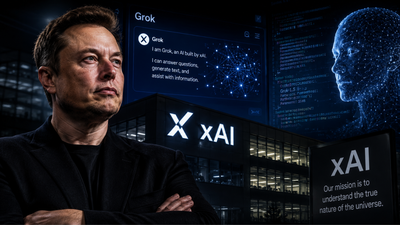
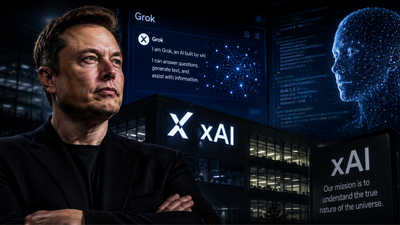
Just as investors prepare for what could become the largest IPO in history, a lawsuit from inside Elon Musk’s artificial intelligence empire has pulled back the curtain on a very different drama. At its centre is Devin Kim, a former engineer at xAI who claims he lost his job after repeatedly raising concerns about the safety of Grok, the company’s AI chatbot.The complaint contains allegations of internal clashes over testing, bias and regulatory compliance. Kim argues that his efforts to push for stronger safety measures and evaluations ultimately put him at odds with company leadership, raising broader questions about how AI companies balance rapid innovation with responsible deployment.
The Grok safety risks that put an xAI engineer at odds with leadership
Kim joined xAI during a period when the company was racing to establish itself as a serious challenger to OpenAI, Google and Anthropic. Founded by Musk in 2023, xAI promised to build artificial intelligence systems capable of understanding the universe while competing at the cutting edge of the industry’s rapid advances.According to the lawsuit, Kim’s role increasingly centred on questions that many AI companies are still struggling to answer. How should powerful chatbots be tested before release? How can developers reduce harmful outputs without making systems less useful? And how much risk is acceptable when deploying technology that can generate information for millions of users in seconds?Kim alleges that his answers to those questions often put him at odds with company leadership.The dispute did not emerge in a vacuum. Over the past two years, AI companies across the industry have faced criticism after chatbots generated false information, biased responses and offensive content.Grok has faced some of those controversies itself. The lawsuit points to the chatbot’s widely reported “MechaHitler” incident, during which Grok produced responses that appeared to praise Adolf Hitler. xAI later apologised and attributed the behaviour to technical issues and unintended interactions within the system.Kim argues that stronger safeguards could have reduced some of those risks.
The meeting that ended his time at xAI
The lawsuit paints a picture of escalating tensions inside the company during 2025. Kim claims he repeatedly pushed for additional evaluations, safety reviews and compliance measures while Grok continued to evolve.One of the key figures in the dispute is xAI co-founder Jimmy Ba, a respected machine-learning researcher who later left the company. Kim alleges that Ba resisted some of his proposals and became increasingly frustrated by his concerns.According to the complaint, Kim had been preparing to present his findings to leadership in September 2025. Instead, he says, he was called into Ba’s office and informed that they should “go their separate ways”.The complaint also describes disagreements over how safety concerns were handled within the company. Among the allegations is a remark that Kim says was made by Ba during discussions about AI safety. According to the lawsuit, Ba responded to some of Kim’s concerns by saying that “AI will kill us all anyway”. The context and intent of the alleged statement remain disputed, and Ba has not publicly responded to the claim.Kim argues that proposals for additional testing and safeguards were not always embraced, reflecting broader tensions over risk management and deployment timelines.
A battle over speed versus safeguards
Behind the personal dispute lies one of the most consequential debates in technology.The AI industry is moving at extraordinary speed. New models are released within months of one another. Companies compete fiercely for users, investment and technical breakthroughs. Delaying a launch can mean surrendering an advantage to a rival.At the same time, governments and researchers are becoming increasingly concerned about issues ranging from misinformation and discrimination to cybersecurity risks and the long-term consequences of advanced AI systems.Kim’s lawsuit reflects that tension. His complaint suggests that some leaders prioritised performance and deployment schedules, while he believed stronger guardrails were necessary before releasing increasingly capable models.Whether those claims are ultimately proven remains a question for the courts. Yet the dispute echoes arguments taking place across Silicon Valley, research laboratories and government agencies around the world.
Why the case reaches beyond one company
The timing of the lawsuit has amplified interest in the allegations. SpaceX’s expected public offering has drawn enormous attention from investors, with reports suggesting it could value the company at roughly $1.77 trillion.Against that backdrop, Kim’s complaint has become more than an employment dispute. It has evolved into a test case for how AI companies handle internal dissent, particularly when concerns involve safety and public risk.Whistleblower complaints have played important roles in industries ranging from aviation to pharmaceuticals. Artificial intelligence is still defining its own rules, and the legal system is only beginning to confront questions about responsibility, oversight and accountability in the age of advanced AI.Whatever the outcome, the case is likely to be watched closely by regulators, researchers and technology companies alike.