





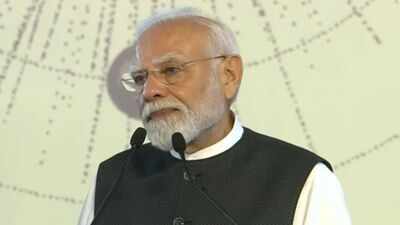
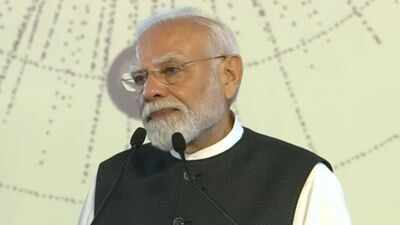
NEW DELHI: Prime Minister Narendra Modi on Friday said that ancient Indian astronomers closely studied the cosmos and the movements of planets despite not having access to modern equipment.He also highlighted how India’s space technology is being used to improve people’s lives, from helping fishermen during storms to tracking trains and supporting crop insurance.Addressing a gathering after inaugurating the state-of-the-art COSMOS Planetarium at the University of Mysore campus in Mysuru, PM Modi said India had a rich tradition of scientific study.“India has produced many great astronomers, including Aryabhata, Varahamihira, Bhaskaracharya and Nilakantha Somayaji,” he said.“Despite not having access to the advanced technology and instruments available today, they made remarkable discoveries and performed some of the most complex calculations. Today, as India continues to achieve one milestone after another in the field of science, Mysuru, through the state-of-the-art COSMOS Planetarium, is adding a new chapter to India’s scientific journey,” he said.He recalled how ancient Indian astronomers studied the cosmos and calculated the movements of stars and planets despite not having access to modern technology.“Our ancestors studied the sky very closely. They understood the movements of stars and planets, and they created calendars. They calculated solar and lunar eclipses,” he added.Space technology used to help fishermen, farmersThe Prime Minister said India’s space programme was not limited to achievements beyond Earth but also contributed to the welfare of people through practical applications.“Isro has developed a satellite communication system for our fishermen; boats equipped with receivers can receive timely alerts during storms, and their safe return to the shore can be monitored. Many of you likely check the live location of trains to see where they are and when they will arrive at a station—this is made possible by a real-time train tracking system developed by the Indian Railways and Isro,” he said.“Similarly, satellite data is utilised in the ‘Pradhan Mantri Fasal Bima Yojana’ where information from fields combined with satellite data is used to estimate crop yields—estimates that form the basis for determining farmers’ insurance claims. In short, while our satellites are reaching great heights in space, they are simultaneously being used to improve the lives of people here on Earth,” he added.‘Spirituality & science have always advanced together’Drawing a parallel between the planetarium and the Viveka Smaraka, which he had inaugurated earlier, PM Modi said the two institutions reflected India’s spiritual and scientific traditions.“The Viveka Smaraka inspires us to look within and seek spiritual wisdom, while a visit to the Cosmos Planetarium draws our gaze toward the sky, motivating us to explore this vast universe and unravel its mysteries. This serves as an example of how, in India, the traditions of spirituality and science have always progressed hand in hand,” he said.The Prime Minister said the government’s decision to open up the space sector had created new opportunities for private companies and startups.He also cited India’s achievements in satellite docking and undocking and sending an Indian astronaut to the International Space Station (ISS).“For a long time, our country has embraced the call of ‘Jai Jawan, Jai Kisan’. Atal Ji added ‘Jai Vigyan’ to it, and I further added ‘Jai Anusandhan’. India in the 21st century is moving forward with this very vision, and our youth are performing exceptionally well in this endeavour,” he said.“Last year, India hosted the International Olympiad on Astronomy and Astrophysics in Mumbai. Our young participants took part in it with great enthusiasm,” he added.PM inaugurates Bengaluru Metro’s Pink LineEarlier in the day, PM also inaugurated the Pink Line of Bengaluru’s Namma Metro, highlighting the expansion of the city’s public transport network and its role in improving connectivity.Addressing the inauguration ceremony, he said Bengaluru had become the third city in the country, after Delhi-NCR and the Mumbai Metropolitan Region, to have a metro network spanning 100 km.“After Delhi-NCR and the Mumbai Metropolitan Region, Bengaluru is the third city in the country where the metro network has reached 100 km,” he said.“With this new metro line, connectivity between Bengaluru and numerous educational institutions will be further improved. Furthermore, areas known as major business, technology, and commercial centres in Bengaluru will also be connected by the metro,” he added.
Share your thoughts in the comments
Be respectful · TOI community guidelines
The Prime Minister said the metro expansion reflected the government’s focus on improving ease of living and travel, and would help commuters save time and money.The planetarium inaugurated by PM Modi is located on the University of Mysore campus at the foothills of Chamundi Hills. It is India’s first LED dome planetarium.PM Modi also praised the Mysuru royal family for its contribution to promoting science and education, including the establishment of the University of Mysore and the donation of land for the Indian Institute of Science (IISc).