








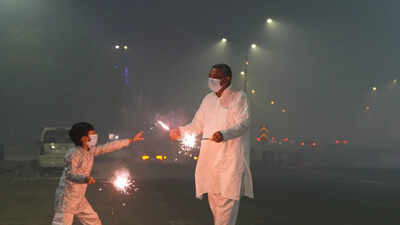
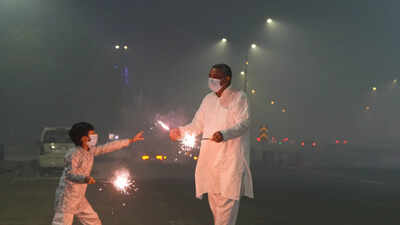
NEW DELHI: Delhi saw its most polluted Diwali day in five years, with AQI touching 376 at 4pm Nov 8, the worst since 2021. The city, however, narrowly escaped its worst post-Diwali pollution day in five years, with Monday’s AQI touching 370 at 11am before improving to 344 by 4pm, better than 2025’s post-Diwali air quality.Diwali AQI in 2025 (Oct 20) was 345, 328 in 2024 (Oct 31), 218 in 2023 (Nov 12), 312 in 2022 (Oct 24) and 382 in 2021 (Nov 4). Post-Diwali AQI in 2025 was 351, 339 in 2024, 358 in 2023, 303 in 2022 and 462 in 2021. Diwali-eve this year, Nov 7, was the most polluted since 2016, with AQI of 369.Meanwhile, several monitoring stations failed to report crucial AQI data. Initially, hourly data went missing for 35 air quality monitoring stations. Although DPCC later updated data at some of its stations, several went blank at peak pollution hours, and only 47 contributed to average AQI on Diwali day. Delhi has 60 monitoring stations managed by DPCC, CPCB, IITM and IMD, of which one had been defunct for a few months.Firecrackers emerged as the biggest contributor a day before Diwali (Chhoti Diwali), accounting for 41.1% of the total load, according to IITM data till 9am Nov 8.On a wind and prayer, capital braces for uncertain times as winter sets inWhile traces of lead, potassium and sulphur in the air were confirmed, officials said they can confirm the presence of mercury only in a long-term study.At midnight on Nov 8, IITM recorded its highest average PM2.5 concentration, at 671.1 micrograms per cubic metre (µg/m³). Among individual stations, Jahangirpuri in northwest Delhi recorded a peak of 4,985 µg/m³ Sunday night and Monday morning. However, DPCC later updated to park PM2.5 level of 776µg/m³ at 11am Sunday. Mundka in west Delhi recorded PM2.5 level at 3,744 µg/m³ at 2am, which remained unchanged, followed by 3,023.2µg/m³ at JNU. The prescribed 24-hour average national limit for PM2.5 is 60 µg/m³.The average PM2.5 concentration on Diwali 2026 stood at 257 µg/m³, against 228 µg/m³ last year, 201 µg/m³ in 2024, 134 µg/m³ in 2023, 176 µg/m³ in 2022 and 318 µg/m³ in 2021.On Monday, Delhi saw the season’s first dense fog, with visibility dropping to 50m at Safdarjung at 6.30am, which kept the AQI in the upper range of very poor levels. However, a sudden, unusual shift in winds from northwesterly to strong easterly, aided by faster dispersion, kept stubble smoke from Punjab and Haryana at bay, preventing a sharper spike, especially when Punjab on Nov 8 saw the highest farm fire incidents of the season, at 1,152.The post-Diwali reprieve, said experts, was more meteorological than the result of pollution-control measures. With winter conditions setting in, the wind reversal could bring back the familiar pollution cocktail, they added.Gufran Beig, founder of System of Air Quality and Weather Forecasting and Research (SAFAR) and chair professor at the National Institute of Advanced Studies (NIAS), said Delhi was “very lucky” this year, not cleaner.“An unusual weather development associated with an approaching cyclone and a western disturbance caused winds to turn easterly from their persistent northwesterly direction. These winds, travelling at around 6.7 metres per second from the surface to nearly 400 metres, against the usual 3-4 m/s, helped disperse pollutants rapidly and prevented stubble-burning smoke from reaching Delhi,” he said. The easterlies were expected to persist until Tuesday morning, before winds potentially reverted to northwesterly.Calling the situation a reflection of the region’s worsening pollution-control battle, Anumita Roychowdhury of Centre for Science and Environment (CSE) said, “This post-Diwali pollution crisis is the direct result of a toxic convergence of adverse winter meteorology, escalating pre-Diwali traffic gridlocks and a rise in contribution of farm fires. Firecrackers were an uncontrolled tipping point.”
Share your thoughts in the comments
Be respectful · TOI community guidelines
Delhi and the wider region, she added, were losing the battle to curb emissions from both continuous local sources and episodic spikes, at a very high health cost.The scale of the firecracker contribution was even more stark in an analysis by Sunil Dahiya, founder and lead analyst at Envirocatalysts. He estimated that crackers added roughly 450 µg/m³ to peak-hour PM2.5 concentrations and contributed around 270-400 µg/m³, or more than half the PM2.5 Delhi residents breathed, during the 9pm-2am period.Dahiya said pollution began building from around 8pm, peaked between 1am and 3am, and remained above 500 µg/m³ for four hours.