









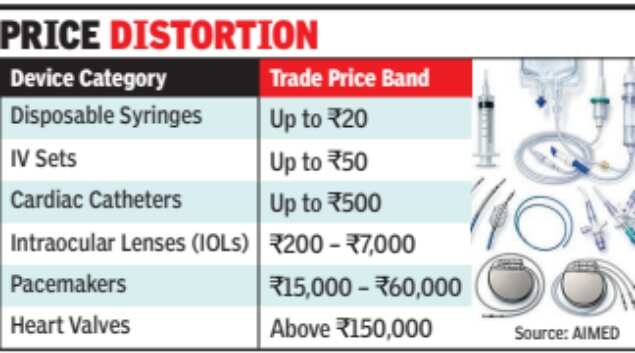
NEW DELHI: An IV infusion set priced in the wholesale market for Rs 11 carries an MRP of Rs 325, while a disposable syringe available for under Rs 7 has a price tag of around Rs 60, putting a spotlight on one of the least visible components of hospital bills: the price of widely used consumables during treatment. The gap becomes even more stark for high-value devices such as pacemakers, heart valves and intraocular lenses, where the final MRP may be 10-30 fold higher than the import landed price.Such huge mark-ups ultimately inflate the patient’s hospital bill and may add significantly to the out-of-pocket treatment cost.
How the prices are changed
The issue has been flagged multiple times over last 15 years but a fresh push by Maharashtra Food and Drug Administration (FDA) has revived a question that has remained unresolved for years: who ultimately sets price of a medical device – the manufacturer, the hospital or the regulator?Several earlier analyses by National Pharmaceutical Pricing Authority (NPPA) of hospital bills had shown how certain private hospitals procured consumables at rock-bottom prices but charged patients the high printed MRP, sources told TOI.Flagging mark-ups as high as 2,841% on commonly used hospital consumables, Tukaram Mundhe, Maharashtra FDA commissioner, posted on X on Tuesday, “The regulatory gap is structural: scheduled medicines are capped under the Drugs (Prices Control) Order, 2013. Most medical devices and consumables are not, leaving both the pricing and the information around it almost entirely unmonitored.” He urged the Centre to frame guidelines to address the “permissible gap between trade procurement price and declared MRP”.Nearly a decade ago, prices for cardiac stents and orthopaedic knee implants were capped by NPPA. And, in 2020, govt capped trade margins on certain critical items, including pulse oximeters, blood pressure monitors and glucometers, during the Coronavirus pandemic.
Share your thoughts in the comments
Be respectful · TOI community guidelines
Historically, the industry – domestic and MNCs – have been split over the capping of trade margins. The domestic industry represented by AiMeD cautioned that the current regulatory framework under the Drugs (Prices Control) Order, 2013, is inadequate to address the pricing of medical devices and has proposed capping trade margins at 75% for widely used consumables such as syringes and IV sets, and at 50% for high-value devices such as pacemakers and heart valves.“Genuine device manufacturers and importers are at a clear disadvantage under the current system of unchecked hospital mark-ups. Ethical suppliers price their products transparently, based on ex-factory or landed import price, but when hospitals inflate MRPs by 10-30 times, the market rewards those willing to play the distortion game. Responsible companies that refuse to indulge in excessive margins are forced out of competition or in order to survive, have to comply with these unfair demands,” said Rajiv Nath, forum coordinator, AiMeD, saidAs against this, Medical Technology Association of India, which represents MNCs, said it concurred with Maharashtra FDA Commissioner’s “three asks of margin rationalisation, an inter-agency review and clear guidelines governing the permissible gap between trade procurement costs and declared MRPs”, which is the “essence of Trade Margin Rationalisation”.