







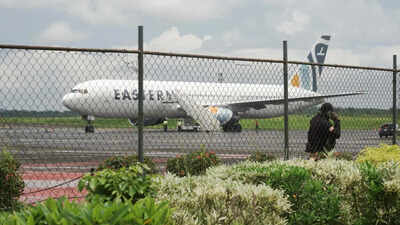
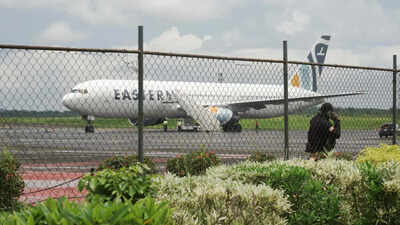
The United States on Thursday carried out its first deportation under an agreement allowing Liberia to accept up to 1,200 people who are not Liberian nationals, marking one of the Trump administration’s largest efforts yet to send deportees to countries other than their own.An initial group of 20 deportees arrived at Roberts International Airport outside Monrovia, according to the news agency Associated Press.The deportees will include nationals from Africa as well as North America, South America and the Caribbean, Liberian information minister Jerolinmek Piah said.Liberian justice minister Natu Oswald Tweh has said those arriving could seek asylum in Liberia if they wished.
Liberia calls arrangement humanitarian
Piah said the people being sent to Liberia were being received as “guests” and that the arrangement was humanitarian. According to the BBC, he said none of the initial deportees were criminals or facing prosecution in either the US or Liberia.The Liberian government has not disclosed the nationalities of the 20 people who arrived Thursday.Piah said Liberia had “not demanded or received any compensation or promise of rewards” in exchange for agreeing to participate in the programme. He added that the US would provide support to manage the programme and strengthen Liberia’s migration system, according to the BBC.Liberia’s decision is rooted partly in its history, Piah said, pointing to the country’s origins as a settlement for formerly enslaved and freed Black people from the US and the Caribbean.The US State Department declined to answer specific questions about the Liberia agreement but said implementing the Trump administration’s immigration policies was a “top priority” and reaffirmed its commitment to ending what it called illegal and mass immigration and strengthening US border security.The Department of Homeland Security declined to confirm Thursday’s deportations, citing “operational security reasons”, and referred questions to the State Department.
US expands third-country deportation programme
The Liberia arrangement is part of a wider US policy under President Donald Trump of sending some deportees to countries other than their countries of origin.According to the Third Country Deportation Watch, a partnership between Refugees International and Human Rights First that draws on public records requests, news reports and other sources, the Trump administration has reached agreements with at least 35 countries to accept third-country deportees.More than 23,000 people have been deported to 26 countries under such agreements, according to the organisation.The US State Department previously confirmed that Liberia had agreed to accept people who were not from Liberia. However, a six-page agreement reached in September 2025 and published on the department’s website does not specify either the number of people to be accepted or their nationalities.Several African countries have also reached similar arrangements with Washington, including Ghana, Equatorial Guinea, Eswatini, the Democratic Republic of Congo and Sierra Leone.
Abrego Garcia case highlights third-country policy
The Liberia agreement has also drawn attention because of the case of Kilmar Abrego Garcia, a Salvadoran national who was mistakenly deported by the Trump administration to a prison in El Salvador.After being blocked from sending him to his native El Salvador, the administration has said it could deport him to a third country, including Liberia.Abrego Garcia has said he would agree to be sent to Costa Rica, which has said it would accept him. The US government has not sent him there, and he is challenging deportation to Liberia in a federal lawsuit in Maryland.The use of third-country deportations has faced criticism from rights groups, which have raised concerns about migrants being sent to countries where they have no previous connection and where their safety or legal status may be uncertain.The Trump administration has defended the arrangements as lawful.The Liberia agreement is expected to run for a year and could ultimately involve up to 1,200 third-country nationals, making it a significant expansion of Washington’s efforts to find alternative destinations for people it seeks to deport.