






MUMBAI: In a first, Tata Sons was forced to adjourn its 108th annual general meeting on Tuesday after a regulatory action deprived the company of the quorum required to transact business.The unprecedented development stalled adoption of Tata Sons’ FY26 financial statements, delayed equity dividend payouts critical to principal shareholder Tata Trusts, and left the reappointment of chairman N Chandrasekaran to the board unresolved. The AGM, held at Bombay House, Tata Group’s headquarters, began at 2.30pm. Chandrasekaran, who chaired the meeting, waited 30 minutes for the requisite quorum. With quorum unmet, he adjourned the AGM and said a new date would be communicated later.The quorum failure does not, however, threaten Chandrasekaran’s board position, lawyers said. Since the AGM was adjourned before shareholders could vote, company law preserves the status quo, allowing him to continue as a director until the meeting reconvenes and a formal vote is held.Chandrasekaran was up for re-election as the longest-serving non-independent director on Tata Sons board and first in line to retire by rotation. Last reappointed on Sept 16, 2024, he moved to the head of the queue after Noel Tata’s appointment and the reappointments of Saurabh Agrawal and Venu Srinivasan on Aug 14, 2025.
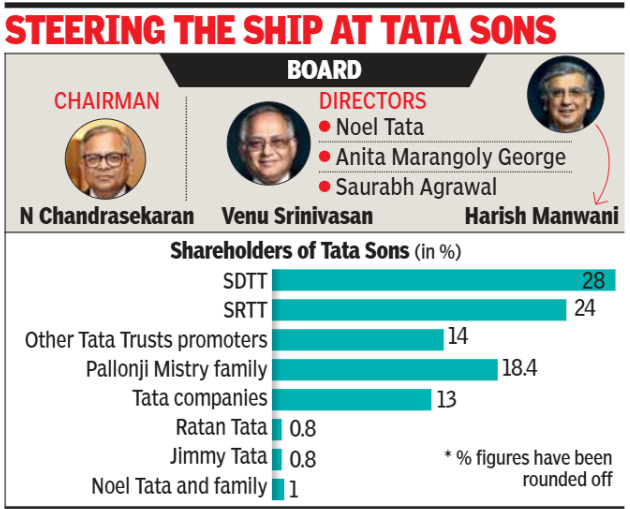
Who controls Tata Sons? A look at its board and shareholders
Tata Sons’ Articles of Association require a nominee jointly appointed by the Sir Dorabji Tata Trust (SDTT) and Sir Ratan Tata Trust (SRTT) to be present as part of the five-shareholder quorum. With SRTT subject to a regulatory ban, the two trusts were unable to make a joint nomination. The Articles allow the adjourned meeting to be held on the same day the following week or on a date determined by the board — either way, the joint SDTT-SRTT nominee would still be required for quorum.Under the Companies Act, Tata Sons has until Sept 30 to hold its AGM, and can seek a three-month extension from the Registrar of Companies, pushing the deadline to Dec 31.It is not clear whether the board will meet before Sept 17 to decide a new AGM date, or defer that decision to its scheduled meeting that day. Directors are expected at the Sept 17 board meeting to formally note Chandrasekaran’s decision not to seek another term as chairman and begin the succession process following SDTT’s endorsement of the move. The entire Tata Sons board attended Tuesday’s AGM. Tata Trusts chairman Noel Tata, vice-chairman Venu Srinivasan and independent director Harish Manwani joined virtually. At Bombay House, Chandrasekaran was joined by independent director Anita George and executive director and CFO Saurabh Agrawal.Barring the Trusts, most shareholders were also represented virtually. The Shapoorji Pallonji Group, which owns 18.4% of Tata Sons, was represented by Vinay Karve and Shriram Hegde, while Mehli Mistry attended on behalf of Ratan Tata’s estate, and Chhota Udaipur royal family member Jay Pratapsingh Chauhan represented his own holding.The Tata companies, which together hold 13% of Tata Sons, were represented by Tata Motors MD Shailesh Chandra, Tata Steel CFO Koushik Chatterjee, Tata Chemicals MD R Mukundan, Tata Consumer Products MD Sunil D’Souza, Tata Power MD Praveer Sinha and Indian Hotels MD Puneet Chhatwal. Vinay Balse of NM Raiji and Prakash Mehta of Bilimoria Mehta, Tata Sons’ auditors, also attended.Absent from the meeting were Leah, Maya and Neville Tata, Noel Tata’s children and the newest shareholders of Tata Sons.While SRTT had sought lifting of the regulatory ban, SDTT had informed Tata Sons that the Trusts would be unable to meet quorum. Tata Sons nevertheless proceeded with the AGM to comply with statutory requirements.Lawyers said Bombay high court judgments have held that regulatory action should not paralyse a public trust’s internal democracy or day-to-day governance, citing rulings, which have held that powers under the Maharashtra Public Trusts Act are administrative in nature and cannot be used to prevent trusts from holding meetings, conducting routine business or exercising voting rights.Katalyst Advisors partner Binoy Parikh said governance uncertainty would persist until the regulatory restrictions on SRTT were lifted or an alternative legal solution emerged.At the Aug 2025 AGM, the Trusts were represented by Mehli Mistry and Vijay Singh. Since then, Mistry’s terms at both SDTT and SRTT have expired. Singh’s term at SRTT lapsed in Aug following the regulatory action against the trust, though he remains a trustee of SDTT.