





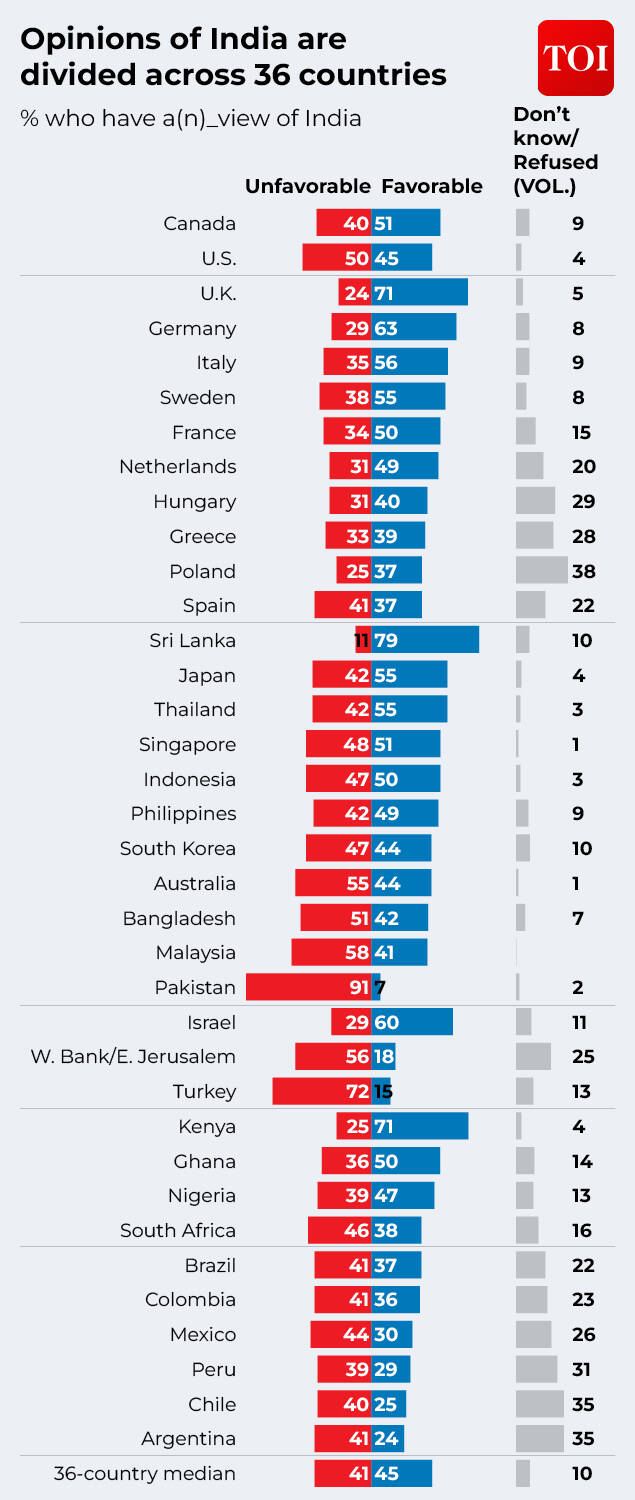
As India completes 79 years of independence, its global standing presents a striking study in contrasts.A Pew Research Center survey conducted across 36 countries between February and May 2026 reveals an international community divided down the middle: a global median of 45% of respondents hold a favorable view of India, while 41% express an unfavorable opinion.Read more: 80 years on, still enemy No. 1: What Indians and Pakistanis think of each otherBehind this median lies a complex tapestry of geopolitical shifts, historical rivalries, and evolving regional alliances.From enthusiasm in Western Europe and East Africa to frosty hostility in parts of the Middle East and South Asia, public perception of the world’s most populous democracy depends heavily on where you ask.
Neighbourhood contrasts & global scorecard
Nowhere is this divergence more intense than in India’s immediate backyard. While proximity can foster cooperation, in South Asia it has produced antithetical attitudes.Sri Lanka has the most favourable view of India, with 79% of adults expressing a positive opinion.Pakistan sits at the opposite end, with just 7% viewing India favourably. The gulf between the two countries reflects decades of conflict, political rivalry and competing national narratives.Turkey is another major outlier. Only 15% of Turks have a favourable opinion of India, while a majority hold an unfavourable view. In the West Bank and East Jerusalem, just 18% express a positive opinion.Yet beyond these pockets of hostility, India finds considerable goodwill across much of the world.
as India enters its 80th year as an independent nation, what does the world think of it?
Kenya and the United Kingdom rank alongside Sri Lanka among the countries most positive towards India, with roughly seven in 10 adults expressing favourable views.Majorities in Germany, Israel, Italy, Sweden, Japan and Thailand also see India positively.In contrast, Latin American publics express mixed-to-negative views, alongside substantial shares of respondents who offer no opinion.The findings suggest that India’s global image is not simply a reflection of its diplomatic alliances.Economic ties, strategic partnerships, cultural familiarity and perceptions of India’s growing global role all appear to shape how people view the country.
India’s image is changing
The bigger story is perhaps not where India stands today, but how its image has changed.In most countries surveyed, opinions have remained relatively stable since Pew last asked the question. But in 10 countries, the change has been statistically significant — and in seven of them, India’s favourability has fallen.Turkey and Nigeria have recorded the sharpest declines since 2025, with the share of people expressing a favourable opinion of India falling by 10 percentage points in both countries.India has also lost ground in the United States, Indonesia, South Africa and Mexico.The decline is particularly striking in Bangladesh.Pew’s previous survey there was conducted in 2024. Since then, the share of Bangladeshis with a favourable opinion of India has fallen by 15 percentage points, leaving fewer than half with a positive view.At the same time, the number of Bangladeshis who do not express an opinion has also fallen sharply, from 24% to just 7%. In other words, more Bangladeshis now appear to have a defined opinion of India — and that opinion has become considerably less favourable.The trend is not uniformly negative, however.India’s image has improved significantly in Germany, Britain and Sri Lanka.The share of Britons with a favourable opinion of India has risen 11 points since 2025, while Germany has recorded a six-point increase. Sri Lanka has seen an even bigger jump, with favourability rising 14 points since 2024.Looking further back to 2023 reveals another interesting divide.Across several European countries, India’s image has strengthened substantially since the first post-pandemic survey. In Germany, for example, only 47% had a favourable opinion of India in 2023. That figure has now climbed to 63%.France has followed a similar trajectory. India’s favourability there has risen from 39% in 2023 to 50% today.Outside Europe, however, the picture is less encouraging.South Korea is one example. In 2023, 59% of South Koreans viewed India favourably. Today, that figure has dropped to 44%.Latin America also tends to lean more negative, although large numbers of people in several European and Latin American countries do not express an opinion at all.
Politics matters too
India’s global image is also shaped by domestic political ideology in some countries.The United States and Canada show a striking pattern: people on the political left are more likely than conservatives to view India favourably.In the US, 54% of liberals express a positive opinion of India, compared with 40% of conservatives. In Canada, the corresponding figures are 58% and 45%.Israel presents almost the exact opposite picture.There, 68% of people on the political right view India favourably, compared with just 46% on the left.The ideological divide underlines how perceptions of India can be tied not only to India’s own policies, but also to how different political constituencies interpret its role in the world.
A mixed but largely positive global image
So, as India enters its 80th year as an independent nation, what does the world think of it?The answer is neither uniformly celebratory nor overwhelmingly negative.Pakistan and Turkey may give India the stink eye, but they represent the more hostile end of a much broader spectrum.From Sri Lanka and Kenya to Britain, Germany and Israel, India enjoys strong positive sentiment in several strategically important countries.
Share your thoughts in the comments
Be respectful · TOI community guidelines
At the same time, the declines in Bangladesh, the US, South Korea, Turkey, Nigeria and other countries show that India’s global image cannot be taken for granted.India’s international reputation is therefore becoming more consequential — and more contested.As New Delhi seeks a larger role in global affairs, its challenge will not simply be to build economic and military power, but also to shape how that power is perceived abroad.At 80, India is increasingly a country the world has an opinion about.