





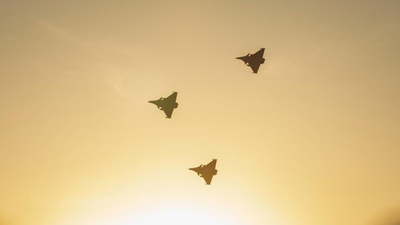
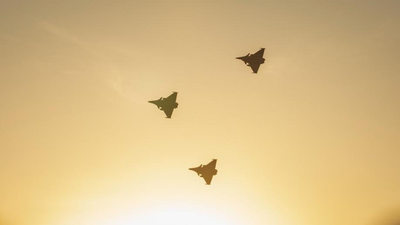
On the morning of August 6, 1945, the now well-known city of Hiroshima became the backdrop to perhaps the biggest transformation in modern warfare and the strategic use of technology.In a flash, this time quite literally, history changed forever.Three days later, a similar blast struck Nagasaki, nearly 300 km away.Six days after the second bombing, Emperor Hirohito announced Japan’s surrender. Japan formally surrendered aboard the USS Missouri, anchored in Tokyo Bay, on September 2, 1945.The twin atomic bombings fundamentally altered the strategic calculus between major powers. The explosions generated temperatures estimated at around one million degrees Celsius at their core and nearly 7,700°C at the surface of the fireball, hotter than the surface of the Sun. They killed an estimated 2,46,000 people in total.With the end of World War II, the Cold War quickly intensified. The Soviet Union tested its first nuclear weapon in 1949, followed by the United Kingdom in 1952, France in 1960 and China in 1964. In the subcontinent, India and Pakistan became declared nuclear powers in 1998. Israel and North Korea are also believed to possess nuclear weapons.The Carnegie Endowment for International Peace has called the Indian subcontinent the world’s most dangerous nuclear flashpoint. Since the introduction of nuclear weapons in South Asia, India and Pakistan have experienced several major crises. The first came during the Kargil conflict in 1999. The two countries again came close to war during the 2001–02 military standoff following the attack on the Indian Parliament. More recently, the two sides engaged in a sharp 88-hour conflict following the Pahalgam terror attack, making India and Pakistan the only two nuclear-armed nations to have engaged in open conventional conflict.The latest conflict also triggered nuclear sabre-rattling from Pakistan. Conventionally weaker than India, Pakistan has often reminded New Delhi of its nuclear capabilities during periods of heightened tensions. Responding to such threats, Prime Minister Narendra Modi has said that India’s nuclear arsenal is “not for Diwali.”India and Pakistan today maintain nuclear arsenals of near parity, with India estimated to possess around 190 warheads and Pakistan about 170, according to the Stockholm International Peace Research Institute (SIPRI) estimates released in January this year.Yet beneath this numerical similarity lie divergent doctrines and delivery systems that shape the strategic balance in South Asia. India’s nuclear posture is anchored in its declared No First Use (NFU) policy and the pursuit of a credible minimum deterrent. Pakistan, by contrast, has rejected NFU and adopted a policy of full-spectrum deterrence aimed at offsetting India’s conventional military superiority.India’s arsenal is primarily plutonium-based, with reserves sufficient for future expansion. Its modernisation programme emphasises credible deterrence through the steady development of a nuclear triad.Aircraft such as the Mirage 2000H and Jaguar IS are nuclear-capable, while the Rafale is widely believed to be adaptable to this role.On land, India fields the Prithvi-II and successive generations of Agni missiles, ranging from short-range systems to the 6,000-kilometre Agni-V, with the Agni-VI reportedly under development.At sea, the ballistic missile submarines INS Arihant and INS Arighat, armed with K-15 and K-4 submarine-launched ballistic missiles, provide a credible second-strike capability, particularly against China, while also keeping Pakistan within range.Pakistan’s arsenal, while similar in size, is structured differently. Aircraft such as Mirage fighters and Ra’ad-equipped JF-17s are believed to be nuclear-capable, supported by Ra’ad air-launched cruise missiles with ranges of 350–600 kilometres.On land, the Shaheen missile series covers ranges from 750 to 2,750 kilometres, supplemented by shorter-range systems such as the Abdali and the tactical Nasr missile.Babur cruise missiles, with ranges of 700–1,000 kilometres, add further flexibility, while sea-based variants are under development, although Pakistan’s naval nuclear capability remains in its early stages.The strategic outlook reflects these differing approaches. India continues to expand its nuclear triad and modernise its missile forces, increasingly orienting its deterrence posture toward both China and Pakistan.Pakistan, meanwhile, continues to emphasise tactical nuclear weapons and full-spectrum deterrence, a posture that lowers the threshold for potential nuclear use.